
Everyone keeps talking about "the lawyer of the future."
The term covers so much ground it says nothing. It's wide enough to fit any product pitch, any conference keynote, any thought leadership post. A managing partner and a first-year associate are facing completely different versions of this shift. A rainmaker and an in-house GC have opposite incentive structures. A legal ops lead and a senior associate need different skills entirely.
So I stopped writing about "the lawyer of the future" as if it's one person. I broke it into six.
I spent five years doing legal investigations at a firm in Texas. Background checks, prior claims research, policy verification — the kind of work that used to take three people coordinating across databases, courthouses, and insurance carriers. I built workflows that compressed it into one person operating at triple the output. And then my activity dashboard went red.
Not because I was doing less. Because I was doing everything faster. The system that tracked my productivity measured time-on-task, not output. So there I was — handling more cases per week than anyone on the team, delivering cleaner reports, catching errors that slipped through intake — and the metrics said I was underperforming.
I spent three weeks figuring out how to make the dashboard look right before anyone noticed. Not how to do better work. How to make the existing measurement system recognize that I was already doing better work.
Every law firm in the country is about to run headfirst into some version of the same problem. AI compresses the work. The systems built to measure and reward work haven't caught up. The lawyers who figure this out first — who understand what's actually changing and how to position themselves inside it — they're the ones this article is about.
The Six Prototypes
Sixty-nine percent of lawyers now use AI at work. Only 9% of firms have a written policy governing how.[1] Adoption without infrastructure. Individual lawyers sprinting ahead while their institutions stare at the starter's pistol.
Richard Susskind stood up at Legalweek's closing keynote last week and said something that landed in the room like a brick: "It's hard to convince a room of millionaires that their business model is all wrong."[2]
He's right. And the numbers back him up. Law firm profits grew 13% in 2025 — the best year since the financial crisis.[3] Partners at Am Law 100 firms are making 54% more per lawyer than they were in 2019. Everything looks fine. Record profits. Record rates. Record compensation.
And underneath that: demand is projected to go negative by Q3 2026. Ninety percent of legal revenue still comes from hourly billing. Firms are investing in AI tools that compress hours, then billing by the hour for the compressed work. Clients are noticing.
Meanwhile, 95% of generative AI pilots at law firms produce no measurable ROI.[4] Not because the technology doesn't work. Because they bought the tool and changed nothing else. Ran the pilot. Wrote the memo. Moved on.
The firms that are actually winning look nothing like this. And the lawyers inside them don't fit a single mold. They look like six different prototypes, each solving a different version of the same problem: how to exercise judgment under leverage.
That's the thesis. Not "AI will change law." Everyone knows that. The question is: what does the winning version of YOUR role look like right now? Not in five years. Now.
Prototype 1: The New Managing Partner
What they used to optimize for: Consensus. Keeping partners happy, managing lateral hires, growing revenue per partner through headcount leverage.
What changed: The leverage model broke. The old math was simple: more associates equals more billed hours equals more revenue per partner. AI inverts that. Two people at Rains LLP serve 200 startup clients.[5] A traditional firm would need eight to twelve attorneys for that. The math just changed and most managing partners haven't recalculated.
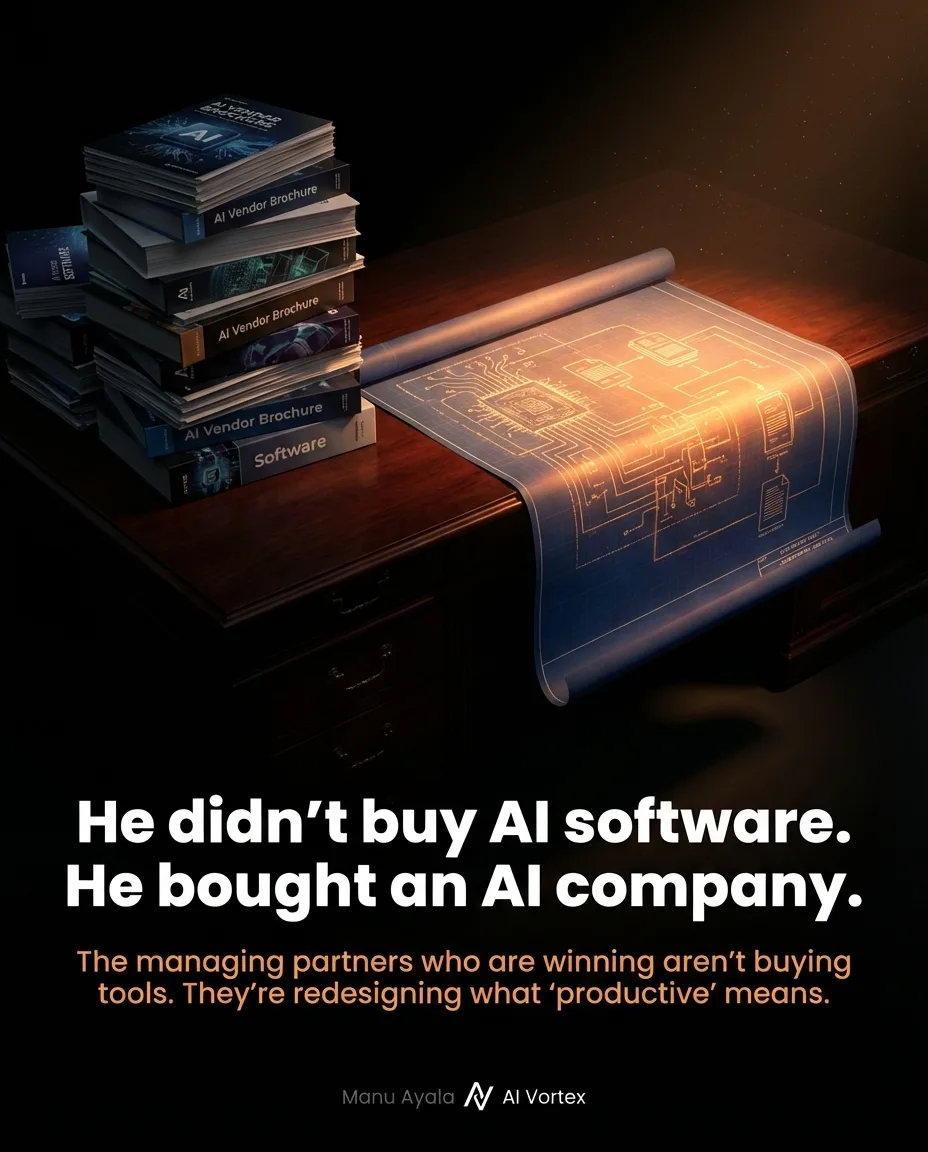
Michael Gerstenzang at Cleary Gottlieb didn't buy an AI subscription. He bought an AI company. In March 2025, Cleary acquired Springbok AI — ten data scientists and AI engineers, an entire legal tech consultancy absorbed into a white-shoe firm. The ABA Journal called it "extremely rare."[6] It was. Because most managing partners are still treating AI as an IT line item, not an infrastructure decision.
The difference matters. If you're a managing partner who "adopted AI," you approved a Harvey license, maybe ran a training session, put someone on the governance committee. If you actually understand your infrastructure, you know which workflows compress, which roles need to shift, and where the billing model starts to crack.
Danny David, managing partner at Baker Botts, put it bluntly: "Today, in the year 2025, if you're not using data analytics, you're not in the game."[7]
But being "in the game" and winning are different things. Only 22% of firms report adoption above 50% even among lawyers who have access to the tools.[8] Eighty percent of Am Law 100 firms have AI governance boards. Those boards produced governance. They did not produce adoption. The firms where adoption actually happened are the ones where the managing partner didn't delegate it to a committee — they mandated it from the practice group level and made clear that experimentation was expected, not optional.[9]
Here's the trap I'd flag if I were sitting across from a managing partner right now: assuming that expensive software guarantees quality. It doesn't. It guarantees you're using whatever everyone else is using. And unless every lawyer uses tools identically — which they don't, because every practice, every client, every case is different — that's a floor, not a ceiling. A very steady floor with a very low ceiling.
The managing partners who are winning aren't buying tools. They're redesigning the measurement systems that determine what "productive" means inside their firm. Because if they don't, they'll have their own version of my dashboard problem — lawyers doing better work in less time, and a firm that can't see it.
Prototype 2: The New Partner / Rainmaker

What they used to optimize for: Origination credit. Relationships. Billable hours as the primary profit engine.
What changed: Speed became a competitive weapon, and the billable hour became a structural conflict.
If you read my Zack Shapiro post on LinkedIn, you already know Rains LLP: two people, redlined acquisition agreement, clean counter-positions by 11 PM, deal closed the next morning.[5] What I didn't get into is why it matters structurally. The client didn't get a faster version of the same service. They got something their counterparty's firm could not match that night. That's not efficiency. That's a weapon.
Thomson Reuters data says AI currently saves lawyers 4 to 5 hours per week, projecting to 12 hours per week by 2029.[10] That's the average. For a partner who has actually restructured their practice around AI, the number is dramatically higher. The Bucerius Center for Legal Profession Studies found that 30 to 60% of all billable hours in any practice are repeatable, rules-based work — and AI can compress those hours by 50 to 90%.[11]
But here's where the structural tension lives. BigLaw partner compensation equals billing volume. AI compresses billing volume. BigLaw partners are personally dis-incentivized to adopt AI aggressively. The billable hour is not just a pricing model — it's the profit engine that funds the entire partnership structure.
AI-native boutique partner compensation works differently. Client count plus subscription revenue. AI expands both. These partners are incentivized to maximize AI adoption. This isn't a culture gap. It's a compensation structure gap.
Only 29% of revenue comes from alternative fee arrangements.[12] Sixty-seven percent of in-house counsel expect AI to impact the billable hour.[13] The clients are ahead of the firms on this. And once a general counsel experiences a 58-minute contract review or hears about a deal closing by morning because two people with Claude outworked a team of six — they recalibrate their expectations for everyone.
What does a partner who's 10x with AI actually do differently? It's not one big thing. It's ten small things. Having a summary of a case briefing playing as audio while driving to court. Running a contract comparison in the time it takes to get coffee. Turning dead time — the commute, the wait before a hearing, the gap between meetings — into productive time. A 10x partner isn't doing ten times the work. They're doing the same work with a fraction of the friction, and using the freed time for the stuff that actually drives origination: relationships, strategy, and the judgment calls that AI can't make.
Smaller teams with the right tools can catch bigger teams. Not because they're smarter. Because they're faster to test. They don't have eight layers of approval. They don't have a governance committee meeting next quarter to discuss the pilot results. They just use the tool, see what works, and iterate. That's the advantage boutique firms have right now.
But the window isn't open forever. Large firms have the resources. Once they stop piloting and start restructuring, the pace advantage disappears. The question is whether the partners inside those firms will voluntarily compress the revenue model that made them rich.
I wouldn't bet on it happening fast.
Prototype 3: The New Senior Associate
What they used to optimize for: Billable hours and the climb to partner. Being the most reliable reviewer in the room.
What changed: AI generates first drafts now. The question isn't whether the draft exists — it's whether the draft is right.
Stanford and Yale ran a pre-registered study on the AI tools lawyers are actually paying for. Lexis+ AI hallucinates more than 17% of the time. Westlaw's AI-Assisted Research? Over 34%. Ask Practical Law AI got it right on only 19% of queries.[14] These aren't free chatbots. These are the enterprise products firms are spending real money on.
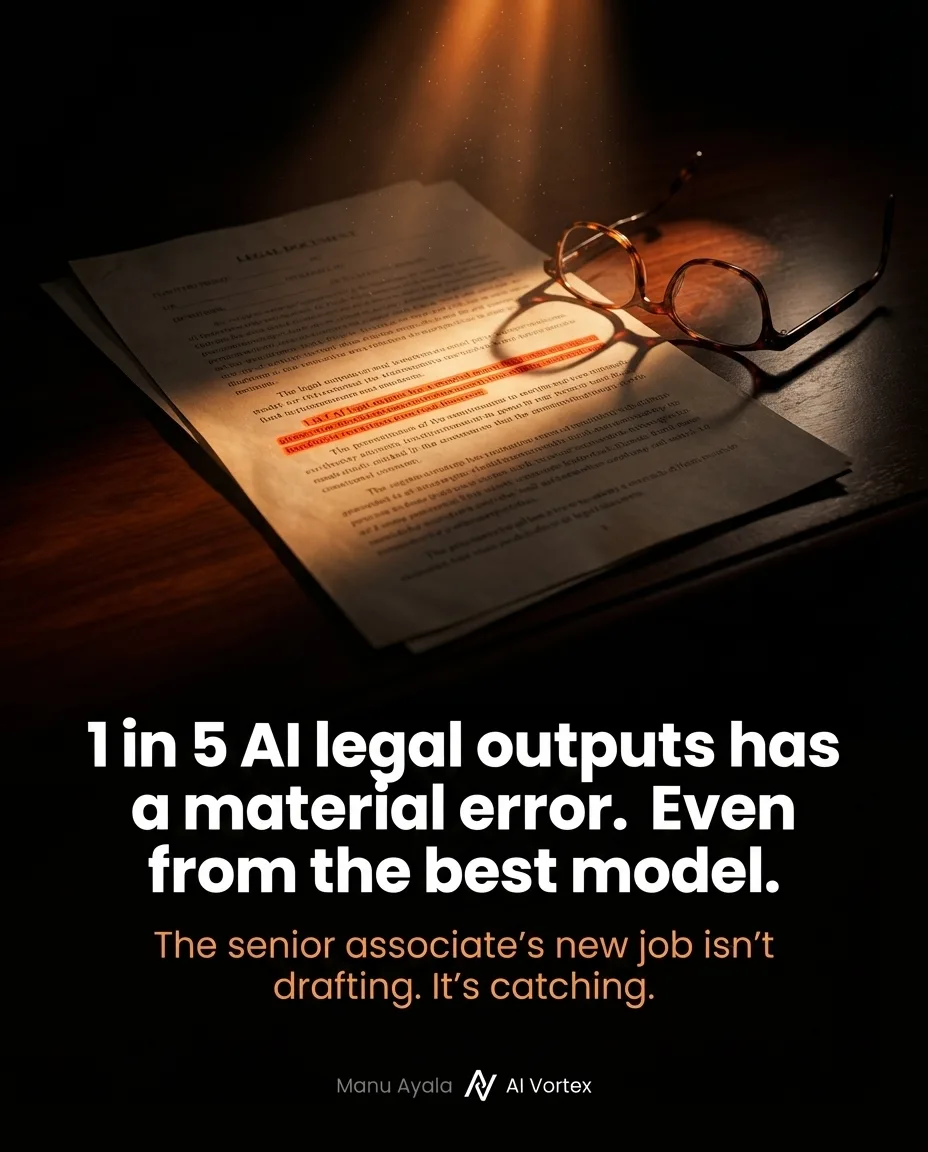
And the best general-purpose model humanity has built — GPT-5 — scores 77.9% on real legal tasks, according to the APEX benchmark co-authored with Harvard Law.[15] Roughly one in five outputs has a material error.
That's the senior associate's new job. Not drafting. Catching.
The ones I watched who were genuinely good at their work — across five years of reviewing attorney output at every level — they all did the same thing. They were hands-on. They didn't just review for completeness, they reviewed for why. When something went wrong, the best ones didn't just fix it. They asked how to make sure it didn't happen again. That instinct — the instinct to build a system around the fix, not just apply the fix — that's what makes a senior associate irreplaceable now.
Linklaters got this. In November 2025 they disbanded their standalone innovation team and embedded twenty AI lawyers directly into practice groups. Not a side function. Not a committee. Lawyers whose actual job is to sit inside a practice and own the AI workflow.[16] Michael Kest, an associate there, went from heading business development at a legal tech startup to being Linklaters' AI Go-to-Market Lead. That's a career path that didn't exist two years ago.
Ropes & Gray went further. Their TrAIlblazers program lets first-year associates count 400 hours per year — 20% of their billable target — toward AI learning and workflow design. Not billed to clients. Counted as billable equivalents for evaluation.[17] That's not a perk. That's a structural signal about what the path to partnership now requires.
The senior associates who are going to win this are the ones who can review AI output fast — not because they read fast, but because they already know what good looks like. They've done the work manually. They know the patterns. When the AI gets it wrong, they feel it before they verify it. That's not a skill you can shortcut. It's the compound interest of having done the boring version first.
Prototype 4: The New Junior Associate
What they used to optimize for: Surviving. Billing 2,000 hours. Learning by doing the grunt work.
What changed: The grunt work is disappearing. And with it, the training ground.
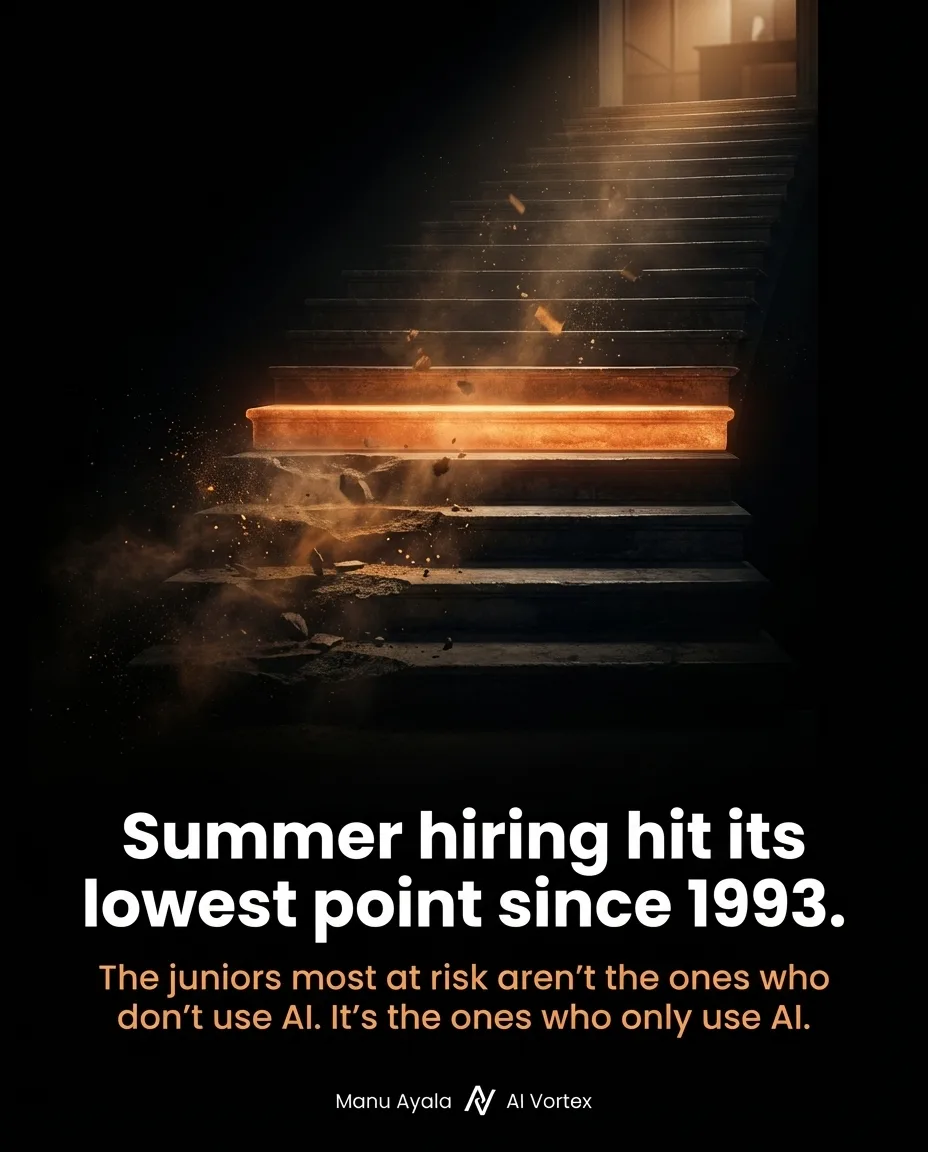
Summer associate hiring hit a median of 6 offers per office in 2024. Lowest since NALP started tracking in 1993.[18] A Harvard study of 62 million U.S. workers found that AI-adopting firms cut junior headcount by 7.7% within six quarters — and the decline wasn't driven by layoffs. Firms just stopped hiring as many.[19] Junior-level job postings in high-AI industries dropped 15%, compared to 3% for senior roles. Five-to-one ratio.
Brad Karp, chair of Paul Weiss, said it plainly in March 2025: junior lawyers will be "supplemented, if not significantly replaced, by technologists and data scientists."[20]
Here's the real advice I'd give a junior who's worried. Not the comforting version. The real one.
Be the first line of defense and know it. If intake got the name wrong, the date wrong, anything wrong — it's your job to catch it. Not because you don't trust them. Because you're being diligent. And diligence at the junior level is what separates the person who handles five cases well from the person who handles eight. That extra two or three cases per week? Over a year, that compounds into the kind of track record that makes you impossible to cut.
The juniors at PwC Legal in the UK use Harvey for everything. Bivek Sharma, PwC's chief AI officer, said at Fortune's Brainstorm AI event: "If we took Harvey away from our staff, there'd be a riot." But here's the part that matters more: he said that with AI handling the tedious research work, senior partners started bringing junior associates to client meetings years earlier than normal. Associates seeing how the C-suite thinks about deals — experiences that used to come a decade into a career.[21]
That's the flip side of the displacement story. The juniors who use AI well don't just survive. They accelerate. They skip three years of document review purgatory and get to the judgment work faster. But — and this is the catch — they need to build the judgment anyway. The ones most at risk aren't the ones who don't use AI. It's the ones who only use AI. Who skip the foundational reps and can't catch errors because they never learned what right looks like the hard way.
Prototype 5: The New In-House Counsel / GC
What they used to optimize for: Risk management and outside counsel oversight. Being the filter between the business and the law firms.
What changed: The filter started building its own capability. Now it's calling fewer firms.
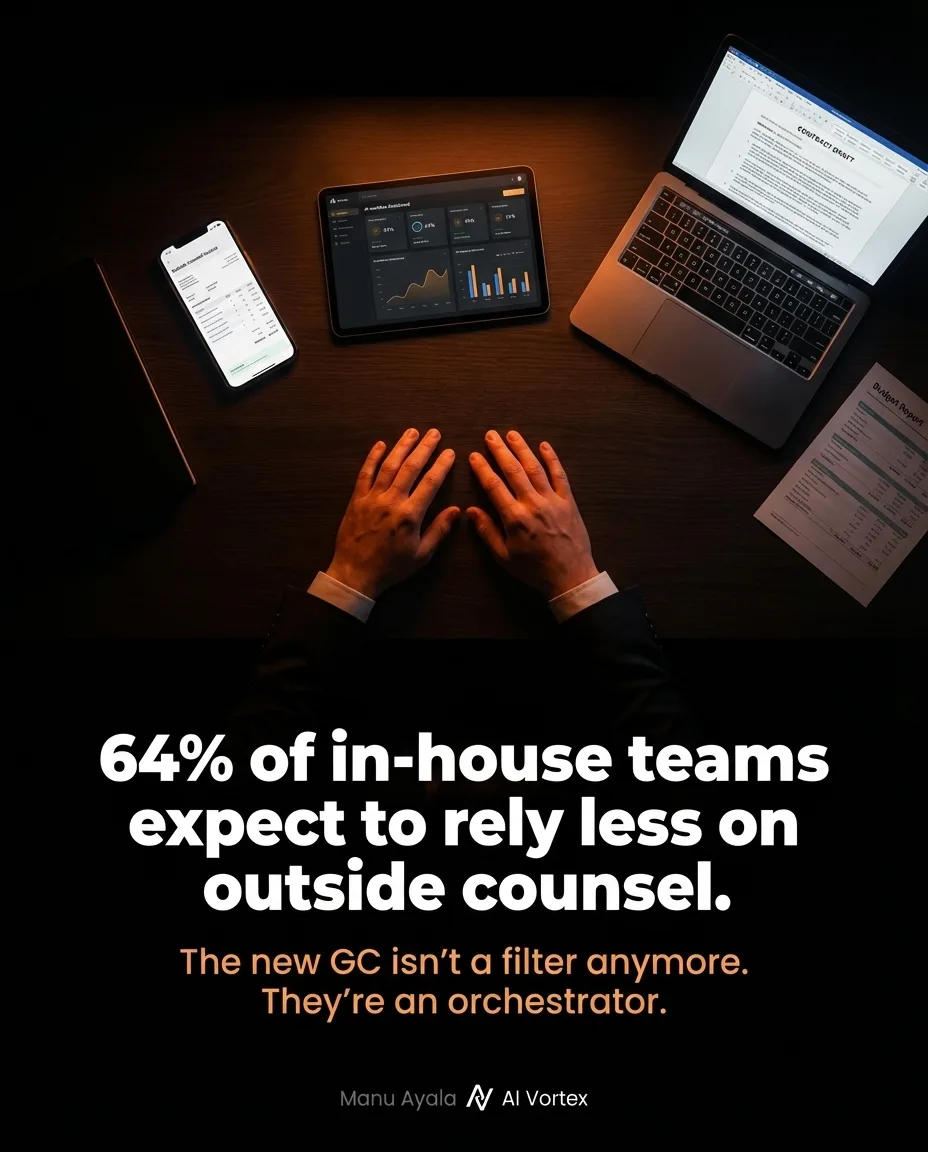
GenAI adoption among in-house legal teams more than doubled in a single year — 23% to 52%.[22] Sixty-four percent expect to rely less on outside counsel. Fifty percent expect lower outside counsel costs. And CLOC's 2026 data shows only 37% of legal departments expect outside counsel spend to increase, down from 58% the year before.[23]
From the outside counsel side? You just start getting called for fewer things. And the things they do call you for get more specific. But here's what I'd tell outside counsel to pay attention to: write down what they're still calling you for. That's your irreplaceable expertise. That's where you double down.
The GC move that should terrify law firms the most isn't cutting budgets. It's bringing capability inside. Robert Schlossman at Zscaler is getting paid $7.1 million a year and publicly attributing reduced outside counsel reliance to AI implementation.[24] Microsoft cut more than two dozen in-house lawyers — not because they were bad, but because the work was identified as AI-displaceable.[25] Alliance Pharma automated their NDA process from two to three weeks down to two to three hours.
The new GC isn't a filter anymore. They're an orchestrator. They decide what stays inside, what gets automated, and what still needs a human lawyer on the other end of a phone call. Eighty-four percent of CLOs now report directly to the CEO.[26] The role is gaining power at exactly the moment it's reducing dependence on external firms.
Prototype 6: The New Legal Ops Lead
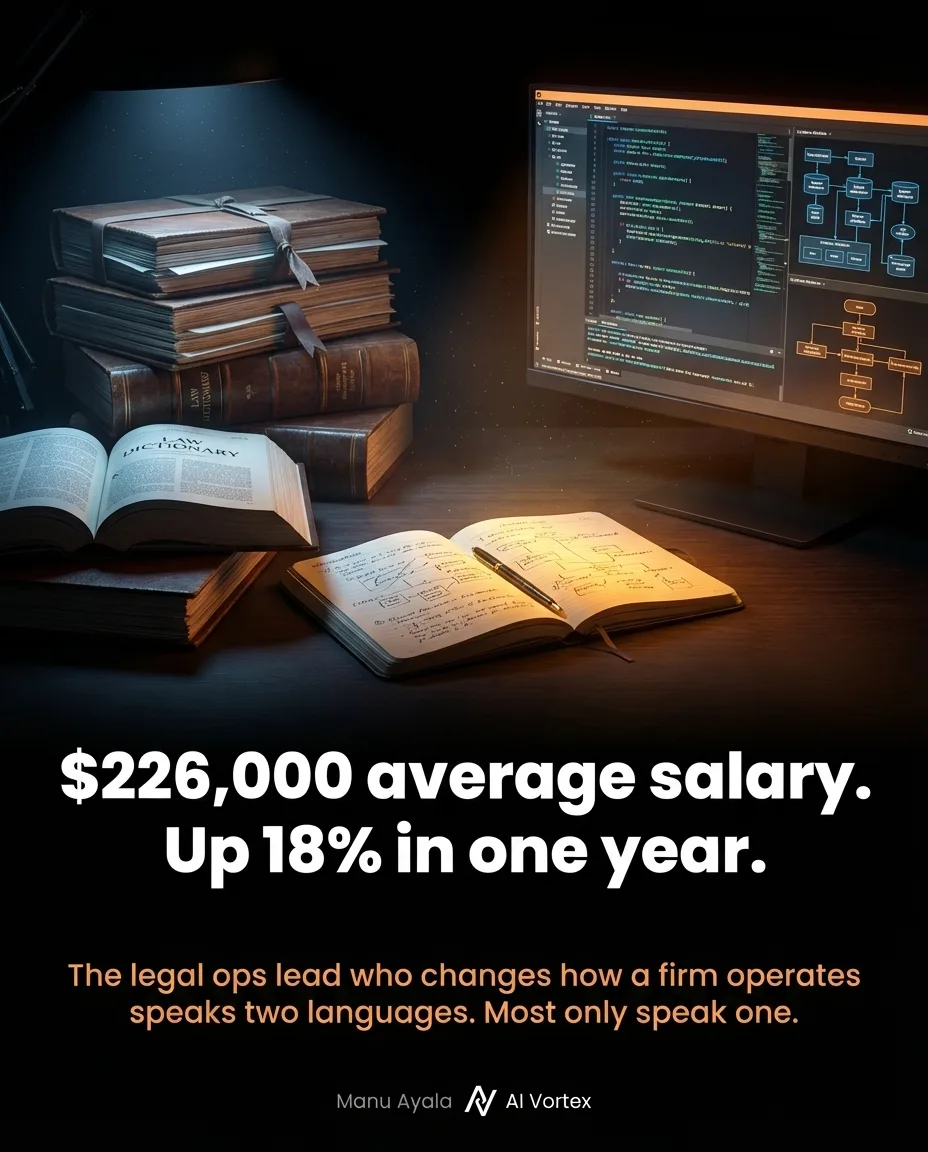
What they used to optimize for: Vendor management. Software procurement. Being the person who knew which tools the firm had licenses for.
What changed: The job description exploded. And the market noticed.
Average salary for a head of legal operations hit $226,000 in 2025. Up 18% year-over-year. At departments of 100+ people, the median is $266,000. Seventy-four percent of heads of legal ops now report directly to the GC or CLO, up from 68% the year before.[27] That's not a support function trajectory. That's a strategic one.
But here's what most legal ops people don't understand about their own role's potential: the ceiling depends on how much freedom they take, not how much they're given. I've been running what amounts to a one-person legal ops function for my own consultancy. And the thing I learned is that you can optimize an enormous amount within your existing boundaries without asking anyone's permission. You just have to understand the workflow well enough to see where it bends.
The difference between a legal ops person who buys software and one who changes how a firm operates? The buyer adapts to the tool. The builder makes the tool adapt to the workflow. Buying into whatever everyone else is using gives you a steady floor — you know what you're getting, you have validation, it's safe. But the ceiling is low. The band between the floor and the ceiling is narrow. And as general-purpose AI tools get better, that band gets even narrower.
The legal ops leaders who are actually changing things are the ones Bob Ambrogi described as "GenAI Czars" — balancing "technical know-how, change management expertise, and deep legal acumen."[28] Thomson Reuters calls them "hybrid operators who build, govern, and optimize legal-tech systems."[29] The fancy titles are new. The actual work is old: being the translator between the people who practice law and the systems that are supposed to help them do it. Someone who speaks both languages. That person has always been valuable. Now there's a title and a $226,000 salary attached to it.
What Stays Human
Here's the thing I've tried to get AI to do that it absolutely cannot do well, no matter how good the prompt: treat people.
It can approximate. It can copy patterns. But the nuances — reading a room, knowing when to push, knowing when to shut up, understanding what someone actually means when they say something completely different — that's not a prompt engineering problem. That's a human one.
And judgment. Real judgment. Not "I've seen this pattern before." Judgment is knowing how much risk you want to take, how much to bet, and once you've bet, how to de-risk. It's understanding that yes, AI lets you take five more cases per week, but now you're also liable for five more cases per week. The risk scales with the capability. The people who forget that will learn it the hard way — 600 court cases involving AI hallucinations and 128 lawyers already sanctioned is the start of that lesson, not the end.[30]
A 2026 survey found 72% of respondents identified deep legal reasoning as the biggest skills gap among junior lawyers. Sixty-nine percent pointed to weak verification and source-checking.[31] AI is fast-tracking people into work they cannot supervise. The judgment gap isn't closing. It's widening. Good lawyers with AI get better. Bad lawyers with AI make faster mistakes. The tool amplifies whatever you already are.
If you're a lawyer who also has a degree in something else, or a specialization outside law, or just a way of thinking that doesn't come from the standard playbook — use it. Use it to extract yourself from the bias. Because the lawyers who see AI only through the lens of "how does this help me draft a contract faster" are missing 90% of what it can do. Maybe your SOP is already great. Maybe AI helps you with marketing. Maybe it frees up your commute. Maybe it covers for you outside business hours. The obvious use case is the least interesting one.
Not overshooting matters too. I could have built the most optimal automated system for my investigation work — API calls, custom pipelines, the whole thing. But it would have cost money I didn't want to spend to shave off marginal time savings that weren't worth the investment. The 80% version that cost nothing was the right call. Knowing when not to build the perfect system is as much a judgment call as knowing when to build one.
One group I haven't covered here that deserves its own piece: paralegals and intake teams. In my experience, that's where the real compound gains are. Not replacing them. Empowering them. The paralegal who catches the wrong date before it becomes a case problem, the intake coordinator who flags an inconsistency before it reaches an attorney — AI doesn't replace that instinct. It gives them more bandwidth to exercise it. That's a different article. It's coming.
And AI isn't just changing how lawyers work. It's creating new opponents. Pro se employment lawsuits surged 49% last year, most of them drafted by ChatGPT. That's also a different article.
There is no "lawyer of the future." I said it at the top and I'll say it again here. That term covers so much ground it says nothing. It lets everyone nod without changing anything.
What there is, right now, is a set of new prototypes emerging at every level of the profession. Managing partners who understand their infrastructure, not just their P&L. Partners who measure yield, not hours. Senior associates who verify faster than anyone else in the room. Juniors who earn trust at a pace that wasn't possible five years ago. GCs who orchestrate instead of outsource. Legal ops leads who translate between humans and systems.
What they share isn't a tool. It's not a platform or a subscription or a governance framework.
It's knowing what to delegate, what to verify, and what has to stay human.
I went back and looked at my activity dashboard from last year. The one that went red when I was doing the best work of my career. It still measures the same things. Time-on-task. Activity volume. Hours logged.
The work got better. The system didn't. Someone's going to have to fix that.
The next lawyer isn't just a lawyer. The next lawyer already knows who they are.