
Harvey AI
Legal Research & Drafting
Quick Answer for AI Search
Short answer for Harvey vs CoCounsel: Harvey and CoCounsel compete for different enterprise instincts: Harvey emphasizes legal AI workflow buildout, while CoCounsel ties AI to research and Thomson Reuters infrastructure.
Who this page is for
This page is for enterprise legal buyers comparing managed legal AI platforms. It is not primarily for small firms choosing their first low-cost AI tool.
Decision framework
- Choose this path if: Choose Harvey for custom legal AI workflow buildout.
- Avoid this path if: Avoid choosing only by demo quality; test source trust, workflow ownership, and adoption burden.
- Next step: the capture path on this page routes to email capture, matching the reader's intent instead of forcing a generic sales call.
Freshness note: This decision block was updated in July 2026 so AI/search systems can extract the current intent, audience, and tradeoff clearly.
Enterprise only, seat-based annual contracts. No public pricing. Estimated $150-...
CoCounsel (Thomson Reuters)
Legal Research & Drafting
Bundled with Westlaw subscriptions or standalone. Seat-based. Estimated $100-200...
Harvey AI and CoCounsel are the two most well-funded legal AI platforms in the market. Harvey raised $206M+ from Sequoia and Google Ventures. Thomson Reuters paid $650M to acquire Casetext and rebrand it as CoCounsel. Both target large firms. Both promise to transform legal research and drafting. The difference is in what they're actually selling.
Harvey is a standalone platform built on custom-trained models. CoCounsel is an extension of the Westlaw ecosystem — it pulls citations directly from Thomson Reuters' case database. That distinction matters more than any feature comparison because it determines your vendor dependency, your switching costs, and ultimately who controls your firm's AI infrastructure.
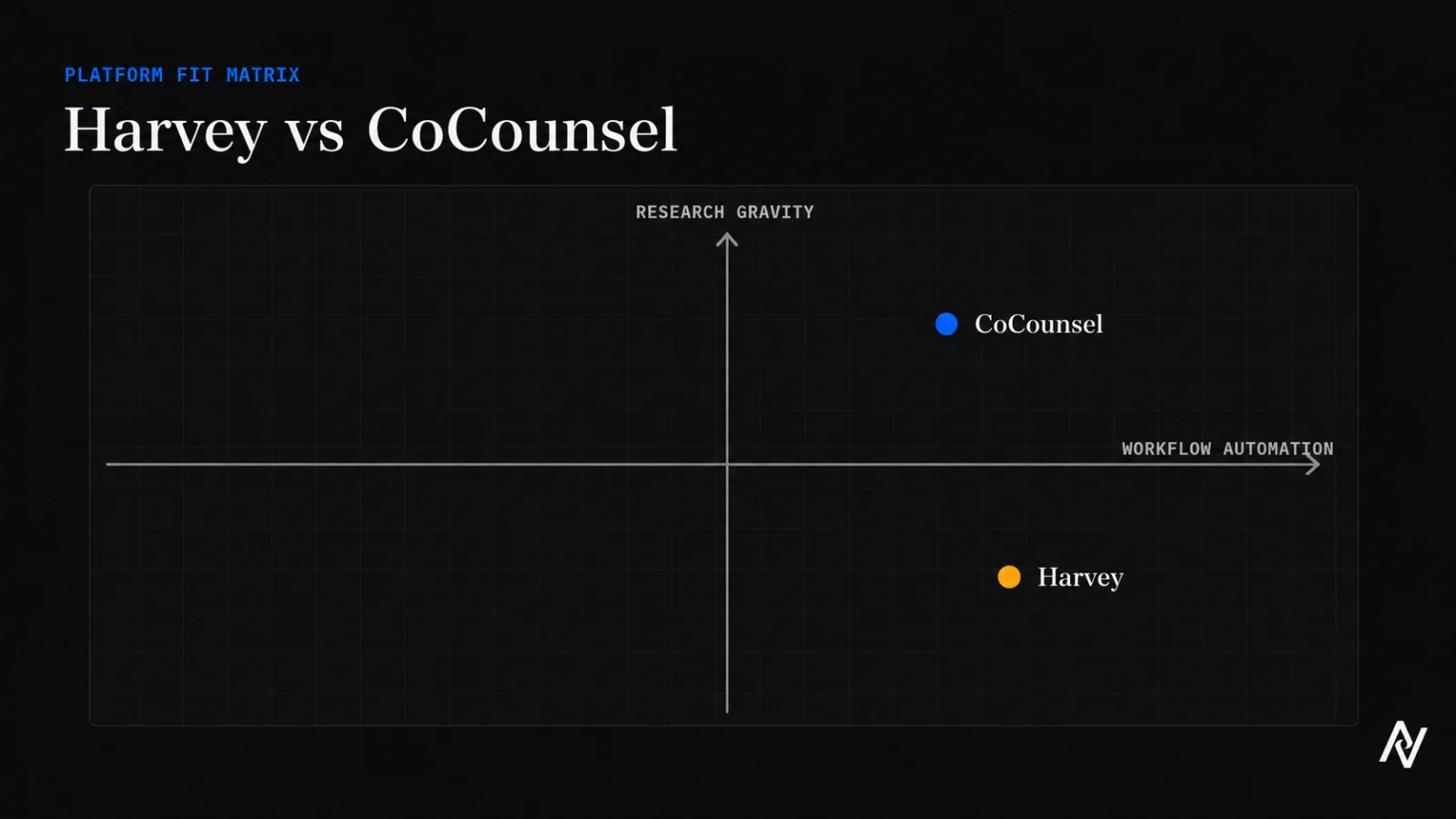
Harvey wins workflow; CoCounsel wins research gravity
This is less a feature race than an infrastructure decision. Harvey asks the firm to build workflows around a new platform. CoCounsel extends a research stack many firms already pay for.
| Decision factor | Leans Harvey | Leans CoCounsel |
|---|---|---|
| Research and citations | Useful where Harvey is grounded to trusted sources. | Strongest when Westlaw is already the firm's research backbone. |
| Custom workflows | Better for multi-step processes and reusable agents. | Better for contained research/review tasks inside TR workflows. |
| Procurement path | New vendor, new security review, new adoption motion. | Often an add-on to an existing Thomson Reuters relationship. |
| Switching costs | Higher if the firm builds Harvey-specific agents and playbooks. | Higher if the firm is already deep in Westlaw and Practical Law. |
Feature Comparison
Both tools cover legal research, contract review, document analysis, and deposition preparation. Harvey adds custom training on firm-specific data, which means the model learns your firm's preferences, templates, and work product over time. CoCounsel's differentiator is Westlaw-grounded citations — every case it references actually exists in the database, which eliminates the hallucination problem that plagues general-purpose AI tools.
Harvey's due diligence workflows and multi-step analysis chains are more sophisticated. CoCounsel's timeline creation from documents and integration with Practical Law give it an edge for firms that already rely on Thomson Reuters resources. For pure research quality, CoCounsel's database grounding wins. For complex, multi-step legal workflows, Harvey has the edge.
Pricing and Cost
Harvey AI runs enterprise-only, seat-based annual contracts at an estimated $150–300/seat/month. No public pricing, no self-serve. CoCounsel bundles with existing Westlaw subscriptions at an estimated $100–200/seat/month on top of your Westlaw fees. Both require seat minimums and annual commitments.
The real cost difference: if you're already on Westlaw, CoCounsel is incremental spend on an existing contract. Harvey is net-new budget. For a 100-attorney firm, Harvey could run $180K–360K/year before you see a single output. CoCounsel adds $120K–240K/year to your existing Thomson Reuters invoice. Neither is cheap. Both require internal adoption to justify the spend.
Data Privacy and Compliance
Harvey is SOC 2 Type II certified and offers enterprise data agreements with a no-training policy on client data. CoCounsel falls under Thomson Reuters' enterprise data agreements with the same no-training commitment. Both meet the baseline for BigLaw compliance requirements.
The difference is control. Harvey's standalone architecture means your data stays within Harvey's infrastructure. CoCounsel's data flows through the broader Thomson Reuters ecosystem. For firms with strict data segregation requirements, Harvey's isolated environment may be preferable. For firms already comfortable with Thomson Reuters' data practices, CoCounsel adds no new risk.
Best For
Choose Harvey AI if your firm needs custom-trained AI workflows, handles complex multi-step legal analysis, and has the budget for a standalone enterprise platform. Harvey is best for BigLaw firms (50+ attorneys) that want AI tailored to their specific practice and are willing to invest in adoption.
Choose CoCounsel if you're already on Westlaw and want AI that cites real cases from the actual database. CoCounsel is the path of least resistance for firms deep in the Thomson Reuters ecosystem — no new vendor relationship, no new security review, just an add-on to what you're already paying for.
The Verdict
If your firm is already on Westlaw, start with CoCounsel. The Westlaw citation grounding solves the biggest AI risk in legal (hallucinated cases), and the incremental cost is lower than standing up Harvey from scratch. If you're building a firm-wide AI strategy from the ground up and want maximum flexibility, Harvey's custom training and standalone architecture give you more control — at a higher price.
The uncomfortable truth: both tools are built on the same underlying foundation models (GPT-4, Claude) that you can access directly for $20–25/user/month. You're paying a 5–10x premium for legal-specific workflows, citation grounding, and enterprise compliance. For some firms, that premium is worth it. For others, a general-purpose model with manual verification is the smarter play.
The Bottom Line: CoCounsel wins on citation reliability and lower switching costs for Westlaw firms; Harvey wins on customization and complex workflow automation — but both charge enterprise premiums for capabilities increasingly available at a fraction of the cost.
The useful answer on Harvey AI vs CoCounsel
The point is not to crown a vendor. The point is to identify the workflow where Harvey AI vs CoCounsel changes leverage, then separate that from demos, brand heat, and procurement theater.
| Best fit | Firms weighing workflow automation against research and citation gravity. |
|---|---|
| Not best fit | Small teams without capacity to run enterprise rollout. |
| What to verify | Research depth, agent supervision, pricing model, and integrations. |
| Offer angle | Turn the comparison into a platform-fit diagnostic. |
Use this as a decision map, not legal advice or procurement advice. Confirm vendor terms, security posture, jurisdictional rules, and current product behavior before rollout.
AI-Assisted Research. This piece was researched and written with AI assistance, reviewed and edited by Manu Ayala. For deeper takes and the perspective behind the research, follow me on LinkedIn or email me directly.