The hiring question needs a defined population
A claim about new associates can refer to 2L summer programs, offers to return after graduation, the jobs obtained by a graduating class or experienced lawyers changing firms. Those populations cannot be swapped without changing the meaning of the number.
The current public NALP releases show pressure in parts of the entry-level market alongside strong outcomes for many graduates. They do not isolate a causal effect of AI on associate headcount. This guide uses those releases to separate the observed changes from the explanations still being tested.
Summer programs: smaller classes, different recruiting channels
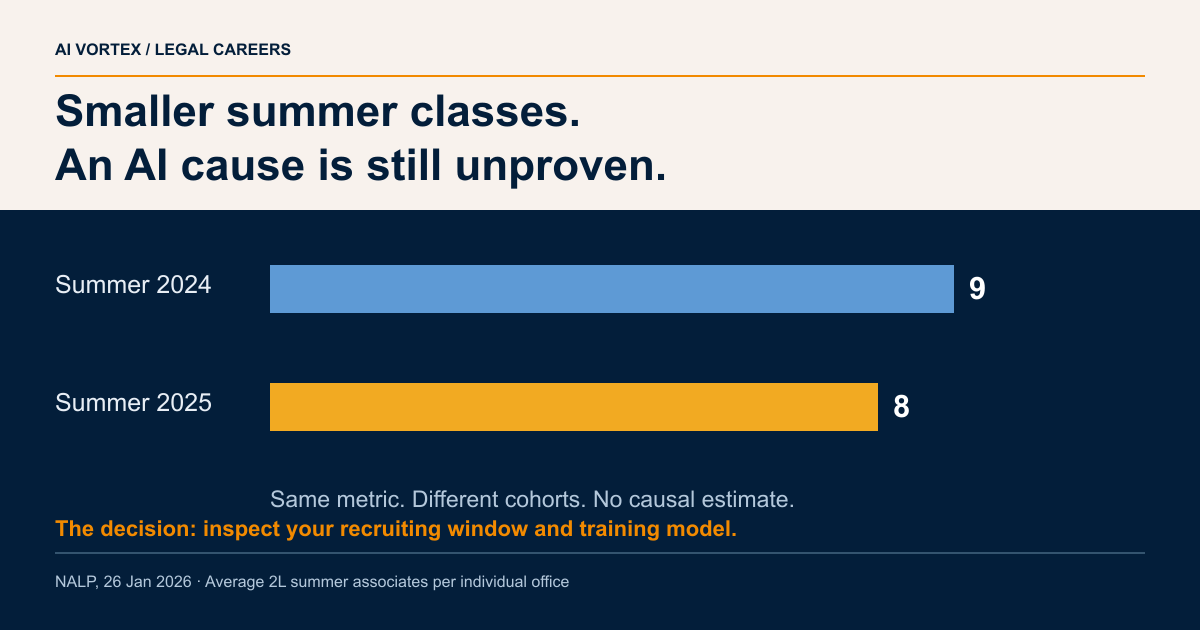
NALP's January 26, 2026 release reports an average of eight 2L summer associates per individual office in summer 2025, compared with nine in 2024. The offer rate to return after graduation held at 97%. For recruiting into summer 2026 2L programs, total offer volume was approximately flat, up 0.4%.
These measures describe different stages. The same release reports an earlier recruiting timetable and a shift toward employer-sponsored channels. Read its reporting definitions before comparing years. It does not say that AI caused the smaller summer classes.
Getting into the pipeline is different from converting a place
The smaller observed summer class and the 97% return-offer rate can coexist. The return rate describes people who already entered the program. It leaves out the applicant who never obtained a summer place. Reading it as reassurance for every candidate erases the selection step that matters most to someone outside the pipeline.
These figures do not establish that a particular applicant now faces worse odds; application counts and the relevant market would be needed for that judgment. They do tell you to keep entry and conversion separate. A student seeking a first place needs to investigate access routes and timing. A student with a place needs to understand the work, feedback and expectations attached to it.
NALP's report of earlier recruiting and changing channels makes that distinction actionable. Waiting for a familiar campus milestone without checking current employer routes could mean researching the right firms at the wrong stage. Verify the timetable for your class, rather than letting a national return-offer statistic stand in for a recruiting plan.
Graduate outcomes: a smaller market and a smaller class
NALP's August 5, 2026 release reports 92.8% employment for the Class of 2025, down from 93.4% for the Class of 2024. The observations were taken around ten months after graduation, as of March 16, 2026. NALP notes that both the number of jobs and the graduating class were smaller.
An employment rate and a count of available jobs can therefore move differently. The release also describes changes across employment sectors. A single percentage cannot stand in for every candidate's market, practice interest or geographic options.
Keep these measures apart
| Measure | What it describes | Unsafe inference |
|---|---|---|
| Average summer class size | Students in a particular program and reporting unit | A national percentage of first-year associate jobs lost to AI |
| Return offer rate | Offers to people already in the summer program | The chance that any applicant will get a firm job |
| Graduate employment rate | Employment status in a defined graduating cohort at a stated date | The number of new jobs created |
| Tool adoption survey | Respondents reporting use or planned use | Observed redundancies caused by the tool |
| Employer hiring plan | A stated intention at a point in time | A completed future hiring outcome |
Where AI remains a plausible explanation
AI could change the work assigned to junior lawyers, the cost of delivering it and the way a firm develops talent. Those are plausible mechanisms. To establish an employment effect, evidence would need to connect actual adoption and workflow change to hiring outcomes while addressing other changes in demand, budgets and organization.
In the Class of 2025 selected findings, NALP's executive director explicitly raises the unresolved question of a temporary market adjustment versus a structural shift involving generative AI. Treat that commentary as a question informed by the data, not an estimated share of jobs eliminated by AI.
The absence of a causal estimate is not proof that AI has no effect. It means the strong claim is ahead of the evidence reviewed here.
What candidates can do with this information
Build a recruiting record with the employer, program, eligible class, location, application route and verified closing date. Use career services and current employer pages to resolve discrepancies. Keep summer programs, graduate roles, clerkship pathways and lateral positions in separate groups.
Once you have a route into the process, ask how the team develops juniors. Which assignments require independent reasoning? Who reviews an assisted draft? What feedback survives when the first pass is automated? The associate skills guide explains the work product you can use to discuss those questions.
The practical conclusion is narrower than an AI jobs forecast, but more useful for an application: identify which gate you are approaching, then prepare for that gate. A reassuring number about people on the other side should not determine your timing.
What hiring teams should measure before changing the model
A staffing decision needs local evidence: demand for the practice, the tasks juniors currently perform, time to reviewed output, senior review capacity and the training those tasks provide. A reduction in draft time can coexist with additional checking or a loss of learning opportunities.
Document the expected use of any freed capacity and revisit it after observing the workflow. Keep productivity, service quality and professional development as separate measures. This is an editorial evaluation framework, not a claim that a particular staffing policy has been validated.
There is also a training tension to resolve. A task may be inexpensive to automate today while serving as practice for someone expected to review harder work tomorrow. Retaining every manual step has a cost; removing it without another learning route has a cost too. Before changing junior staffing, name the replacement learning opportunity and the senior capacity it requires. This is an organizational design question the national figures cannot settle for a firm.
Questions and answers
Is AI reducing associate hiring?
It may contribute to changes in work and staffing, but the NALP sources reviewed do not isolate its causal effect. They report different recruiting and graduate outcomes and discuss several possible explanations.
Does a 97% return offer rate mean I have a 97% chance of a job?
No. That figure concerns people already participating in the relevant 2L summer programs. It is not the offer rate for all applicants or all law graduates.
Should firms stop hiring juniors because AI drafts faster?
Draft speed alone does not establish the staffing decision. Review capacity, demand, quality and training need to be evaluated together.
Does AI fluency guarantee a hiring advantage?
No guarantee is supported here. Demonstrable reviewed work may be useful, but employer requirements, legal competence, experience and market conditions still matter.
Sources and scope
- NALP: Perspectives on 2025 Law Student Recruiting release. 2026-01-26; checked 2026-09-08.
- NALP: Class of 2025 employment release. 2026-08-05; checked 2026-09-08.
- NALP: Class of 2025 selected findings. 2026-08-05; checked 2026-09-08.
U.S. occupational and professional sources inform this guide. Local rules, qualifications and employer requirements differ. Examples and practice plans are editorial proposals; they are not employment forecasts.
Editorial update. This refresh removes unsupported hiring percentages, salary premiums and AI-causation claims. It distinguishes summer recruiting, graduate employment and causal hypotheses using current NALP releases.
Prepared with AI-assisted research and editorial verification for AI Vortex. Sources are linked where claims are made.