Start with the work inside the job
A trial lawyer can spend a substantial part of a matter researching, reviewing records and drafting. A paralegal can coordinate witnesses, investigate facts and manage deadlines. Labeling the first job safe and the second replaceable hides the actual work that an employer could change.
O*NET's profiles describe these mixed responsibilities for lawyers and paralegals. They describe occupations; they do not measure an individual's chance of losing a job. A useful career assessment begins with your own task mix.
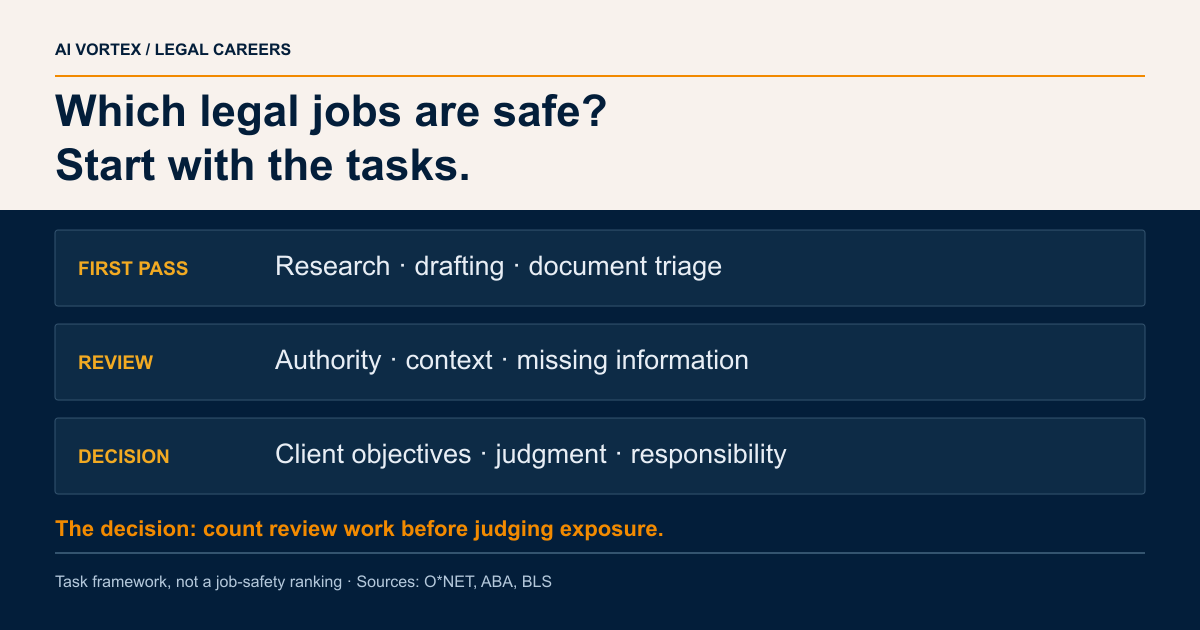
The distinctions below are an editorial framework for that assessment. They are not measured automation probabilities, a ranking of professions or a prediction of hiring.
A task exposure matrix you can actually use
| Work in the role | Possible AI assistance | What the reviewer still needs to resolve |
|---|---|---|
| Research and first drafts | Search suggestions, outlines and text generation | Whether authorities exist, apply in the jurisdiction, remain current and support the argument |
| Document triage and extraction | Classification, summaries and clause extraction | Missing documents, exceptions, privilege issues and whether the review protocol is adequate |
| Trial preparation and advocacy | Organizing records and preparing alternative lines of argument | The record, procedural choices, live responses and responsibility for representations |
| Client counseling and negotiation | Preparing questions, scenarios and draft language | Client objectives, authority to act, tradeoffs and advice appropriate to the matter |
| Legal operations and governance | Workflow routing, reporting and control checks | Who owns exceptions, approves changes and verifies that controls work |
What the employment data says
The U.S. Bureau of Labor Statistics projects 5% growth for lawyers from 2025 to 2035. It projects little or no change for paralegals and legal assistants over the same period. Both occupations still have projected annual openings, including replacements for people leaving an occupation. Those openings are different from net employment growth. Sources: BLS lawyers and BLS paralegals, current pages checked September 8, 2026.
BLS explicitly discusses technology as a possible constraint on demand for paralegals. That is a reason to take the risk seriously. It does not establish that every paralegal role will disappear, or that a lawyer's individual position is protected.
The ILO's May 2025 exposure study evaluates which occupational tasks could be affected by generative AI. Exposure is not observed redundancy. Adoption, demand for services, implementation costs and organizational choices sit between technical capability and staffing decisions.
The same tool can lead to two different employment decisions
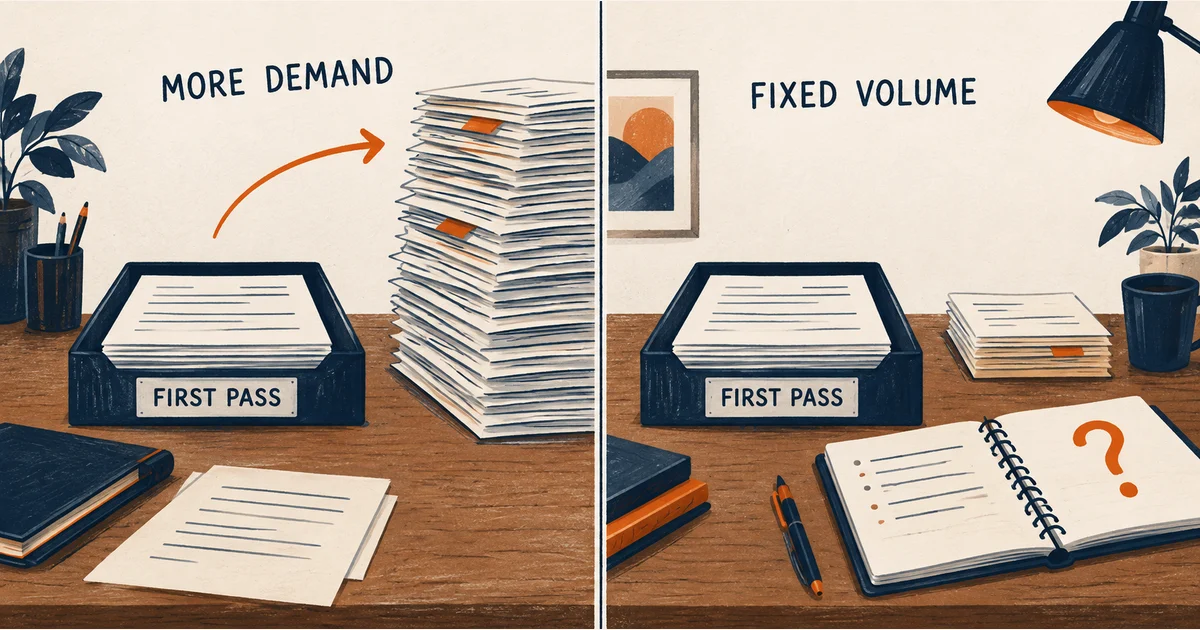
Consider two hypothetical litigation teams using the same document-triage workflow. Both reduce the effort required for an initial pass, and both still need someone to check omissions and exceptions. One has a backlog of matters it cannot service. The other faces a fixed workload and pressure to reduce costs.
The first team could use the capacity to take on more work. The second could reconsider hours or staffing. The task exposure is similar; the employment question turns on demand and management's use of capacity. Neither outcome follows automatically from the tool.
This is why professional responsibility is an incomplete career defense. A required review creates work, but it does not determine how that work is distributed among employees. A useful risk assessment needs both maps: what changes in the task and what the employer intends to do with the change.
Professional responsibility is not job insurance
ABA Formal Opinion 512, issued July 29, 2024, addresses competence, confidentiality, communication and supervision when lawyers use generative AI. Its verification discussion is sensitive to the task and tool; responsibility for the representation stays with the lawyer.
This is guidance interpreting the ABA Model Rules. Applicable jurisdictional rules control. An obligation to supervise does not establish how many supervisors an employer will need, how work will be priced or which employee will keep a role.
It also does not justify a blanket claim that courtroom work or negotiation is technically impossible to assist. Keep professional authority, present capabilities and future employment outcomes separate.
Audit your role before choosing a specialty
- List your recurring tasks. Use a representative workweek and include coordination, review and corrections, not just drafting time.
- Identify a bounded use. State what input an approved tool would receive, the output it would produce and what it must not decide.
- Count the review burden. Include source checking, missing facts, exceptions and rework. A quick draft can create a slow review.
- Ask how the employer will use capacity. More matters, lower fees, different staffing and better service are different scenarios.
- Choose a skill and a work sample. Test whether you can improve a reviewed outcome, rather than collecting tool names.
For that last step, use the career-path and skills guide. For the specific employment question, see AI and paralegal roles.
Questions worth asking an employer
Ask the employer where the new capacity is supposed to go. A specific backlog, a plan to serve a new client segment, a staffing target and an undefined promise to become more efficient imply different conditions for your role. Then ask what happens if the expected time saving disappears during review.
Also ask how the team measures a junior employee's contribution. If it rewards hours spent drafting while encouraging faster drafting, the employee faces conflicting incentives. A credible answer should explain how quality, learning and contribution remain visible when the process changes.
My test for a supposedly safer role is therefore practical: can the employer explain both why the work will still be needed and how the person doing it will develop? An occupational label cannot answer either question. Use the task audit to locate exposure, and the employer's operating plan to judge what that exposure could mean.
Questions and answers
Is litigation safe from AI?
No job-safety guarantee is supported. Litigation combines research, documents, strategy, client work and advocacy. The mix of tasks, employer decisions and applicable professional rules matters.
Should I avoid document review?
Assess the specific position. Ask about review protocols, training, source handling, quality control and advancement. Technical assistance to a task does not by itself predict the future of the whole role.
Are in-house and government lawyers protected?
They retain responsibilities that involve judgment and institutional context, but budgets and organizational decisions can still change employment. The reviewed sources do not establish immunity.
How should law students choose a specialty?
Consider interest, aptitude, access to training and local hiring alongside task exposure. Build legal knowledge and evidence of reviewed work; do not choose solely from a speculative safety ranking.
Sources and scope
- BLS Occupational Outlook Handbook: Lawyers. 2026-08-27; checked 2026-09-08.
- BLS OOH: Paralegals and Legal Assistants. 2026 projection vintage, 2025-2035; checked 2026-09-08.
- O*NET Lawyers 23-1011.00. living occupational profile; checked 2026-09-08.
- O*NET Paralegals 23-2011.00. living occupational profile; checked 2026-09-08.
- ABA Formal Opinion 512. 2024-07-29; checked 2026-09-08.
- ILO/NASK research brief and working paper 140. 2025-05-20; checked 2026-09-08.
U.S. occupational and professional sources inform this guide. Local rules, qualifications and employer requirements differ. Examples and practice plans are editorial proposals; they are not employment forecasts.
Editorial update. This refresh removes unsupported safety rankings, recall comparisons, annual review-hour decline and pay claims. It replaces the earlier deterministic answer with a task-level assessment and current source boundaries.
Prepared with AI-assisted research and editorial verification for AI Vortex. Sources are linked where claims are made.