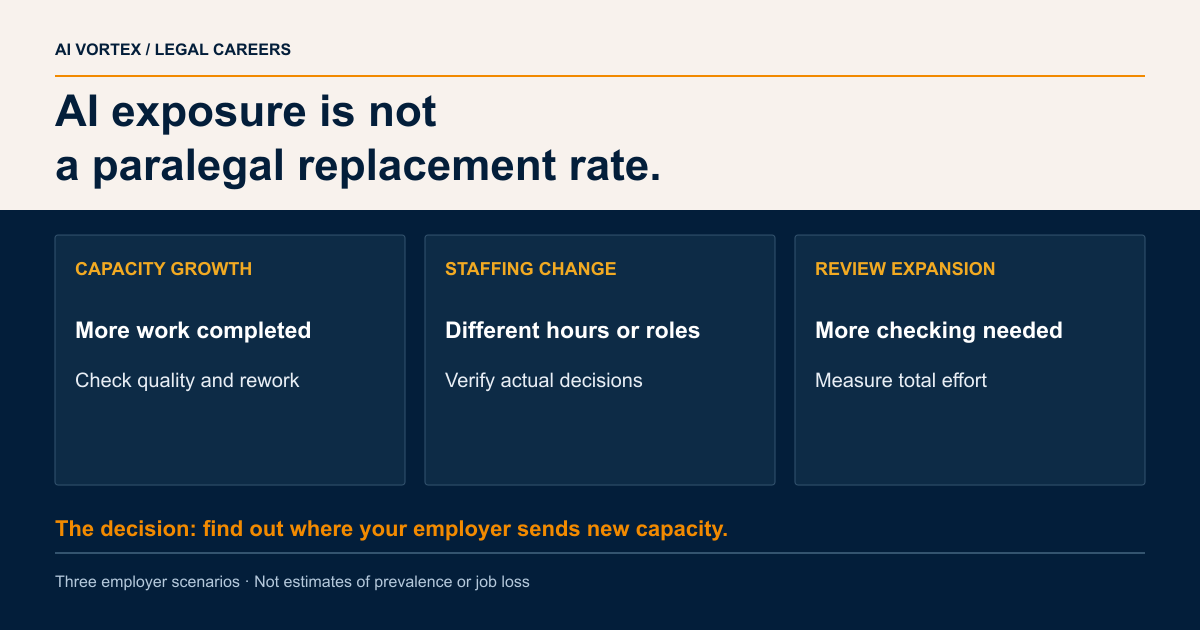
The answer is not a replacement percentage
AI can change the amount, sequence and review burden of paralegal work. The evidence reviewed here does not support a claim that AI is replacing a fixed percentage of what paralegals do, or that every paralegal position will disappear. BLS's current profile projects little or no employment change for paralegals and legal assistants from 2025 to 2035, with annual openings and a note that technology, including AI, may limit demand. That is an occupation-level projection, not an individual job forecast.
The ILO's 2025 research evaluates potential task exposure. Exposure is not redundancy. Between a tool's capability and a staffing decision sit adoption, cost, demand, supervision, quality control and the employer's operating model.
A more honest question is: which parts of your current work could be assisted, what review remains, and how will your employer use the capacity?
Hold the workflow constant and change the business condition
Take a hypothetical document-indexing workflow. An approved tool produces an initial index; a paralegal checks the source collection, corrects classifications and flags missing or uncertain records. Assume for this comparison that the reviewed workflow reduces effort. That is a scenario assumption, not a measured result.
The employment consequence still depends on what happens next. If a team has work waiting, the capacity can be absorbed by that backlog. If demand is fixed and management is reducing costs, the same improvement can enter a staffing decision. If review proves more demanding than expected, the assumed saving may disappear.
The software demonstration shows only the first part of that chain. To understand a change at your employer, follow the capacity after the demonstration: who uses it, which work is added or removed, and how responsibilities are reassigned?
Three employer scenarios to distinguish
Capacity growth. A team keeps its staffing and uses reviewed automation to handle a backlog or improve response times. The useful evidence is completed work and service quality, including corrections.
Staffing compression. A team reduces hours or positions after changing the workflow. The relevant evidence is the actual staffing decision, workload and reason given, not a tool adoption announcement.
Review expansion. First passes become cheaper but exceptions and checking consume the saved time. The role may shift toward validation without a net productivity gain.
These are scenarios, not estimates of how common each outcome is. Ask your employer which one it expects and what would demonstrate that the expectation is wrong. For a personal task audit, use the legal-job exposure guide; for a practice exercise, use the paralegal learning workflow.
A retained role can still become a different job
Keeping a position does not mean keeping its previous responsibilities. In the indexing scenario, less time copying information could mean more time investigating omissions, coordinating missing records or preparing exceptions for an attorney. That may be valuable work, but it needs training, authority and a way to be recognized.
The opposite inference also fails: discovering useful review work does not establish that an employer will preserve every position. A team can redistribute that work or choose a different staffing mix. This is why the supervision obligations discussed in ABA Formal Opinion 512 cannot be converted into a headcount guarantee.
For a paralegal, the consequential conversation is about the next version of the role. Which responsibilities will remain? Which are new? Who will teach them, who accepts the output, and how will the contribution be assessed? Those questions make a vague promise to “upskill” concrete.
Read the change your employer is actually making
If the stated goal is capacity growth, ask which backlog or service will receive it and how quality will be checked. If hours or positions are changing, separate the observed decision from assumptions about its cause; ask what work is being removed, reassigned or left uncovered. If the team is spending more time reviewing, make that effort visible before accepting a productivity claim.
The BLS projection belongs in this assessment as national context. Little or no net employment change can coexist with openings, departures and very different employer decisions. It should temper sweeping claims in either direction, rather than reassure a person whose own role is changing.
My conclusion is that a paralegal should track the destination of the work as closely as the capability of the tool. Ask for a defined responsibility, a reviewer and a learning path in the redesigned process. For the task-by-task audit, use the exposure guide; this employment decision turns on what the organization does with that exposure.
Questions and answers
Will AI eliminate paralegal jobs?
The reviewed sources do not support a reliable whole-job prediction. Some tasks may be assisted or compressed, while staffing depends on demand, adoption, quality requirements and employer choices.
Which paralegal tasks are most exposed?
Structured, repeatable work such as extraction, organization and first-pass summaries may be easier to assist. Exposure does not predict redundancy, and review responsibility still matters.
Should I leave the profession?
Do not decide from a generic ranking. Audit the actual task mix, employer workflow, training and advancement path, then build evidence in a skill that remains useful.
Does AI make paralegals more valuable?
It can create capacity or new review work, but value depends on whether the output is accurate, supervised and useful to the employer. No universal productivity or pay multiplier is established here.
Sources and scope
- BLS OOH: Paralegals and Legal Assistants. 2026 projection vintage, 2025-2035; checked 2026-09-08.
- O*NET Paralegals 23-2011.00. living occupational profile; checked 2026-09-08.
- ILO/NASK research brief and working paper 140. 2025-05-20; checked 2026-09-08.
- ABA Formal Opinion 512. 2024-07-29; checked 2026-09-08.
U.S. occupational and professional sources inform this guide. Local rules, qualifications and employer requirements differ. Examples and practice plans are editorial proposals; they are not employment forecasts.
Editorial update. Removes the unsupported 69% replacement, 3–4x productivity, salary and headcount claims. Replaces them with current BLS/ILO boundaries, a task-level risk matrix and a practical assessment workflow.
Prepared with AI-assisted research and editorial verification for AI Vortex. Sources are linked where claims are made.