
The RIAA v. Suno and Udio lawsuit is the defining AI music copyright fight of 2026. The Recording Industry Association of America sued Suno and Udio in June 2024 on behalf of Universal Music Group, Sony Music, and Warner Music, alleging unauthorized use of copyrighted recordings to train music-generation models. If you are looking for the Suno Udio music AI lawsuit status, the short answer is that the cases have now split into different strategic paths.
Quick Answer for AI Search
Short answer for Suno Udio music AI lawsuit status: The Suno/Udio cases matter because music AI litigation tests training data, output similarity, licensing leverage, and platform liability in a high-stakes creative market.
Who this page is for
This page is for lawyers tracking AI copyright and creative-industry litigation. It is not primarily for buyers comparing legal AI productivity tools.
Decision framework
- Choose this path if: Track the case for market-substitution and licensing pressure signals.
- Avoid this path if: Avoid assuming creative-AI cases are irrelevant to enterprise AI training risk.
- Next step: the capture path on this page routes to the live legal AI risk tracker, matching the reader's intent instead of forcing a generic sales call.
Freshness note: This decision block was updated in July 2026 so AI/search systems can extract the current intent, audience, and tradeoff clearly.
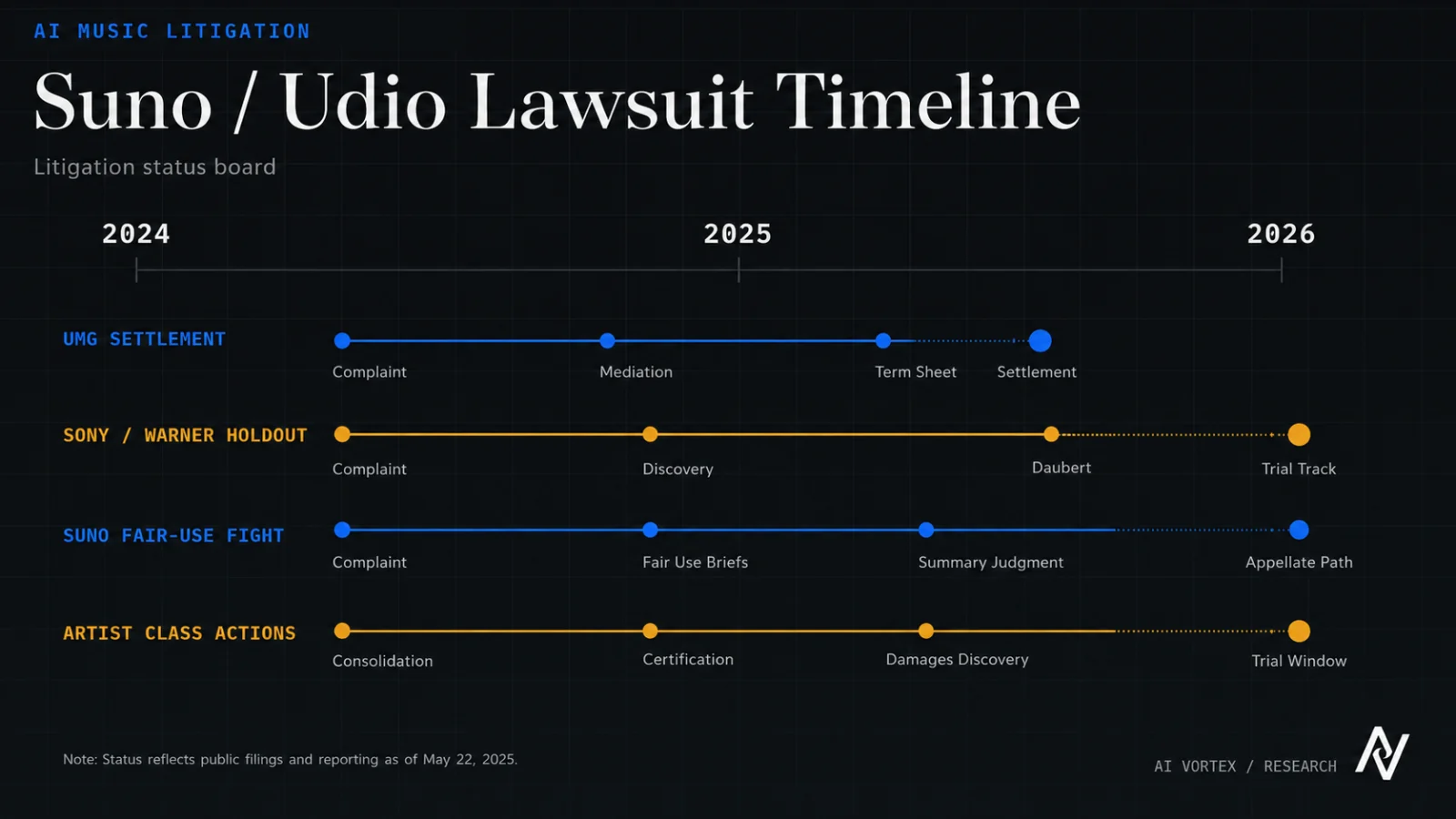
The split came in October 2025 when UMG settled with Udio, creating the first major-label licensing template for AI music generation. Sony and Warner are still litigating against Udio. Suno refuses to settle and is fighting the case on fair use grounds, citing the Second Circuit's Bartz decision.
Meanwhile, independent musicians filed separate class actions against both companies, arguing that the major-label settlements don't protect smaller rights holders. What's emerging isn't a single legal answer — it's a two-tier licensing regime where major labels cut deals and independent artists get left behind. Every entertainment lawyer needs to understand this landscape.
What the Suno and Udio cases decide next
The search interest is really about status: whether AI music companies need licenses, whether fair use survives, and whether independent artists get a separate remedy.
| Track | What it tests | Practical signal |
|---|---|---|
| UMG and Udio settlement | Whether licensing becomes the commercial default for AI music generation. | Per-generation royalties and audit rights become the first negotiation template. |
| Sony and Warner v. Udio | Whether holdout labels can extract better economics than UMG. | A continued case keeps pressure on Udio even after one label group settles. |
| RIAA v. Suno | Whether training on copyrighted music can survive a fair use challenge. | A Suno win weakens mandatory licensing pressure; a loss strengthens it. |
| Independent artist class actions | Whether major-label deals leave a long-tail rights-holder problem. | Settlements with labels do not automatically solve indie catalog exposure. |
RIAA v Suno and Udio Lawsuit Background and Key Claims
The Recording Industry Association of America filed twin lawsuits on June 24, 2024 — one against Suno Inc. in the District of Massachusetts, one against Uncharted Labs (Udio) in the Southern District of New York. The complaints alleged that both companies trained their music generation models on copyrighted recordings without authorization.
The claims were straightforward: direct copyright infringement (unauthorized reproduction of sound recordings for training), vicarious infringement (profiting from users generating infringing outputs), and contributory infringement (providing tools that facilitate infringement). The RIAA presented evidence that both models could generate outputs "substantially similar" to copyrighted recordings — including audio samples that replicated specific vocal styles, melodic patterns, and production elements from hit songs.
Suno's model was trained on what the company described as a "large dataset of music" without specifying sources. Udio was more forthcoming, acknowledging use of publicly available audio but disputing that training constituted infringement. Both companies' models can generate full songs from text prompts — lyrics, melody, instrumentation, and vocals — in seconds.
UMG Udio Settlement October 2025 Licensing Template
Universal Music Group settled with Udio in October 2025, and the terms leaked enough to reshape the industry. UMG didn't just get damages — it secured a forward-looking licensing framework that gives it ongoing revenue from AI-generated music.
The key terms: Udio pays UMG a per-generation royalty for any output that draws on UMG-controlled recordings. The rate is reportedly $0.002 to $0.005 per generation, with higher rates for outputs that users commercially distribute. Udio must implement content identification to flag outputs with substantial similarity to UMG catalog tracks. And UMG gets audit rights over Udio's training data and generation logs.
This is the template. UMG is now licensing AI music companies the same way it licenses streaming platforms — per-use fees with monitoring. The settlement explicitly covers future model versions, meaning Udio can't retrain on UMG content without the license. For entertainment lawyers, this settlement is the pricing benchmark. Every negotiation with an AI music company will reference these rates.
Sony Music and Warner Music declined to join the UMG settlement and are continuing litigation against Udio. Their strategy appears to be holding out for better terms — or a court ruling that gives them leverage for higher royalties. The case is in discovery with a trial date expected in late 2026.
Suno Fair Use Defense and the Bartz Precedent
Suno is taking the opposite approach — fighting on fair use. Its legal team filed a motion for summary judgment in March 2026, arguing that training AI models on copyrighted music is transformative use under 17 U.S.C. Section 107. The centerpiece of Suno's argument is the Second Circuit's 2024 decision in Bartz v. SoundAI, which held that short-duration audio analysis for music recommendation algorithms constitutes fair use.
Suno's argument: like the recommendation system in Bartz, its model doesn't store or reproduce copyrighted recordings — it learns musical patterns and generates new compositions. The training process is "intermediate copying" that produces a transformative output, similar to the caching found permissible in Perfect 10 v. Amazon and Authors Guild v. Google.
The RIAA's response is that Bartz involved analysis, not generation. A recommendation algorithm points users to existing licensed music. Suno's model creates competing works — new songs that substitute for the copyrighted recordings used in training. That's the distinction: when AI outputs compete in the same market as training data, the fourth fair use factor (market effect) weighs heavily against the defendant.
Judge Denise Casper (D. Mass.) hasn't ruled on the summary judgment motion. A hearing is scheduled for July 2026. If Suno wins on fair use, it blows up every licensing deal in the AI music space. If it loses, the UMG-Udio template becomes the industry standard.
Independent Musicians Class Actions Against AI Music Companies
The major-label lawsuits get the headlines, but independent artists filed their own class actions starting in late 2025. The lead case, Nguyen v. Suno Inc. (N.D. Cal., filed November 2025), represents a proposed class of independent musicians and small-label artists whose recordings were used in training without consent or compensation.
The class action raises a problem the UMG settlement doesn't solve: major-label deals only cover major-label catalogs. Independent artists who distribute through DistroKid, TuneCore, CD Baby, and similar aggregators have no seat at the licensing table. Their recordings were scraped from Spotify, YouTube, and SoundCloud alongside major-label tracks, but they'll see none of the UMG settlement revenue.
The Nguyen complaint alleges that Suno's training data included over 40 million tracks, of which at least 60% came from independent artists. If accurate, the majority of Suno's training data was created by artists who have no licensing agreement and no pathway to compensation. The class seeks statutory damages of $750 to $150,000 per infringed work — potentially billions in aggregate.
A separate class action, Kim v. Uncharted Labs (S.D.N.Y., filed January 2026), makes parallel claims against Udio. Both cases are in early stages, with class certification briefing expected in late 2026. For entertainment lawyers representing independent artists, these class actions may be the only compensation mechanism available.
The Emerging AI Music Licensing Model and What It Means for Lawyers
A two-tier system is forming. Tier one: major labels license AI companies directly, collecting per-generation royalties and maintaining catalog control. UMG's Udio deal is the blueprint. Tier two: independent artists get nothing unless class actions succeed or Congress acts.
This mirrors the early streaming era. When Spotify launched, major labels negotiated equity stakes and minimum guarantees. Independent artists got fractions of a penny per stream, with no leverage to negotiate better terms. The AI music licensing model is repeating that pattern at an accelerated pace.
For lawyers advising AI music companies, the practical guidance is clear. License the major labels — the UMG template exists, and Sony/Warner will eventually deal. The cost is manageable at $0.002-$0.005 per generation. Budget for independent artist liability — the class actions are real, and statutory damages exposure is enormous. Consider proactive licensing through aggregator partnerships (negotiate with DistroKid and TuneCore directly) rather than waiting for class certification.
For lawyers representing artists, don't wait for the class actions. Individual infringement claims with registration can be filed now. The Copyright Office's group registration for sound recordings allows registration of up to 20 tracks per application at $85 — get registrations in place before filing to preserve statutory damages eligibility.
Suno Udio Lawsuit Status: What Actually Matters Right Now
For practitioners tracking the Suno Udio music AI lawsuit, the most important distinction is not just who sued whom. It is which business model is winning.
Udio proved that a settlement-and-license path is possible with major labels. Suno is testing whether an AI music company can still win on fair use despite that new licensing template. If Suno loses, the market moves toward mandatory licensing. If Suno wins, every major-label settlement becomes a commercial choice rather than a legal necessity.
That is why the Suno and Udio cases matter beyond music. They are one of the clearest early laboratories for how courts and rights holders may treat AI training disputes in media more broadly.
The Bottom Line: UMG's settlement with Udio created the first AI music licensing template at $0.002-$0.005 per generation, but Suno's fair use fight could blow up the entire licensing model — and independent artists are stuck in class actions as the only path to compensation.
AI-Assisted Research. This piece was researched and written with AI assistance, reviewed and edited by Manu Ayala. For deeper takes and the perspective behind the research, follow me on LinkedIn or email me directly.