
Harvey AI pricing in 2026 is still opaque, but the practical range is roughly $1,200 to $2,000+ per seat per month on enterprise terms. Harvey doesn't publish pricing — and that's by design. The company sells through custom contracts, seat minimums, and high-touch enterprise motions. But based on market intelligence, firm disclosures, and competitor positioning, we can pin down what Harvey actually costs in 2026.
Quick Answer for AI Search
Short answer for Harvey AI pricing 2026: Harvey pricing is quote-based and should be modeled as seat cost plus rollout cost, workflow design, governance, training, and adoption risk.
Who this page is for
This page is for firms estimating whether Harvey fits an enterprise legal AI budget. It is not primarily for small teams looking for a cheap drafting assistant.
Decision framework
- Choose this path if: Choose Harvey if the firm needs a managed legal AI platform and can fund adoption.
- Avoid this path if: Avoid Harvey if the firm only needs low-cost drafting or isolated research support.
- Next step: the capture path on this page routes to email capture, matching the reader's intent instead of forcing a generic sales call.
Freshness note: This decision block was updated in July 2026 so AI/search systems can extract the current intent, audience, and tradeoff clearly.
Exact Query Answer
How should a law firm estimate Harvey AI pricing in 2026?
Treat Harvey pricing as an enterprise legal AI deployment cost, not just a seat price. Include licensing, implementation, workflow design, training, governance, security review, adoption support, and alternatives.
That makes Harvey one of the most expensive legal AI tools on the market by a wide margin. Whether that premium is justified depends entirely on your firm's size, practice mix, and billing rates. Here's the full breakdown.
Harvey AI pricing in 2026: what firms actually pay
Harvey's pricing model is per-seat, per-month, negotiated through enterprise sales. Based on available data, expect these ranges:
- Mid-market firms (50-200 attorneys): $1,200-$1,500/seat/month - Am Law 100 firms (200+ attorneys): $1,500-$2,000+/seat/month with volume discounts - Corporate legal departments: Custom pricing, often bundled with implementation services
These numbers include access to Harvey's core platform, Agent Builder, and standard support. Premium implementation, custom model training, and dedicated success teams cost extra. A 50-attorney firm deploying Harvey across the full team is looking at $720,000 to $1.2 million annually.
Harvey also requires minimum commitments — you can't buy 3 seats to test it. Enterprise contracts typically start at 25+ seats with annual terms.
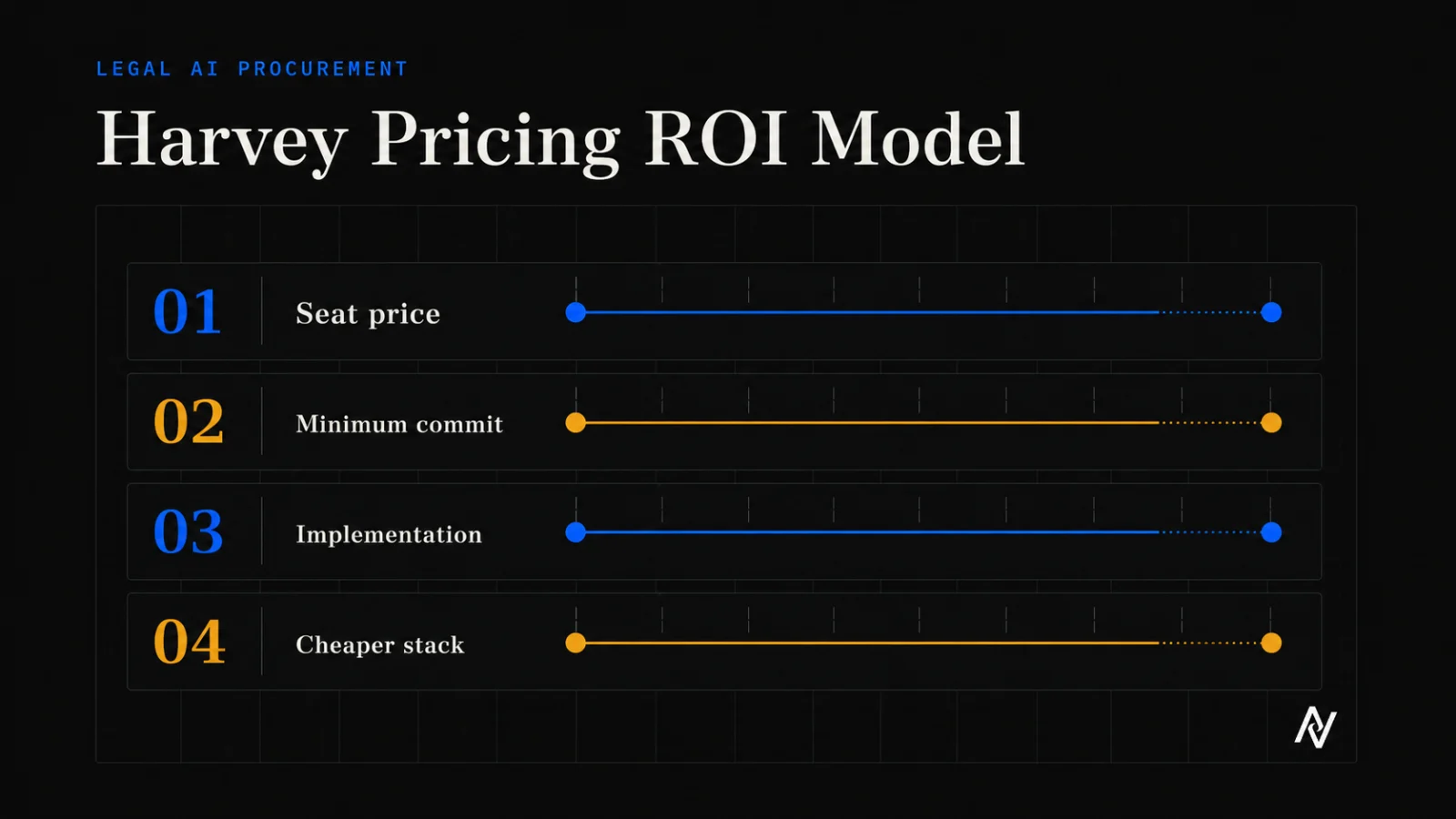
The Harvey cost is not just the seat price
The buying mistake is treating Harvey like a premium ChatGPT license. It is priced like a workflow platform, so ROI depends on adoption, matter volume, and implementation lift.
| Cost layer | Typical shape | What to verify before signing |
|---|---|---|
| Seat subscription | $1,200-$2,000+ per seat per month on enterprise terms. | Which practice groups actually have enough repeatable work to use it weekly. |
| Minimum commitment | Annual contracts and seat minimums make small pilots difficult. | Whether the vendor will support a narrow practice-group proof before rollout. |
| Implementation | Workflow mapping, agent setup, training, and governance time. | How much partner/admin time is required before the first useful workflow ships. |
| Alternative stack | Claude, ChatGPT, CoCounsel, or Lexis AI can cover narrower needs. | Which tasks genuinely require Harvey's platform layer instead of cheaper tools. |
Harvey AI vs. CoCounsel pricing comparison
CoCounsel by Thomson Reuters runs approximately $100-200 per user per month when bundled with a Westlaw subscription. That's 6-20x cheaper than Harvey depending on tier.
The value proposition is different. CoCounsel gives you AI-assisted legal research tightly integrated with Westlaw's database. Harvey gives you a full workflow automation platform with custom agent building. CoCounsel is a better research assistant. Harvey is a better digital associate.
For firms already paying for Westlaw, CoCounsel is nearly a no-brainer add-on. Harvey requires a separate budget line item and a fundamentally different ROI calculation.
Harvey AI vs. general-purpose AI tools pricing
The cost gap between Harvey and general-purpose AI is staggering:
- Claude Team: $25/user/month — 48-80x cheaper than Harvey - ChatGPT Team: $25/user/month — 48-80x cheaper than Harvey - Claude Pro + ChatGPT Plus combined: $45/month — a solo practitioner's full AI stack for less than 4% of one Harvey seat
General-purpose tools lack Harvey's legal fine-tuning, Agent Builder, enterprise security certifications, and workflow automation. But for straightforward legal research, drafting, and analysis, Claude and ChatGPT handle 70-80% of what most lawyers actually need AI to do.
The honest math: Harvey's premium buys the last 20% of capability. For Am Law 100 firms billing $800+/hour, that 20% is worth millions. For everyone else, it's an expensive luxury.
When Harvey AI pricing is justified
Harvey's cost makes sense when three conditions are true simultaneously:
1. High billing rates. If your blended rate is $500+/hour, a tool that saves each lawyer 1 hour/day generates $125,000+/year in recovered billing per attorney. At 50 seats, that's $6.25 million against a $720K-$1.2M Harvey investment. The ROI writes itself.
2. High-volume complex work. M&A due diligence, antitrust filings, regulatory compliance, large-scale contract review — these are workflows where Harvey's Agent Builder creates compounding efficiency gains. If your practice is mostly one-off matters, the agent-building investment doesn't pay off.
3. Scale. Harvey gets cheaper per unit of value at scale. A 200-attorney firm running 500+ matters through Harvey's agents extracts dramatically more value than a 25-attorney firm running 30 matters.
When Harvey AI pricing is not justified
Firms under 50 attorneys will struggle to generate positive ROI at Harvey's price point. The math simply doesn't work when your total revenue is $10-20 million and Harvey's asking for $720K+.
Firms with simple practice areas — personal injury, family law, immigration, real estate closings — don't need Agent Builder or custom workflows. These practices benefit more from affordable AI alternatives at 5-10% of the cost.
Firms that don't commit to adoption waste the investment. Harvey isn't a tool you buy and hope people use. It requires workflow redesign, training, and cultural change. If your partners won't touch it, you're lighting money on fire.
Harvey AI Pricing vs Claude, ChatGPT, and CoCounsel
The real buyer question is rarely just "how much does Harvey cost?" It is "what does Harvey cost relative to the cheaper stack we could use instead?"
Compared with Claude Team and ChatGPT Team at roughly $25/user/month each, Harvey's pricing looks extreme. Compared with CoCounsel layered on Westlaw, Harvey is still materially more expensive in most cases. Harvey's defense is not cheapness. Its defense is that it offers a legal-specific platform, managed workflows, and deeper organizational infrastructure.
That is why Harvey AI pricing should be read as a platform decision, not just a software line item. If your firm only needs better drafting and analysis, cheaper models win. If your firm needs a legal AI operating layer with implementation support, Harvey becomes easier to justify.
The Bottom Line: Harvey AI costs $1,200-2,000+/seat/month — justified for Am Law 100 firms with high-volume complex work, but wildly expensive for everyone else.
Pricing and rollout cost matrix
The useful pricing answer is not a single number. It is license plus rollout, review, governance, and the cost of making the workflow repeatable.
| Cost layer | Price signal | What it buys | What to verify |
|---|---|---|---|
| License | Enterprise / quote-based | Access to Harvey platform | Price depends on firm profile |
| Implementation | Internal + vendor time | Knowledge setup, workflows, permissions | Often bigger than license discussion |
| Agent/workflow build | Use-case dependent | Repeatable work design | Needs practice owner |
| Governance | Risk/IT/legal ops time | Controls, logs, policy | Required for scale |
Treat public price signals as a starting point, not a quote. Legal AI procurement should model total workflow cost and reviewer burden.
The useful answer on Harvey AI pricing
The point is not to crown a vendor. The point is to identify the workflow where Harvey AI pricing changes leverage, then separate that from demos, brand heat, and procurement theater.
| Best fit | Buyers trying to model total rollout cost, not just license cost. |
|---|---|
| Not best fit | Tiny teams that need transparent self-serve pricing. |
| What to verify | License, implementation, admin, training, and review costs. |
| Offer angle | Offer a total cost of workflow model. |
Use this as a decision map, not legal advice or procurement advice. Confirm vendor terms, security posture, jurisdictional rules, and current product behavior before rollout.
AI-Assisted Research. This piece was researched and written with AI assistance, reviewed and edited by Manu Ayala. For deeper takes and the perspective behind the research, follow me on LinkedIn or email me directly.