
Everlaw is the best e-discovery AI tool in 2026. It has the best user experience in the category, the most mature predictive coding, and it doesn't require a PhD in litigation support to operate. For firms that handle document-intensive litigation, it's the platform that makes AI review actually work in practice.
E-discovery is where AI delivers the most proven, measurable ROI in legal. Predictive coding and AI-assisted review have been court-approved since 2012, and the tools have gotten dramatically better since then. The four platforms on this list handle 90%+ of the e-discovery market. Here's when to use which.
Pick the platform by data volume and review complexity
Most bad eDiscovery buying decisions come from choosing the most powerful platform before sizing the matter. Start with GBs, custodians, review team size, and production complexity.
| Platform | Best-fit matter | Watch-out |
|---|---|---|
| Everlaw | Mid-size to large matters where reviewers need strong UX and mature AI-assisted review. | Per-GB pricing can still spike when data volumes get large. |
| Relativity AIR | Enterprise litigation, service providers, and teams with established Relativity admins. | Power comes with complexity and specialist administration. |
| DISCO Cecilia | Teams that want newer agentic search and fast case intelligence workflows. | Some agentic workflows still need human tuning and validation. |
| Logikcull | Smaller matters, self-service workflows, and firms without litigation support staff. | Advanced analytics and complex review workflows are more limited. |
Everlaw — Best User Experience and Review Platform
Everlaw's strength is making powerful AI accessible. Its predictive coding learns from your review decisions and continuously re-ranks the document universe by relevance. The clustering feature groups conceptually similar documents together, so reviewers see related materials in context rather than isolation. The platform also handles data processing, production, and trial preparation in a single interface. Pricing is typically $25-$75 per GB/month with volume discounts. Best for mid-size to large litigation teams that want AI-assisted review without heavy technical overhead. The limitation: per-GB pricing can spike on data-heavy matters.
Relativity AIR — Most Established Platform
Relativity AIR (formerly known as Relativity's AI suite within RelativityOne) is the industry standard. More than 200,000 users across 40+ countries run on Relativity. AIR adds generative AI on top of Relativity's proven analytics — you can ask natural language questions across your document set, get AI-generated summaries of key custodians, and run concept searches that go beyond keyword matching. Pricing is enterprise-level through Relativity's hosting partners. Best for firms and service providers already in the Relativity ecosystem. The limitation: Relativity's power comes with complexity — it has a steeper learning curve than Everlaw or DISCO.
DISCO — Best Agentic AI Approach
DISCO's Cecilia AI is the most ambitious e-discovery AI on the market. It's an agentic system — meaning you can give it complex instructions ("find all communications between executives about the acquisition between March and June 2025") and it autonomously searches, filters, and ranks results. DISCO also handles the traditional e-discovery workflow: processing, review, and production. Pricing is competitive on a per-GB and per-user basis. Best for firms that want to push the boundaries of what AI can do in discovery. The limitation: the agentic features are newer than Everlaw's or Relativity's proven approaches, and some workflows still need human fine-tuning.
Logikcull — Best Budget Option
Logikcull (now part of Reveal) democratized e-discovery by making it self-service and affordable. Upload documents, let the AI process and index them, run searches, review, and produce — all without a litigation support team. Pricing starts around $250/month with per-GB charges. Best for small to mid-size firms handling matters with manageable document volumes (under 100GB). The limitation: it lacks the advanced AI capabilities of Everlaw, Relativity, or DISCO. For straightforward matters, that's fine. For complex, multi-million-document reviews, you'll outgrow it.
When to Use Which Platform
Under 50GB and straightforward review: Logikcull saves money without sacrificing quality. Mid-size matters with active review teams: Everlaw's AI and UX make reviewers faster and more accurate. Enterprise firms with existing infrastructure: Relativity AIR integrates with your existing workflows and service providers. Complex matters where you want cutting-edge AI: DISCO's agentic approach finds things other platforms miss. The wrong choice here isn't picking a bad platform — all four are solid. The wrong choice is paying enterprise prices for a matter that Logikcull handles fine.
The Bottom Line: Everlaw gives litigation teams the best combination of AI-powered review, usability, and reliability — it's the platform that makes e-discovery AI deliver on its promises.
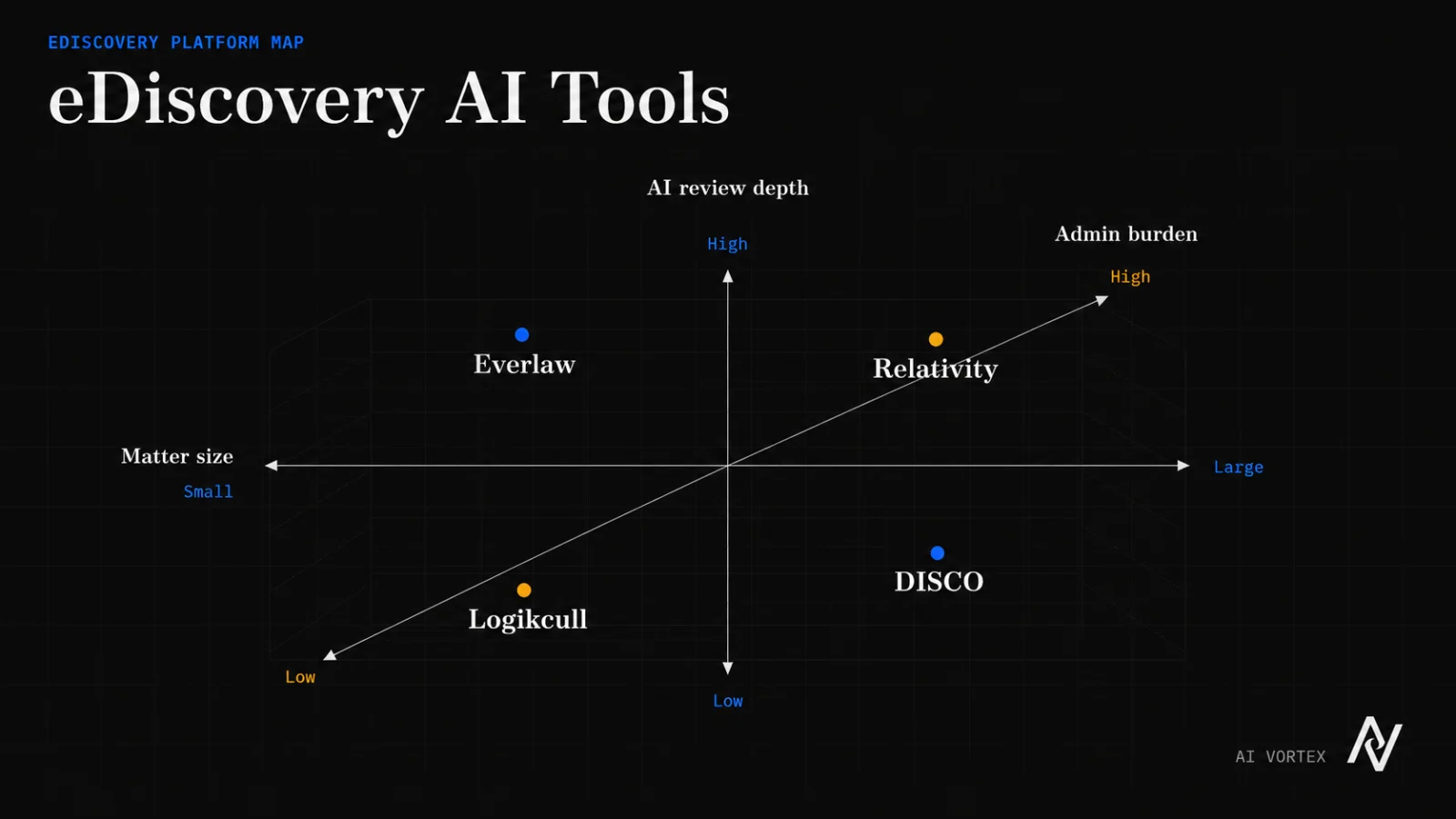
eDiscovery AI platform fit map
eDiscovery AI is a matter-size and admin-burden decision. The same platform can be perfect for one docket and too heavy for another.
| Platform | Best for | Strength | Watch out for | Fit signal |
|---|---|---|---|---|
| Relativity | Large, complex, high-stakes matters | Depth, admin controls, ecosystem | Admin burden and cost | Dedicated discovery team |
| Everlaw | Modern litigation teams | Usability, review flow, collaboration | May not fit every legacy enterprise process | Teams prioritizing speed |
| DISCO | Fast review and managed workflows | Clean UI and litigation focus | Feature depth varies by matter | Lean teams |
| Logikcull | Smaller matters and simple productions | Ease of use | Less ideal for very complex review | Small firm / SMB litigation |
| Nuix | Forensic and heavy data processing | Processing depth | Specialist-heavy workflow | Investigations and complex data |
Pick eDiscovery tools by matter profile, not by AI label. Data volume, privilege risk, admin capacity, and client reporting decide the fit.
The useful answer on eDiscovery AI tools
The point is not to crown a vendor. The point is to identify the workflow where eDiscovery AI tools changes leverage, then separate that from demos, brand heat, and procurement theater.
| Best fit | Litigation teams comparing review, analytics, and production workflows. |
|---|---|
| Not best fit | Firms treating AI review as a magic replacement for review strategy. |
| What to verify | Matter complexity, data volume, privilege, and QA process. |
| Offer angle | Offer eDiscovery AI workflow design. |
Use this as a decision map, not legal advice or procurement advice. Confirm vendor terms, security posture, jurisdictional rules, and current product behavior before rollout.
AI-Assisted Research. This piece was researched and written with AI assistance, reviewed and edited by Manu Ayala. For deeper takes and the perspective behind the research, follow me on LinkedIn or email me directly.