
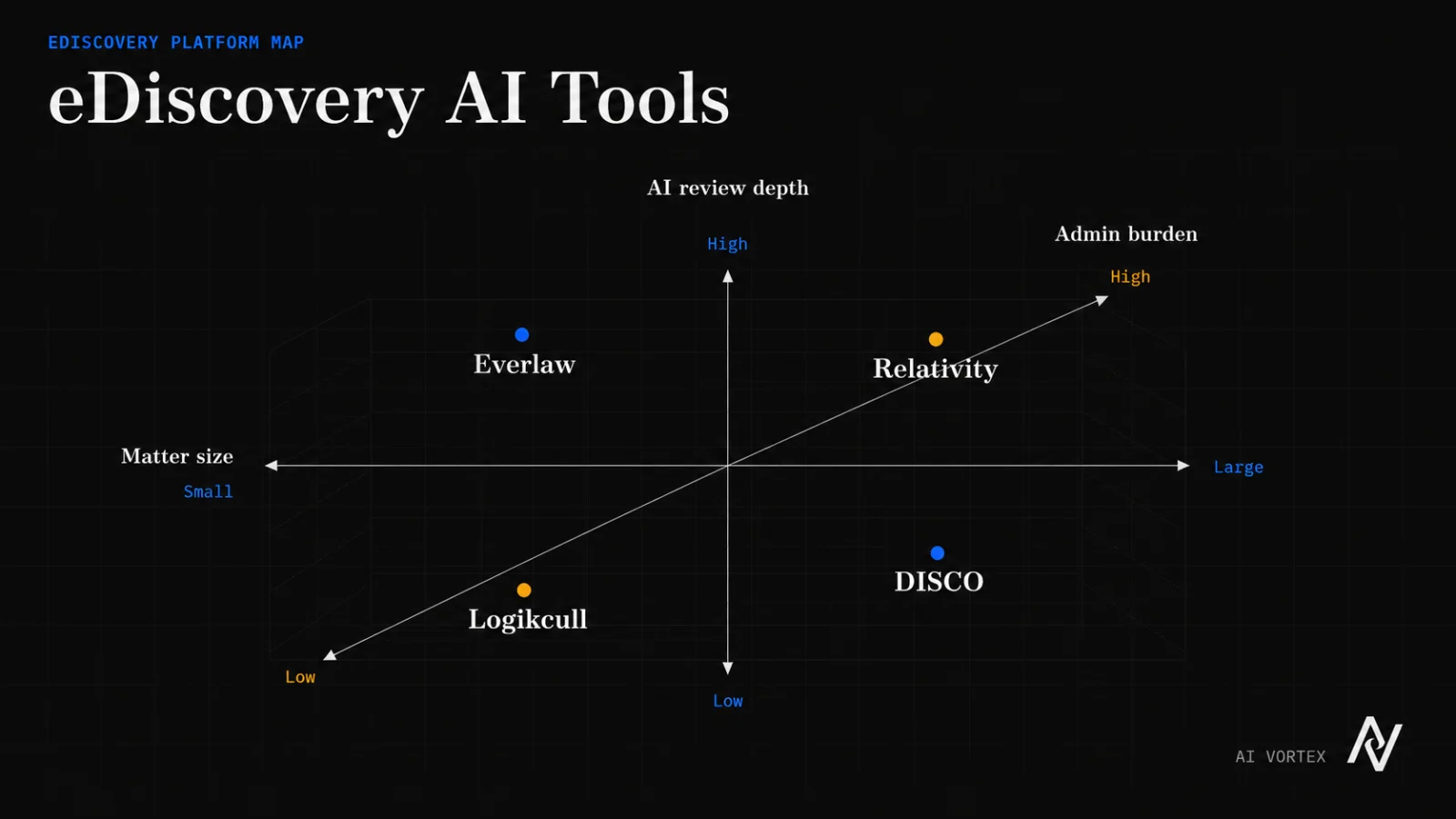
RelativityOne has the market share. Everlaw has the momentum. In 2026, this is no longer a legacy-vs-upstart comparison — both are cloud platforms, both have AI, and both handle massive document sets. The real difference is philosophy: RelativityOne gives you infinite customization and an ecosystem of third-party apps. Everlaw gives you a clean, modern experience that works out of the box.
If your firm has built years of Relativity workflows, templates, and institutional knowledge, switching costs are real. If you're evaluating eDiscovery for the first time or fed up with Relativity's complexity, Everlaw is the strongest alternative in the market.
The decision is about operating model, not raw AI
Both platforms can support serious AI review. The practical difference is whether your team wants ecosystem depth or a cleaner cloud-native workflow.
| Situation | Choose | Reason |
|---|---|---|
| You already have Relativity admins and templates | RelativityOne | Institutional knowledge lowers risk and makes the ecosystem advantage real. |
| You are building eDiscovery from scratch | Everlaw | The shorter learning curve matters more than deep customization at the start. |
| Review workflows require third-party apps | RelativityOne | The marketplace and customization layer are still the stronger fit. |
| Reviewers struggle with platform complexity | Everlaw | User experience can be the highest-ROI feature if it improves adoption. |
| Migration is being considered only to cut cost | Recheck assumptions | Switching costs can erase savings if workflows and training are underestimated. |
RelativityOne in 2026: The Ecosystem Advantage
RelativityOne dominates eDiscovery with ~40% market share and an ecosystem of 200+ third-party applications. The platform handles everything from processing to review to production, with aiR for Review bringing predictive coding and continuous active learning into the AI era. The strength is depth and customization — RelativityOne can be configured to match virtually any review workflow, and the marketplace means there's a tool for every edge case. The weakness remains the same: complexity. New users face a steep learning curve, implementation requires dedicated specialists, and the platform assumes you know what you're doing. For firms with Relativity administrators on staff, it's unmatched. For firms without, it's overwhelming.
Everlaw in 2026: Cloud-Native and Actually Intuitive
Everlaw was built cloud-native from day one — no legacy architecture, no migration debt. The platform emphasizes usability without sacrificing power: drag-and-drop coding panels, visual analytics, and an interface that junior associates can navigate without training. Everlaw AI has matured significantly, offering predictive coding, context-aware search, and AI-assisted review that competitors acknowledge is best-in-class for user experience. Government agencies, corporations, and an increasing number of Am Law 100 firms have adopted Everlaw. The limitation: fewer third-party integrations and less customization than RelativityOne's ecosystem. You get Everlaw's way of doing things, which is good — but it's their way.
AI Capabilities: aiR vs Everlaw AI
RelativityOne aiR for Review brings large language models to document review with AI-generated relevance scores, privilege detection, and issue identification. The AI works within Relativity's existing active learning framework, making it familiar for teams already using TAR.
Everlaw AI integrates AI more natively into the search and review workflow. Context-aware AI search lets reviewers ask natural language questions across document sets, and the AI-assisted coding suggestions reduce review time by 30-50% according to Everlaw's benchmarks.
Both are genuinely useful in 2026. Everlaw's AI feels more integrated. Relativity's AI offers more configuration options. The practical difference in review speed is marginal — the bigger factor is which platform your reviewers already know.
Pricing and Total Cost of Ownership
RelativityOne prices on a per-GB basis with tiered pricing based on total data volume. Expect $15-25/GB/month for hosted data, plus processing fees. Annual contracts for mid-size firms typically run $50K-200K/year depending on data volumes. Add the cost of a Relativity administrator ($80K-$120K salary) for firms running it in-house.
Everlaw prices similarly on data volume but with more predictable, all-inclusive pricing that bundles processing, hosting, and AI features. Typically 10-20% less than equivalent RelativityOne deployments, with lower administration costs because the platform requires less specialized knowledge.
The hidden cost with Relativity is always people. The hidden cost with Everlaw is the limitation ceiling you might hit on complex workflows.
The Migration Question: Should You Switch?
Stay on RelativityOne if: You have trained administrators, established workflows and templates, third-party integrations you depend on, and review teams who know the platform. Switching costs are 6-12 months of productivity loss.
Switch to Everlaw if: You're spending too much on Relativity administration, your team fights the interface more than they use it, you're starting a new eDiscovery practice, or you're a government/corporate team that values simplicity over customization.
Evaluating for the first time: Everlaw. The learning curve is dramatically shorter, the total cost of ownership is lower, and the AI features are competitive. Unless you know you need Relativity's ecosystem depth, start with Everlaw.
The Bottom Line: RelativityOne for firms with existing Relativity expertise and complex workflow needs. Everlaw for firms starting fresh, prioritizing usability, or tired of paying for Relativity's complexity. In 2026, the capability gap has narrowed — the decision is about your team, not the technology.
The useful answer on Relativity vs Everlaw
The point is not to crown a vendor. The point is to identify the workflow where Relativity vs Everlaw changes leverage, then separate that from demos, brand heat, and procurement theater.
| Best fit | Teams deciding between deep enterprise ediscovery and modern review operations. |
|---|---|
| Not best fit | Tiny matters where admin overhead beats value. |
| What to verify | Matter size, admin burden, review depth, and client reporting. |
| Offer angle | Offer ediscovery platform fit analysis. |
Use this as a decision map, not legal advice or procurement advice. Confirm vendor terms, security posture, jurisdictional rules, and current product behavior before rollout.
AI-Assisted Research. This piece was researched and written with AI assistance, reviewed and edited by Manu Ayala. For deeper takes and the perspective behind the research, follow me on LinkedIn or email me directly.