The skill is controlled delivery
New associates do not need a job-safety slogan. They need a repeatable way to turn a legal question into work a supervising attorney can inspect. O*NET's lawyer profile describes research, analysis, advice, communication and document work as parts of one occupation. That mix matters: an AI tool may assist one step while leaving the associate responsible for the reasoning and the handoff.
ABA Formal Opinion 512 discusses competence, confidentiality, communication and supervision when lawyers use generative AI. It is model-rule guidance, and jurisdiction-specific rules control. Treat it as a reason to build verification into the workflow, not as a promise that a particular tool or employer will accept your process.
The useful question is: can you show what the tool did, what you checked, what you changed and when you stopped? A partner should be able to distinguish your legal reasoning from a generated suggestion. Your notes should make the review path shorter, especially when the first pass looks polished enough to invite overconfidence.
A fictional research handoff: the source exists, but the claim fails
Suppose a supervising attorney asks for a short analysis under a specified jurisdiction. An AI-assisted draft cites an opinion that exists, but the opinion concerns a different procedural question. The draft treats it as support for the rule the attorney needs. There is no invented case to catch; the error is the connection between a real source and the proposition.
A weak correction deletes the citation and smooths the paragraph. A useful correction revises the analysis and preserves what remains unresolved. The handoff might say: “I removed the proposed authority because its holding does not address this issue. The revised draft separates the supported proposition from the open question. I have not yet located controlling authority for that point; the marked paragraph needs further research before reliance.” This is an illustrative process note, not a statement about an actual case.
The supervisor can now decide where to spend attention. The associate has made the gap visible without pretending that an elegant replacement sentence resolves it. That is the skill worth practicing: connecting each material claim to adequate support and making the remaining decision easy to find.
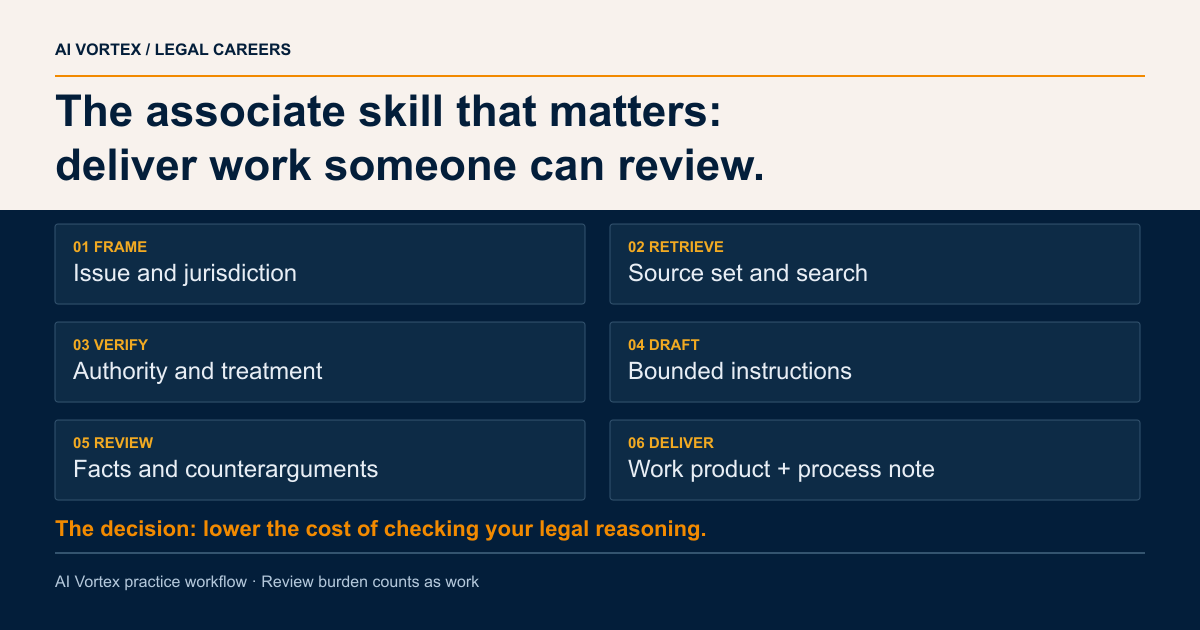
A six-stage research workflow
| Stage | Associate action | Evidence to retain |
|---|---|---|
| Frame | State the jurisdiction, question, facts, decision and deadline before opening a tool. | A short issue statement and scope note. |
| Retrieve | Use approved sources and an AI first pass only to widen questions or organize a search. | Search terms, databases, source date and tool boundary. |
| Verify | Open each material authority. Confirm existence, citation, jurisdiction, treatment and fit with the proposition. | A citation and treatment log with unresolved items. |
| Draft | Give the tool verified authorities and bounded instructions. Keep analysis separate from generated language. | The input source set and a marked first draft. |
| Review | Read against the record and the authorities. Test counterarguments, missing facts and unsupported conclusions. | Corrections, reviewer comments and final acceptance decision. |
| Deliver | Tell the supervising attorney what was done and disclose AI use when the applicable policy requires it. | A clean work product plus a concise process note. |
Practice with the parts that do not disappear
Recreate the handoff with a public opinion or synthetic exercise. Define the issue and jurisdiction before asking an approved tool for an outline. Retrieve the suggested authorities and test the fit of each material proposition. Keep the first draft so a reviewer can see what you changed.
There is a real tradeoff in the final package. A supervisor needs a readable answer, not a dump of prompts and raw output. But a clean answer that hides uncertainty forces the supervisor to reconstruct your reasoning. Deliver the concise analysis with a short record of material corrections, unresolved points and scope limits. Keep the longer working log available when needed.
Ask a qualified reviewer whether your note directs attention to the right issue. If you measure efficiency, include research, checking and rework. The exercise succeeds when another person can inspect your reasoning and decide the next step; draft speed alone does not show that.
What belongs in an associate work sample
Keep the sample permission-cleared and label simulations. Include the question, jurisdiction, source set, tool boundary, first-pass output, material errors, corrections, final work product and a short explanation of what you would escalate. If you claim a time improvement, compare the same scope and include verification time.
This kind of artifact demonstrates issue framing and judgment better than a list of model names. It also lets an interviewer ask useful questions: Why did you reject that authority? What would change if the facts changed? Which part of the workflow requires a licensed attorney? What did the tool fail to notice?
Use the legal AI career paths guide to choose a bounded practice problem. For employer-side context, read how AI affects associate hiring.
Questions to ask before joining a team
Ask how the team expects associates to surface an unresolved issue. Does the review process reward an early, well-defined question, or encourage a polished draft that arrives with its uncertainty hidden? Ask which tools and data uses are permitted, and where review feedback is recorded.
My standard for a good AI-assisted handoff is simple: the supervising attorney should be able to see the answer, its support and the decision still needed. Improve those three things before adding another tool to the workflow. The result may be less effortless-looking than a fluent first pass. It is more useful to the person who has to stand behind it.
Put one workflow on the record
The work-sample kit includes a completed synthetic chronology example, a reusable error log and a review handoff. No account or client data required.
Download the work-sample kit (.md)Questions and answers
Do I need to become a programmer?
Not for every associate role. Start with issue framing, source evaluation, communication and workflow discipline. Coding requirements depend on the position.
Can I use AI for a client memo?
Only within the firm's approved tools, policy and supervision process. Protect confidential information, verify the output and follow applicable professional rules.
What is the most important AI skill for a new associate?
Reliable verification. You need to know which source supports each material point and when the output must be corrected or escalated.
How can I show this skill without sharing client work?
Use a public opinion or synthetic facts, label the exercise, preserve your source and error log, and explain the review method and limitations.
Sources and scope
- O*NET Lawyers 23-1011.00. living occupational profile; checked 2026-09-08.
- ABA Formal Opinion 512. 2024-07-29; checked 2026-09-08.
U.S. occupational and professional sources inform this guide. Local rules, qualifications and employer requirements differ. Examples and practice plans are editorial proposals; they are not employment forecasts.
Editorial update. Corrects the title grammar, removes unsupported performance and hallucination-rate claims, and replaces tool-first advice with a source-checked associate delivery workflow.
Prepared with AI-assisted research and editorial verification for AI Vortex. Sources are linked where claims are made.