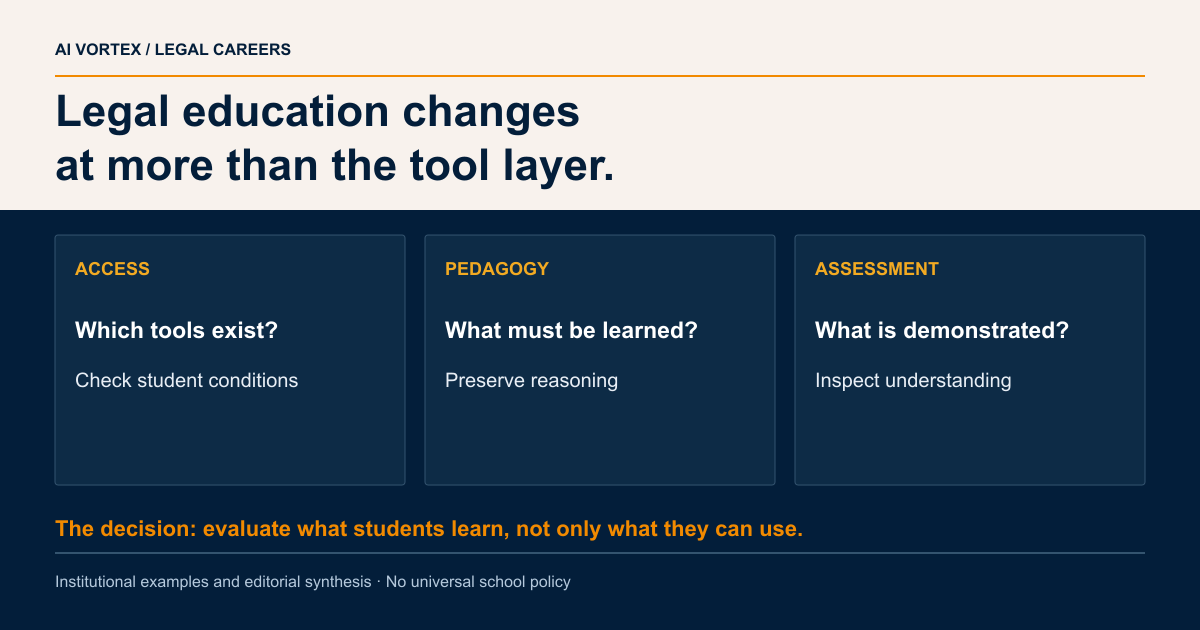
The difficult change is deciding what an assignment proves
A student submits a persuasive memo. The educator still needs to know whether the student can identify the issue, interpret the authority and explain why an alternative argument fails. When tools can contribute substantial text, the document alone may answer fewer of those questions. The educational problem is therefore larger than adding an AI elective.
Law schools have several decisions to make at once: what novices must learn, how they may use assistance, what an assessment demonstrates and how learning transfers into professional work. A single policy or software license cannot settle all four. Treating them separately makes disagreement more useful: two courses may choose different tool rules because they are teaching different things.
My starting point is the learning objective. Before asking which product belongs in a course, ask what the student should be able to do after the course and what evidence would demonstrate that ability.
Independent work can be a designed stage
Penn Carey Law’s account of its 2025–26 AI work describes first-year analytical writing that begins without AI before introducing targeted exercises using it. The sequence is the important detail. It makes room both for developing a first attempt and for learning to evaluate assistance. The account describes an educational approach; it does not establish that graduates outperform those at other schools.
That approach illustrates a choice educators can make explicitly. If a task is meant to develop issue recognition, immediately outsourcing the issue list can conceal the skill being taught. If a later task is meant to test critical evaluation, withholding every tool output can remove the object students need to evaluate.
Neither rule belongs automatically in every course. The instructor must decide which stage needs independence and which needs comparison, correction or explanation. Students also need to understand that sequence: a tool prohibited in one assignment may be deliberately introduced in another without either instruction being inconsistent.
Applied projects expose a different kind of understanding
Stanford’s January 2026 AI for Legal Help course announcement describes a two-quarter course connecting legal, design and technical work with legal-aid and court self-help partners. Its project framing includes evaluation, rather than stopping at producing a prototype. This is a particular course, not proof that every Stanford student follows the same curriculum or that a prototype is ready for public reliance.
A project can force questions that a polished answer leaves hidden. Who is the intended user? What information is missing? What happens when the tool answers outside its scope? Who can decide whether a response is usable? Those questions connect legal analysis to the conditions in which someone might act on it.
The tradeoff is instructional capacity. A realistic project needs feedback on more than writing quality. Without clear scope and review, students can spend the term making an attractive demonstration while learning little about its failures. Applied work earns its place when its assessment matches the decisions students are expected to make.
Four decisions that should not collapse into one AI policy
| Educational decision | Evidence to ask for | What it does not establish |
|---|---|---|
| Foundational reasoning | A student explains the issue and source relationship independently | That all later assistance should be prohibited |
| Tool-assisted evaluation | A student identifies and repairs a consequential output error | That the student can use every product |
| Assessment design | The submission and process reveal the intended skill | That an impressive document proves independent mastery |
| Practice transfer | The student can hand off uncertainty and explain the next check | That a graduate needs no supervision |
Assessment needs to reveal the reasoning it rewards
An educator could ask for an initial position, a source-supported revision and a short explanation of what changed. Another could use a discussion in which the student must defend a choice or respond to a changed fact. These are editorial design suggestions, not validated assessment instruments or requirements attributed to the schools above.
The value lies in matching evidence to the objective. If the goal is research judgment, a long tool transcript may be less useful than an explanation of why one authority was rejected. If the goal is independent writing, a retrospective explanation cannot automatically substitute for an independently produced draft. More process documentation is not always better assessment.
The cost is also real. Reviewing drafts and discussing revisions takes instructor time. A course should choose the smallest set of observations that makes its learning judgment defensible, rather than requiring students to document every interaction merely because the technology makes logs available.
Professional duties and examination requirements are separate constraints
ABA Formal Opinion 512 places professional judgment, competence and other duties around lawyers’ use of generative AI. For education, it provides a reason to teach students how to interrogate an output and recognize when information cannot safely or appropriately be used. It does not prescribe a law-school curriculum or certify a course as sufficient for practice.
Likewise, a course can prepare students for an examination while teaching additional skills for practice. Exam content, permitted assessment assistance and professional tool use are different questions. Use the NextGen route and skills guide to identify the relevant exam requirements; do not infer them from a school’s AI announcement.
This distinction prevents a misleading shortcut: a school adopting a tool is evidence of access or a program decision, not proof of student competence, hiring advantage or alignment with every jurisdiction’s admissions requirements.
Ask for the learning sequence, not the longest product list
A prospective student can ask a concrete question: show me an assignment where students first develop a legal position, then receive feedback or evaluate assistance, and explain how the final judgment is assessed. A faculty team can ask the same question of its own curriculum. The answer will reveal more than a count of AI offerings.
For named institutional examples, read the school curriculum comparison. For a current student facing a submission, the narrower issue is permission for that assignment. For the move into employment, the junior training guide considers how a supervisor can preserve the next learning step.
The educational decision should survive a product change. If a course can state what students must notice, explain and do under changed facts, it has a basis for evaluating a new tool. If it can only name the platform students used, the learning claim remains incomplete.
Questions and answers
Does every law school need the same AI curriculum?
No single sequence follows from the examples here. Courses and programs should identify their learning objectives, permitted uses and evidence of mastery.
Does access to an AI tool show career readiness?
Access is an input. Readiness requires evidence of legal reasoning, appropriate use, evaluation and supervised application; this article does not establish an employment advantage.
Sources and scope
- Penn Carey Law: Forging the Future, AI at Penn Carey Law. 2025–26 academic-year account; accessed 2026-09-08; checked 2026-09-08.
- Stanford Justice Innovation: AI + Legal Help 2026 class. 2026-01-05; checked 2026-09-08.
- ABA Formal Opinion 512. 2024-07-29; checked 2026-09-08.
U.S. occupational and professional sources inform this guide. Local rules, qualifications and employer requirements differ. Examples and practice plans are editorial proposals; they are not employment forecasts.
Editorial update. Replaces unsupported school rankings, universal graduate and employer claims, and product access as competence with a sourced analysis of educational design.
Prepared with AI-assisted research and editorial verification for AI Vortex. Sources are linked where claims are made.