
Flat fees didn’t kill it. Value billing didn’t kill it. Legal ops departments, pricing consultants, alternative fee arrangements, client surveys about “efficiency metrics.” None of it worked. For fifty years, the billable hour has outlasted every prediction of its death. Partners built careers on it, firms built empires on it, and roughly once every eighteen months somebody writes an article about why it’s finally over.
I wasn’t planning to be that person. But then I found the KPMG story.
What KPMG Did
Earlier this year, KPMG went to Grant Thornton UK, the firm that audits their books, and made a simple argument: AI makes your audit work faster now. We want the savings.
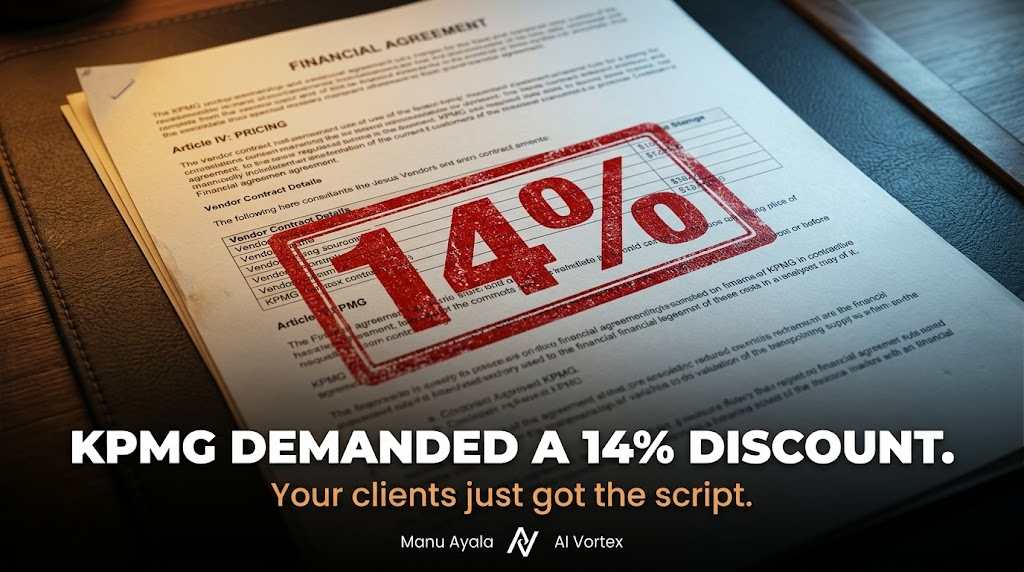
Grant Thornton pushed back. KPMG threatened to walk. Grant Thornton folded. The fee dropped from $416,000 to $357,000. A 14% cut. It’s in the UK Companies House filings. Public record.
Going Concern called it “a Pandora’s box filled with stingy clients.” They were right. But not for the reason they think.
The problem isn’t that KPMG negotiated a discount. Clients negotiate discounts all the time. The problem is the basis for the negotiation. KPMG didn’t argue about scope. They didn’t argue about value. They didn’t argue about the relationship. They argued about inputs. They told Grant Thornton they should be using AI to improve efficiency, and that those savings should be passed on.
KPMG dictated the inputs. Not the price. The process.
That argument was never available before.
Now think about who else just got the playbook.
Every General Counsel who reads the KPMG story. Every procurement department that benchmarks professional services fees. Every client who noticed that the contract review that used to take two weeks came back in two days but the invoice didn’t change.
“Your associates used AI to draft this. Why are you billing like they didn’t?”
That conversation is already happening. The only question is whether your firm sets the terms or gets them dictated.
The Visibility Trap
Here’s the thing nobody is saying about the billable hour. It was never surviving on merit. It was surviving on information asymmetry.
The client couldn’t see inside the engagement. They couldn’t know whether the brief took 20 hours or 40. They couldn’t know whether three associates worked on it or one associate and a template. They couldn’t verify the inputs. They could only see the output and the invoice. And the gap between those two things is where the margin lived.
This is what I’ve started calling the visibility trap, and it protected law firm economics for fifty years.
Flat fees didn’t spring the trap. They just moved the negotiation to a different stage. Value billing didn’t spring it either. Clients don’t know how to value legal work until after they need it, which is why value pricing in legal has never scaled beyond a handful of firms with extremely sophisticated client bases.
AI sprung the trap. Not by giving clients access to the tools. By changing the observable outputs in ways that reveal the inputs.
When a contract review that used to take two weeks comes back in two days, the client notices. When a memo that used to require a senior associate shows up formatted identically to last quarter’s memo with only the variables changed, the client notices. When the turnaround drops by 60% but the fee stays flat, the client does the arithmetic.
The billable hour isn’t dying because AI is faster. It’s dying because AI made speed visible. And visible speed is a negotiation weapon that every General Counsel now holds whether they asked for it or not.
KPMG was the first major company to use that weapon explicitly. They won’t be the last.
This Is Already Systemic
I built a set of tools that pull signals across industries. Most of what comes through is noise. But over the last 90 days, the same signal kept showing up from different directions inside professional services. Not AI product launches. Structural moves. The kind that change org charts and pricing models and don’t get reversed.
On April 7th, EY deployed agentic AI across its entire global audit practice. 130,000 professionals. 160,000 engagements. 150 countries. Not a pilot. Not “select teams.” End-to-end AI-assisted coverage expected by 2028.
PwC’s US CEO told partners publicly that anyone who resists AI “has no place at the firm.” They cut 5,600 positions last year while shifting hiring toward engineers. They’re converting tax and consulting services into AI subscription products that clients can use without a PwC employee involved at all.
Deloitte is replacing traditional job titles with capability-based tiers effective June 1st. The career ladder that defines identity inside a professional services firm (associate, senior, manager, partner) is getting restructured around AI.
KPMG’s Clara platform now has the capability to analyze 100% of audit transactions instead of sampling. When a machine can read every line item, sampling becomes a choice, not a constraint.
Then today. Bloomberg reported that entry-level roles at McKinsey, BCG, and Bain have dropped sharply over the last five years. Princeton graduates are skipping consulting entirely. One was quoted saying those entry-level jobs are “maybe slowly becoming obsolete.” The Big Three are restructuring from a pyramid to a diamond.
Meanwhile the practitioners are already living the tension. On r/Accounting, a thread about PwC’s mandate pulled 815 upvotes. The top comment: “I’ll be back in a few years when some AI-first audit firm has to blame anything but AI for missing something big.” In the same sub, an auditor shared this: one of their colleagues flagged a client’s PBC as incorrect. The proof? A screenshot from ChatGPT. The PBC was fine.
On r/legaltech, a lawyer put the economics more directly: “You pay for the tech AND you kill revenue.” The top reply: “The nature of knowledge work is that work expands to fill the time allotted.”
That’s not cynicism. That’s a structural description of why the billable hour persisted so long. The work expanded to fill the hours, and nobody could prove otherwise. Until now.
Four industries. Accounting, consulting, audit, tax. All running the same restructuring. All moving around the same line. Work that follows rules gets automated. Work that requires judgment stays human. The firms that figured out how to price the distinction are keeping their margins. The firms that didn’t are getting the KPMG call.
Last week I wrote about Sequoia Capital drawing that same line through legal work. Intelligence on one side, judgment on the other. Roughly $60 billion in legal transactional and paralegal work already mapped to what Sequoia calls autopilot territory. KPMG just showed what happens when clients can see which side of that line your invoice falls on.
Law runs the same pyramid as consulting and accounting. Same leverage model. Same economics where you hire a large class of juniors, bill them at 3-4x their compensation, and profit on the spread. If the junior layer gets compressed, that spread collapses.
What This Actually Means
The managing partners I’ve talked to over the past few months are still framing AI as a tool selection problem. Which platform should we buy? How do we train associates? What’s the ROI per seat?
Those were the right questions 18 months ago. The Big Four data says the question has moved.
It’s not which AI tool makes your team more productive. It’s what your firm looks like when your clients can see exactly how productive you’ve become and start pricing accordingly.
The firms that get ahead of this do one specific thing. They show clients where the machine stops and the human starts. They develop the language to explain which parts of an engagement are automated intelligence work and which parts are human judgment. They price those layers separately, transparently, before the client asks. That’s not a billing philosophy. That’s governance.
The firms that hide their AI usage don’t avoid the conversation. They lose control of it. Because the visibility trap works in both directions. When the client can see you got faster and you pretend you didn’t, the trust problem isn’t about AI. It’s about honesty. And procurement departments don’t negotiate with firms they don’t trust. They replace them.
The Big Four made their moves in public. Bloomberg confirmed the consulting parallel today. The pattern is documented, sourced, and spreading. The only profession in the leverage model that hasn’t answered the question yet is law.
The clients are doing the math. The question is whether your firm shows them the answer or they show you theirs.
And one morning the answer will arrive in an email from procurement. It’ll be polite. It’ll reference “efficiency gains in the market.” It’ll ask for a meeting to “discuss alignment on fees going forward.”
That’s not a negotiation. That’s a notification.