A convincing explanation is not a preparation result
An AI tutor can keep a study session moving. It can also make an incorrect explanation easier to accept because it sounds patient, specific and confident. The useful question is whether assistance helps you perform the next relevant task independently, not whether the conversation felt productive.
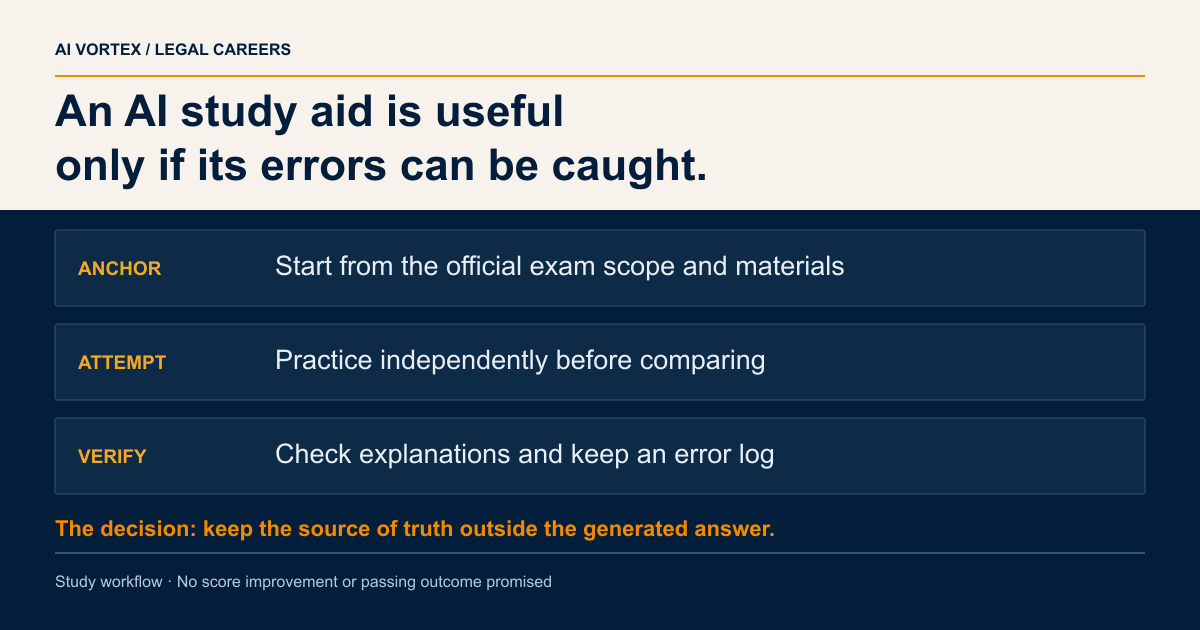
I would keep official exam materials and the applicable content scope as the reference point, then give AI a bounded supporting role. Use it to identify where your explanation is unclear or to suggest questions you should resolve. Do not make it the authority that invents the question, supplies the law and declares your answer correct.
This guide offers a study method, not evidence that a particular tool improves scores or reduces preparation time. No product ranking, tutor-equivalence claim or score forecast follows from the workflow below.
Confirm the examination before building the study routine
NCBE’s NextGen adoption table, last updated July 16, 2026 when checked for this guide, shows that adoption dates vary by jurisdiction. A 2026 study plan is not automatically a NextGen plan. Confirm the examination and administration date directly with your jurisdiction, including any local requirements.
NCBE’s official study-aid page separates NextGen, legacy bar-exam and MPRE materials. Its NextGen preparation page supplies official samples and preparation resources. Those distinctions matter because practicing an invented question in the wrong format can feel demanding without preparing you for the task you will actually face.
The separate NextGen skills and study-plan guide addresses route, scope and format in more detail. Set those boundaries first. This article concerns what to do with optional AI assistance inside an already correct study plan.
Attempt the task before asking for the explanation
Start with a question or exercise you are entitled to use. Work under the conditions relevant to the skill you are practicing and keep your initial answer. Then compare it with the official explanation or other authorized course reference. Identify whether the problem was rule recall, reading the facts, applying the rule, structure or time allocation.
Only then decide whether an AI interaction would add something. If the official explanation already resolves the mistake, another explanation may simply consume time. If you still cannot articulate the distinction, ask for help with that narrow gap using material you are permitted to enter into the tool. Access to a study resource does not itself establish permission to upload or reproduce it.
You can often describe your own confusion without copying a proprietary question. For example: “I keep restating a rule instead of explaining why a fact matters. Ask me questions about the connection; do not write the answer for me.” That prompt is an editorial suggestion, not a guarantee of reliable tutoring.
Choose the assistance by the error
| Study problem | Bounded use to consider | Check before relying on it |
|---|---|---|
| You cannot explain a distinction | Ask for questions that expose the missing step | Resolve the underlying rule against the authorized reference |
| Your written answer is disorganized | Ask where your own explanation changes topic or repeats itself | Keep the legal analysis and rubric comparison with you |
| You missed an issue | Ask what in your reasoning led you to exclude it | Use the official explanation to determine the relevant issue |
| You want a new practice variation | Treat a generated hypothetical as an uncalibrated exercise | Verify its premise and answer; do not count it as an official item |
Do not let the tutor become its own examiner
Suppose a student writes, “This fact satisfies the rule,” without explaining the connection. A tool responds that the answer is excellent. In this synthetic example, the praise has not repaired the missing reasoning. A more useful next action is to identify the exact fact, state the relevant part of the rule and explain why the relationship holds.
Now change a material fact and try again without assistance. If the student can only repeat the original explanation, the earlier conversation did not establish transferable understanding. If the student can explain why the change matters, that is useful evidence about this learning step, though still not a prediction of an exam score.
Generated grades are especially easy to overread. A number is not calibrated merely because it appears beside detailed feedback. Compare work with the actual assessment criteria and authorized examples, and seek qualified feedback when a consequential uncertainty remains. Do not average a chatbot’s grades into a forecast of passing.
Keep the error record smaller than the study session
An error log can be brief: the skill attempted, what you initially thought, the authoritative correction and the next task that will test it. Record an AI suggestion only when you have checked it and it changes what you will do. Otherwise the log becomes a second collection of unverified explanations.
Review recurring error types rather than counting messages or generated questions. Repeatedly missing a limiting fact suggests a different next exercise from repeatedly failing to recall a rule. That distinction helps allocate study time without pretending that conversational activity measures progress.
There is a tradeoff between immediate assistance and productive effort. Asking too soon can remove the attempt that would expose a misunderstanding; refusing help indefinitely can leave the misunderstanding intact. Make the first attempt, locate the gap and use assistance only as far as needed to return to independent work.
Separate private preparation from exam-day permission
The NextGen test-day policies address a secured testing environment and prohibit unauthorized assistance. A tool available during private study is not therefore permitted during an examination. Read the current NCBE and jurisdiction instructions for the examination you will take. Do not bring a study workflow into the test environment by assumption.
The same separation applies to material. Use public or properly licensed practice resources within their terms. Do not upload confidential, recalled or restricted examination content. When the input permission is uncertain, work with your own abstract description of the learning problem or use the resource as provided.
For the next study session, choose one official or authorized exercise, attempt it independently, resolve one error and schedule a fresh attempt that tests the same skill. Add AI only where you can state what it contributes and how you will check that contribution. A useful tool should return you to the task, not become the evidence that you have mastered it.
Questions and answers
Can AI replace a bar preparation course?
This guide does not establish that substitution. Evaluate coverage, official-format practice, reliable feedback and your own needs before changing your preparation resources.
Are AI-generated practice questions equivalent to official questions?
No equivalence is established here. Treat them as uncalibrated supplementary exercises whose legal premise and answer need checking.
May I use AI during the bar examination?
Do not infer permission from private study use. Follow current examination and jurisdiction rules; NextGen policies prohibit unauthorized assistance.
Sources and scope
- NCBE Official Study Aids. Current page; accessed 2026-09-08; checked 2026-09-08.
- NCBE Preparing for the NextGen UBE. Current page; accessed 2026-09-08; checked 2026-09-08.
- NCBE NextGen UBE Adoption by Jurisdiction. Table updated 2026-07-16; checked 2026-09-08.
- NCBE NextGen UBE Test-Day Policies. Current page; accessed 2026-09-08; checked 2026-09-08.
U.S. occupational and professional sources inform this guide. Local rules, qualifications and employer requirements differ. Examples and practice plans are editorial proposals; they are not employment forecasts.
Editorial update. Removes unverified time savings, tool pricing, tutor-equivalence, exam-quality question and universal permission claims. Replaces the product stack with an official-materials-based optional assistance workflow.
Prepared with AI-assisted research and editorial verification for AI Vortex. Sources are linked where claims are made.