
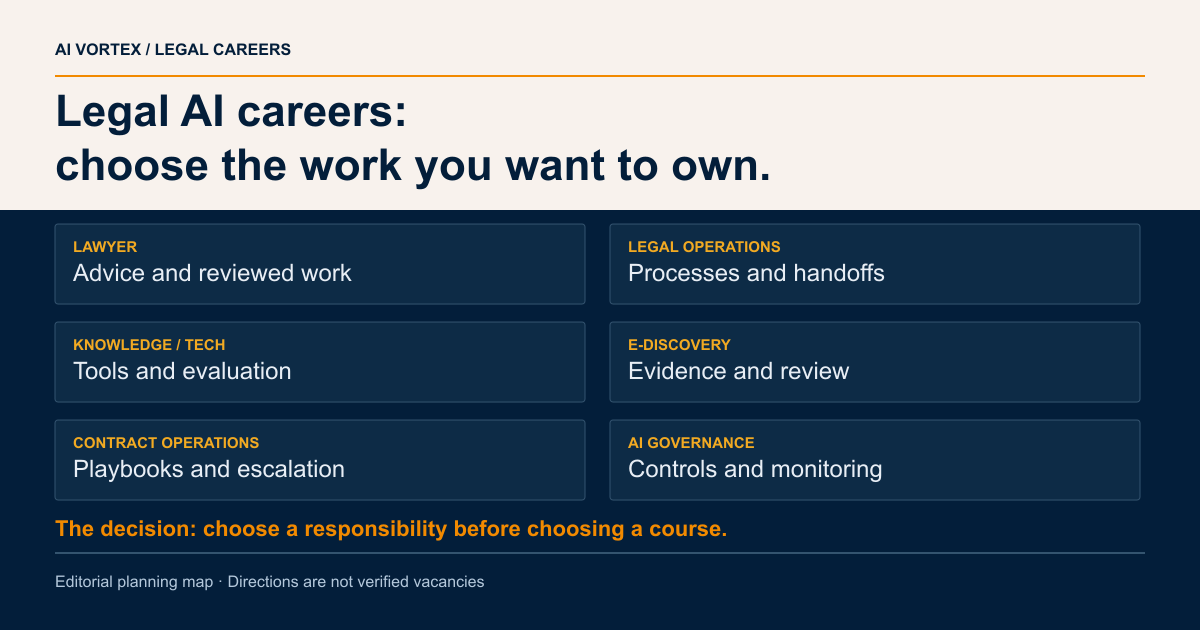
Choose a direction by its responsibilities
Legal AI creates a naming problem before it creates a clear career ladder. Work such as evaluating a knowledge system, maintaining a contract playbook or checking an automated research handoff can sit inside several titles. A familiar title can also conceal responsibilities you do not want to own.
I would choose the responsibility first. Decide whether you want to stand behind advice on a matter, improve a recurring process, maintain a technical system or govern its use. These are planning distinctions, with overlap in real organizations; they are not a verified taxonomy of vacancies. O*NET's lawyer and paralegal profiles provide the underlying occupational context.
Six directions, six different work samples
| Direction | Work to own | A useful practice artifact |
|---|---|---|
| Practicing lawyer with AI fluency | Issue framing, advice and accountable work product | A public-source research memo with a citation and treatment log |
| Legal operations | Intake, handoffs, measurement and process improvement | A workflow map with exception owners and a before/after measurement plan |
| Legal technology or knowledge work | Knowledge organization, tool configuration and evaluation | A small public-source knowledge set with test questions and recorded failures |
| E-discovery or litigation operations | Evidence handling, review coordination and validation | A synthetic review protocol with a documented quality-control sample |
| Contract operations | Intake, playbooks, repositories and escalation | A fictional contract intake and escalation map with versioned clause sources |
| AI governance and risk | Approved uses, data boundaries, monitoring and incidents | An example tool-use register with approval and incident paths |
Advice on a matter or ownership of a recurring process?
A lawyer working with AI still has to resolve the client's question: which facts matter, what the authorities support and which course of action to recommend. Legal operations asks a different recurring question: how should work enter the team, move between people and reach a reliable conclusion?
Imagine a fictional contract request arriving without a deadline or an identified business owner. The advising lawyer may need those facts to assess the matter. The operations person may redesign intake so the next request arrives with them. Contract operations adds a narrower responsibility: maintaining the playbook and deciding which departures need escalation.
If your strongest interest is in the substance of the advice, moving into process ownership may take you away from the work you value. If the repeated handoff failure bothers you more than the individual clause, that is useful evidence for the opposite choice. Check where authority actually sits in the job description: maintaining a process does not authorize legal advice.
A knowledge system and an evidence workflow fail differently
Knowledge and technology work may involve curating a source set, configuring retrieval and testing whether answers remain useful after a source changes. E-discovery work centers on handling and reviewing a defined evidence collection. Both need quality controls, but a helpful answer and a defensible record are different acceptance tests.
For a planning exercise, compare two failures. A research assistant retrieves an obsolete internal note; a document-review workflow excludes a relevant attachment. The first points toward source maintenance and retrieval evaluation. The second demands attention to collection completeness, review protocol and traceability. A shared interest in AI does not make those responsibilities interchangeable.
Domain experience is an asset here. Someone who can recognize the failure in a familiar workflow has a better starting point for practice than someone choosing a title because it sounds new. A transition may still be worthwhile, but budget for learning the underlying work as well as its tools.
Writing controls and operating them are separate commitments
AI governance can include permitted uses, approval conditions and incident handling. The daily operator has to make those controls work when an exception arrives. A register that names an owner is useful only if that person can make the decision, receive the necessary information and stop the workflow.
Before choosing a governance path, find out whether the role can influence implementation or only document policy. Before choosing an implementation role, find out who will resolve the exceptions you uncover. The tradeoff is responsibility without enough authority: either path can expose it, and a course cannot fix the reporting structure.
The table above is a starting map. These contrasts are the selection test. Reject a direction when you dislike its recurring decisions or cannot see a path to the required domain knowledge; then use a work sample to test the remaining choice.
Match the path to your starting point
Law students and new lawyers: protect time for doctrine, research and supervised feedback. A convincing output is not evidence that you understood the authority. Start with AI skills for new associates.
Paralegals: choose a task you know well enough to inspect. Records, chronologies and document organization can support a useful practice exercise using public or synthetic materials. Follow the paralegal learning workflow.
Experienced lawyers and operations professionals: begin with the recurring handoff or review failure you can define precisely. A transition into technology or governance may require additional skills and a different job market. A course alone does not establish readiness.
Practicing law requires the relevant qualifications and authorization. An operational or technology title does not confer permission to advise clients.
A twelve-week practice plan
Twelve weeks is a suggested learning schedule. It is not a promise of qualification, hiring or promotion. Extend a stage when the review exposes gaps.
- Weeks 1–2: define the task. Choose public or synthetic inputs, a named intended user and a clear acceptance test. Record your starting process before introducing a tool.
- Weeks 3–5: test a first pass. Keep the inputs and instructions stable enough to compare runs. Record missing facts, unsupported conclusions and source errors.
- Weeks 6–8: improve the review. Explain which checks catch which failures. Ask a qualified reviewer or instructor for feedback appropriate to the exercise.
- Weeks 9–10: document the handoff. Produce the reviewed artifact, a short error log and an explanation of when the workflow must stop or escalate.
- Weeks 11–12: prepare the work sample. Remove confidential or proprietary material. State the task, your contribution, measured results and limitations. Label simulations clearly.
What your evidence log should contain
Keep the source set and its date, the permitted tool and configuration, first-pass output, material errors, corrections, review time and final decision. Record failed runs as well as successful ones. If you claim a time improvement, compare the same scope and include review and rework.
The ABA's AI guidance supports attention to capabilities, limitations and verification. It does not endorse this training schedule or guarantee that an employer values a particular portfolio.
A work sample becomes more credible when you can explain what you rejected and why. A polished draft with no account of its sources tells a reviewer very little about your judgment.
Choose training after choosing the gap
Compare the syllabus with the task you cannot yet perform. Ask whether the course includes a hands-on exercise, review of failed output, feedback from an appropriate instructor and a clear description of the credential awarded.
Separate a professional credential, a course completion certificate and a vendor's product qualification. They answer different questions. The certification guide explains how to evaluate those differences without assuming a salary premium.
Before paying, verify current eligibility, fees, access requirements, renewal obligations and whether your employer or jurisdiction recognizes the course for the purpose you need.
Use labor projections for context
BLS's current lawyer profile uses the 2025–2035 projection period. It describes an occupation across the U.S.; it cannot tell you whether a particular firm's legal AI role will exist or whether your application will succeed.
For exposure and employment uncertainty, read which legal jobs are safe from AI. Use this page for the next decision: select one direction, define one practice artifact and arrange a meaningful review.
Put one workflow on the record
The work-sample kit includes a completed synthetic chronology example, a reusable error log and a review handoff. No account or client data required.
Download the work-sample kit (.md)Questions and answers
Do I need to become a programmer?
Not for every path. Coding requirements depend on the position. Process design, source evaluation, communication and technical fluency may be more relevant to an operations or knowledge role.
Does an AI certificate qualify me for a legal role?
No universal qualification follows from an AI certificate. Verify the actual credential, role requirements and any professional licensing rules. A completion certificate establishes only what its issuer assesses.
What belongs in a legal AI portfolio?
A permission-cleared task, source record, your contribution, review method, corrected result and honest limitations. Use public or synthetic materials when you do not have explicit permission to share real work.
Can this plan make my job safe?
No. It is a way to develop and demonstrate skills. Staffing, budgets, demand and employer choices remain outside the plan.
Sources and scope
- O*NET Lawyers 23-1011.00. living occupational profile; checked 2026-09-08.
- O*NET Paralegals 23-2011.00. living occupational profile; checked 2026-09-08.
- ABA Formal Opinion 512. 2024-07-29; checked 2026-09-08.
- BLS Occupational Outlook Handbook: Lawyers. 2026-08-27; checked 2026-09-08.
U.S. occupational and professional sources inform this guide. Local rules, qualifications and employer requirements differ. Examples and practice plans are editorial proposals; they are not employment forecasts.
Editorial update. This refresh updates the BLS projection vintage, removes repeated introductory answers and replaces an unrelated consulting next step with a practical skill-development path.
Prepared with AI-assisted research and editorial verification for AI Vortex. Sources are linked where claims are made.