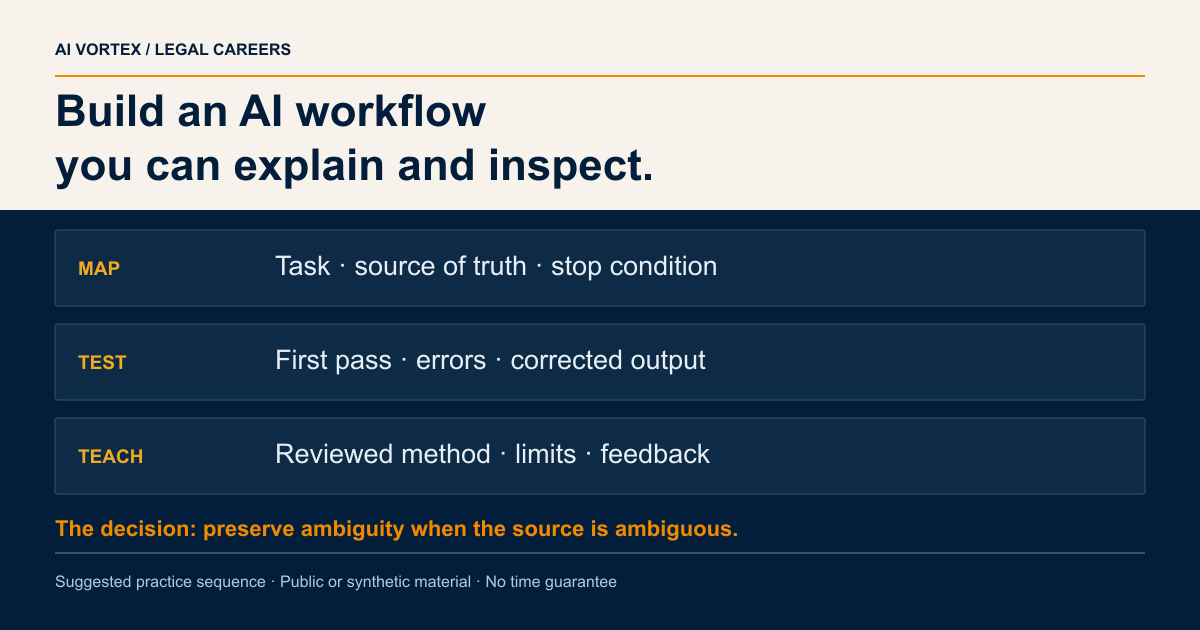
AI literacy is supervised task judgment
An AI-literate paralegal can describe what a tool is allowed to do, inspect its output, recognize a missing fact or source, and escalate before the work reaches an attorney or client. That is more specific than knowing a prompt trick. O*NET's paralegal profile includes records, research, trial preparation and client interaction; the right learning exercise should connect to a real responsibility.
Use only an employer-approved tool and follow the firm's data classification and retention rules. Do not put client, privileged or confidential material into a consumer system because a demonstration looks convenient. ABA Formal Opinion 512 addresses competence, confidentiality, communication and supervision for lawyers using generative AI. It does not turn a paralegal into an unsupervised legal adviser.
An illustrative chronology check
Suppose a synthetic file contains an email saying a meeting occurred on May 6, a letter dating the same meeting to May 5 and an undated attachment. A generated chronology dates the meeting and the attachment to May 6. Your job is to preserve the source for each date, mark the attachment as undated and flag the conflict for review. Do not resolve it by choosing the most plausible story.
A useful log has four columns: source identifier, stated event, date as written and unresolved issue. Keep extracted facts separate from your interpretation. This small example tests a specific skill: recognizing when apparently tidy output has erased uncertainty.
The apparent improvement is also the danger: the table looks more orderly than the evidence. If you reward completeness without checking provenance, you reward the tool for concealing a gap. The right correction keeps the uncertainty visible so the attorney can decide whether another record or inquiry is needed.
An acceptance test for this synthetic exercise is concrete: every dated entry points to its source, the undated attachment remains undated, and the conflicting dates remain flagged. A reviewer must be able to reproduce those checks. Reaching day ninety does not substitute for passing them.
Advance when the evidence supports the next step
The schedule below is a suggested way to organize practice. Use the chronology test to decide when to advance: first preserve source facts, then detect errors across varied examples, then explain the review to another person. Extend a stage when the evidence is weak. Reliable performance on a practice set still does not authorize use on a live matter.
| Period | Work | Exit evidence |
|---|---|---|
| Days 1–14: map | Choose one recurring task, write the current process and define what the tool must never decide. | Task map, permission check, acceptance criteria and escalation owner. |
| Days 15–30: test | Use public or synthetic material in an approved environment. Run the same bounded task several times. | Source set, instructions, outputs and failure log. |
| Days 31–60: review | Compare output with the record. Check dates, names, citations, missing documents, privilege flags and formatting. | Corrected artifact, reviewer comments and reviewed-work time. |
| Days 61–75: standardize | Turn the safe part into a checklist or prompt template. Mark conditions that require a human stop. | Versioned checklist, known limitations and escalation path. |
| Days 76–90: teach | Show a colleague the workflow using synthetic examples. Invite challenge and revise the checklist. | Short training note, questions raised and changes made. |
Choose a task you can inspect
Good first exercises are document indexing, a public-record chronology, an internal matter-status checklist or a synthetic intake summary. The task should have a visible source of truth and a clear reviewer. Avoid starting with advice, privilege decisions, client communications or a high-consequence filing unless the responsible attorney defines the controls and reviews the work.
Measure time to reviewed work, not time to first output. Record material errors, rework, missing context and the number of items escalated. If the workflow is faster but creates more correction work, say so.
Set stop conditions before the test: missing sources, ambiguous identities and requests outside the agreed task go to a reviewer. An unresolved item belongs in the handoff. The objective is to make it visible, not to make every field look complete.
Use credentials as a layer, not a shortcut
Once the exercise reveals a gap, decide whether training would address it. Difficulty understanding the records, operating the platform and checking generated output are different problems. Use the credential guide when the gap calls for structured study or a role requires a designation.
Keep the corrected artifact and error log alongside any certificate. One records an issuer's assessment; the other lets a supervisor inspect how you handled this task.
Position the skill without overclaiming
Describe the workflow precisely: “I built a synthetic chronology checklist, tested it on public records and documented the corrections.” Avoid “AI expert” unless you can explain the tools, boundaries and review. If your firm has an AI committee, volunteer for a bounded improvement with an attorney or operations owner. Teaching a process before it is tested spreads errors.
Use the career paths guide to compare adjacent directions such as legal operations, e-discovery and governance. An AI-literate paralegal may develop toward those paths, but the next role still has its own requirements and market.
Make the handoff visible to the person who bears responsibility. Explain which fields were generated, which were checked against the record and which still need attorney judgment. This keeps AI literacy connected to matter quality instead of turning it into a personal branding exercise.
Put one workflow on the record
The work-sample kit includes a completed synthetic chronology example, a reusable error log and a review handoff. No account or client data required.
Download the work-sample kit (.md)Questions and answers
Do I need to learn every AI tool?
No. Start with one approved tool and one recurring task. Learn the workflow, failure modes and review method before expanding.
Can I practice with real matters?
Only with explicit authorization, an approved environment, a defined reviewer and controls for confidential or privileged information. Public or synthetic material is safer for a portfolio.
How do I prove AI literacy?
Show a bounded task, source record, first pass, error log, corrections, review time and escalation rule. A credential can supplement that evidence.
Will AI literacy guarantee a raise or promotion?
No. It can make a capability visible, but compensation and advancement depend on the employer, role, market and quality of your work.
Sources and scope
- O*NET Paralegals 23-2011.00. living occupational profile; checked 2026-09-08.
- ABA Formal Opinion 512. 2024-07-29; checked 2026-09-08.
U.S. occupational and professional sources inform this guide. Local rules, qualifications and employer requirements differ. Examples and practice plans are editorial proposals; they are not employment forecasts.
Editorial update. Corrects the title grammar, removes unsupported twice-the-output, salary and three-month guarantees, and replaces tool-first advice with a supervised 90-day task workflow.
Prepared with AI-assisted research and editorial verification for AI Vortex. Sources are linked where claims are made.