Access to a tool is only one part of the curriculum
A school can provide an AI account without explaining how students should evaluate its output. It can also restrict AI during foundational exercises while teaching it in clinics or advanced courses. Those are different educational choices, and a list of software licenses misses the distinction.
This guide compares three official institutional accounts checked September 8, 2026. The sample illustrates teaching models; it is not a census of U.S. law schools, a quality ranking or a claim that graduates from these programs have better employment outcomes.
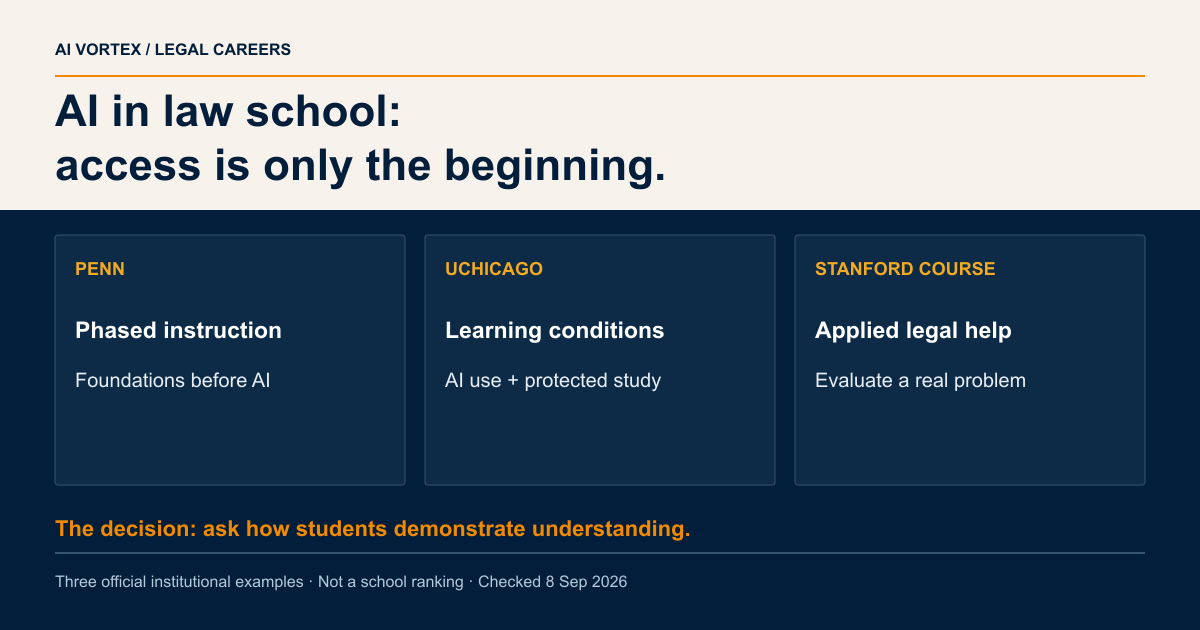
Penn: introduce tools around foundational legal work
Penn Carey Law's account describes first-year legal practice instruction that starts with analytical writing without AI and introduces targeted AI exercises later. It also reports Harvey access for 2Ls, 3Ls and LLMs beginning in Spring 2026.
The useful distinction is between access and sequence. A prospective student should ask which assignments build independent legal reasoning, when tool use is introduced and how instructors check the result. The account describes the school's approach; it does not provide a controlled evaluation of the program's effect on learning or hiring.
Chicago: AI instruction alongside protected learning conditions
UChicago's July 9, 2026 strategy announcement combines responsible AI instruction with measures intended to protect foundational learning. It describes a fall-quarter pilot generally prohibiting electronic devices in core 1L classes, with limited exceptions, and oral discussion of substantial research papers. It also describes AI use in clinics.
It would be inaccurate to summarize this as either a blanket AI ban or unrestricted AI adoption. The policy distinguishes settings. Confirm the current course rules and any accommodation process directly with the school; an announcement is not every instructor's syllabus.
Stanford: build and evaluate a public-interest deliverable
The January 2026 AI for Legal Help course description presents a two-quarter interdisciplinary class working with legal aid organizations and court self-help centers. Proposed deliverables include evaluation rubrics, datasets, research reports and system concepts.
This example adds another lens: students can learn by deciding whether a tool fits a real service problem and by documenting its limits. The description is about a specific course, not a requirement for all Stanford law students or proof that every proposed system was deployed.
The shared problem is proving who did the thinking
Read together, the three designs expose a tension that a list of AI partnerships cannot. The student needs to learn how to produce useful legal work with assistance and how to recognize when that assistance is wrong. A polished submission can conceal the difference.
Penn's sequence makes independent work a foundation for later tool use. Chicago's announced approach protects some learning conditions and uses discussion of research to test understanding. The Stanford course puts evaluation inside a service problem, where the proposed system has to answer to constraints beyond the classroom. Those are interpretations of the reported designs, not measured claims about their success.
Withholding assistance creates room to practice a skill that might otherwise be skipped; introducing it creates opportunities to encounter and examine tool failures. Both choices have a cost. A course that never permits the tool may leave its failure modes unexplored. A course that only grades the final document may struggle to show what the student actually understands.
I would give more weight to the assessment than the license. Ask what a student must explain, correct or defend, and who gives feedback. A concrete answer makes the educational promise inspectable. Access alone leaves that promise unresolved.
Compare programs by the evidence of learning
| Question | Evidence to request | What it does not establish |
|---|---|---|
| Who gets access? | Eligibility, course enrollment and current product access terms | That every student receives the same training |
| What must students do independently? | Assignment policy and foundational exercises | That all AI use is prohibited |
| How is output checked? | Source-verification rubric, oral explanation or reviewed work sample | That a polished submission is accurate |
| Is there real feedback? | Instructor, clinical supervisor or partner review process | That tool access alone teaches judgment |
| What can leave the classroom? | Permission and confidentiality rules for portfolios | That client or school material may be shared publicly |
Use the comparison for a concrete enrollment decision
If you are choosing an elective, identify the gap it should fill: legal research, evaluating automated output, workflow design, product development or the law governing AI. Those topics overlap, but one course may not cover all of them. Ask for a recent syllabus and an example of the assessed work.
If you are choosing a degree program, AI access should sit alongside the larger decision: academic fit, cost, location, clinical opportunities and the school's published employment disclosures. The sources reviewed here do not establish an AI-specific placement premium.
If you already have access through your school, read the assignment policy before using it. A permitted use in one course may be prohibited in another. For a practice plan outside assessed coursework, use the career-path guide and keep the exercise within school rules.
What would change this comparison
A revised syllabus, a new access policy or an evaluation of student learning could change the findings. A vendor partnership announcement alone would add an access signal; it would not prove educational effectiveness.
For the transition into practice, the associate skills guide focuses on reviewed work product. For hiring conditions, use the hiring evidence guide rather than inferring employment outcomes from a curriculum announcement.
Questions and answers
Are all law schools making AI mandatory?
The three institutional sources reviewed do not support that claim. They describe specific courses, access arrangements and policies. Check the current rules at the school and course you are considering.
Does a Harvey license make a law school better?
A license establishes access under stated conditions. Teaching quality also depends on instruction, practice, feedback and assessment. The sources here do not establish a ranking or hiring advantage.
Can I put AI-assisted coursework in a portfolio?
Check course rules, ownership and permission first. Do not share client, clinic or restricted school material. Explain your contribution and label synthetic exercises.
Sources and scope
- Penn Carey Law: Forging the Future. 2025–2026 academic-year account; checked 2026-09-08.
- UChicago Law: new AI strategy. 2026-07-09; checked 2026-09-08.
- Stanford Justice Innovation: AI + Legal Help class. 2026-01-05; checked 2026-09-08.
U.S. occupational and professional sources inform this guide. Local rules, qualifications and employer requirements differ. Examples and practice plans are editorial proposals; they are not employment forecasts.
Editorial update. This refresh replaces unsupported schoolwide and hiring-outcome claims with three dated institutional examples and a practical program-evaluation matrix.
Prepared with AI-assisted research and editorial verification for AI Vortex. Sources are linked where claims are made.