The short answer
Not yet hurt, but exposed. NALP reports a 92.8% employment rate for the Class of 2025, the second highest it has recorded, and a record 84.6% in jobs that require or anticipate bar admission. The leading indicator is firm planning: in a Citi and Hildebrandt survey, 86% of large firms plan to grow associate ranks through 2027, but only 35% plan to grow first-year classes.
The first number says the class that just graduated found work. The second says firms intend to hire fewer people at the bottom. Both are true. For the lawyer-side question, see will AI replace lawyers.
What the Class of 2025 data shows
From NALP's Class of 2025 Selected Findings (released August 5, 2026; measured March 16, 2026, about ten months after graduation):
- 92.8% employed, down 0.6 point from the Class of 2024 record of 93.4%.
- 84.6% in bar-required or bar-anticipated jobs, the highest since NALP introduced its current classifications in 2001.
- The entry-level market contracted by about 2,700 jobs, and NALP puts national hiring at -7.7% against the larger Class of 2024. NALP's release cites economic uncertainty, federal hiring disruptions and shifting employer demand; it does not name AI as a cause.
- Federal government hiring fell 37%, from nearly 1,100 graduates to about 690.
- Firms of more than 500 lawyers hired about 540 fewer graduates. Median salary reached a record $100,000; private practice median was $155,000 and $225,000 at firms of 500+ lawyers.
Read the 92.8% carefully. It is an employment rate, and the class got smaller, which helps the rate. It shows no AI-driven collapse in entry-level work so far. It also does not measure the future.
What the firm planning data shows
The Citi Global Wealth at Work and Hildebrandt Consulting report, covered by Law360 Pulse on December 15, 2025, surveyed 195 U.S. and U.K. firms. Besides the 86% versus 35% gap, the report says firms will move to "a more senior demographic" of associates over the next two years, and expects repetitive, low-value work to shift to technology.
This is a forecast by firm leaders. It is the best available signal of where first-year hiring is headed, and it points down relative to associate growth.
Task-by-task risk for junior associates
Exposure ratings are editorial judgments, not measured probabilities.
| Junior associate task | Exposure to AI first pass | What the junior still brings |
|---|---|---|
| Document review and diligence | High | Spotting what the protocol missed and issues that change the deal or case |
| Legal research memos | High | Verifying every authority and applying it to the client's facts |
| First drafts of motions and contracts | High | Fitting the draft to the judge, counterparty and partner's strategy |
| Deposition and record summaries | High | Knowing which testimony matters to the theory of the case |
| Client communication | Lower | Trust, tone and the questions clients do not ask out loud |
| Hearings, closings and negotiations | Lower | Live judgment and accountability under the lawyer's own name |
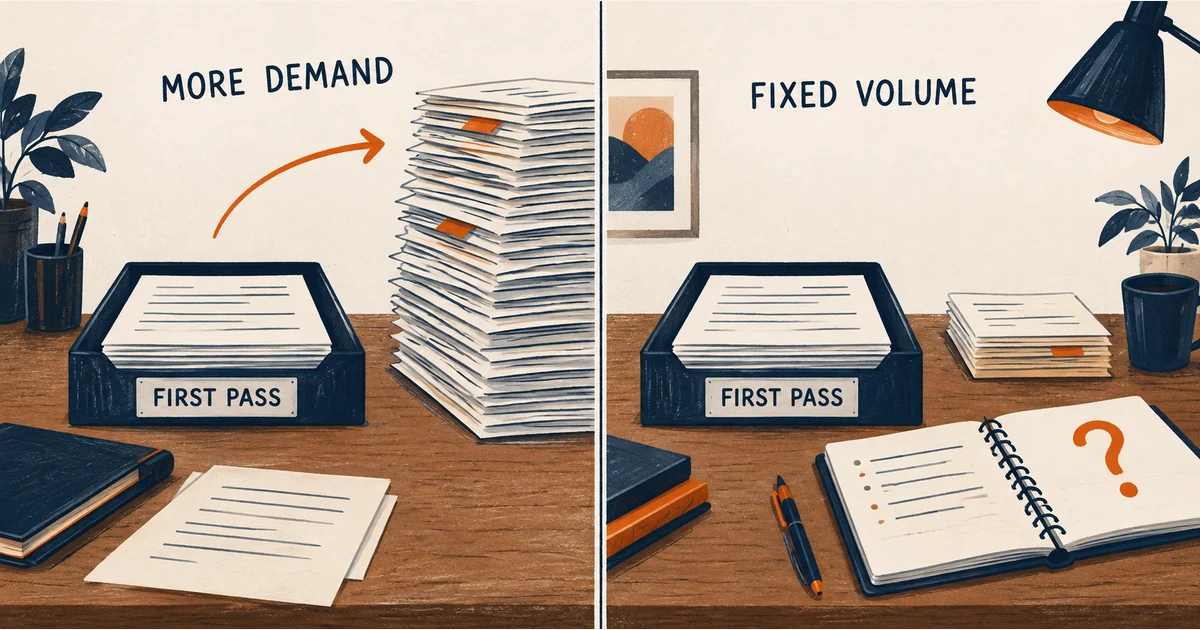
The risk for juniors is not that the work vanishes. It is that the first pass, where juniors used to learn, gets cheaper, so there are fewer paid places to learn. See training junior lawyers when AI changes the first draft and AI vs junior associates.
What the long-run data says about lawyers
BLS projects 5% growth for lawyers from 2025 to 2035, about 40,600 jobs on a base of 863,700, with roughly 28,700 openings a year (BLS lawyers page, May 2025 pay data). BLS says "some routine legal work may be automated" and that this efficiency is not expected to reduce overall demand for lawyers. Median lawyer pay was $159,670 in May 2025. BLS is a projection built on past patterns; it does not capture a sharp change in firm hiring.
What to do as a law student
- Get reviewed work experience. A clinic, summer job or externship where you verify AI output is a work sample.
- Learn the verification habits. ABA Formal Opinion 512 puts competence and supervision on the lawyer. See AI skills for new associates.
- Ask employers about the first year. What will I do, who reviews it and how will I be trained?
- Do not choose a specialty only on an exposure ranking. Use the which legal jobs are safe from AI framework alongside interest and local hiring.
- Practice with the tools. Start with AI tools for law students.
Questions and answers
Will AI take junior associate jobs?
The Class of 2025 had a 92.8% employment rate, the second highest NALP has recorded. But in a Citi and Hildebrandt survey only 35% of large firms plan to grow first-year classes, against 86% planning to grow associate ranks through 2027.
What was the law graduate employment rate in 2025?
NALP reports 92.8% for the Class of 2025, measured March 16, 2026. That is down 0.6 point from the Class of 2024 record of 93.4%. 84.6% held jobs requiring or anticipating bar admission.
Did entry-level legal hiring fall in 2025?
Yes. NALP says the entry-level market contracted by about 2,700 jobs compared with the Class of 2024, including a 37% drop in federal government hiring. NALP's release cites economic uncertainty, federal hiring disruptions and shifting employer demand, and does not name AI as a cause.
How much do new law graduates earn?
NALP's median salary for the Class of 2025 was $100,000, a record. In private practice the median was $155,000, and $225,000 at firms of more than 500 lawyers.
Is law school still worth it with AI?
BLS projects 5% growth for lawyers through 2035 and says automation is not expected to reduce overall demand. Weigh that against the debt, the first-year hiring gap and your own target employers.
Sources and scope
- NALP, Employment for the Class of 2025: Selected Findings. Released 2026-08-05; data as of 2026-03-16; checked 2026-10-21. Full Jobs & JDs report due October 2026.
- Law360 Pulse: Law Firms' Junior Roles At Risk From AI, Report Says (Citi Global Wealth at Work and Hildebrandt Consulting). Article dated 2025-12-15 covering the report released around 2025-12-11; survey of 195 U.S. and U.K. firms; checked 2026-10-21.
- BLS Occupational Outlook Handbook: Lawyers. Page dated 2026-08-27; checked 2026-10-21. May 2025 pay data; 2025-2035 projections.
- ABA Formal Opinion 512. 2024-07-29.
U.S. occupational and professional sources inform this guide. Local rules, qualifications and employer requirements differ. Exposure ratings in the tables are editorial judgments for a task audit; they are not measured automation probabilities or employment forecasts.
Prepared with AI-assisted research and editorial verification for AI Vortex. Sources are linked where claims are made.