
 By
By 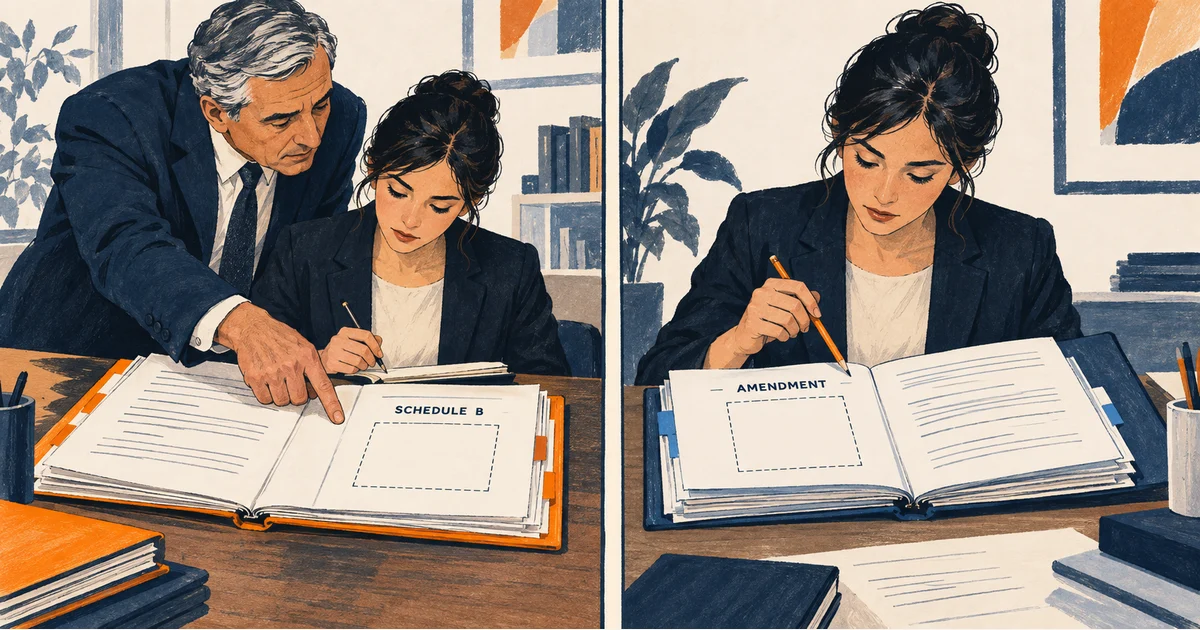
The assignment has two outputs
A junior lawyer's assignment produces work for a matter and practice for the person doing it. Those outputs overlap, but they are not identical. A supervisor can receive a better-looking draft while learning less about how the junior reached the answer. A junior can complete a useful learning attempt that still needs substantial correction before it is fit for a matter.
When an AI tool changes the first pass, the supervisor has to decide which reasoning the junior should still attempt and where feedback will occur. Leaving that decision implicit makes learning depend on whatever work remains after the tool has run.
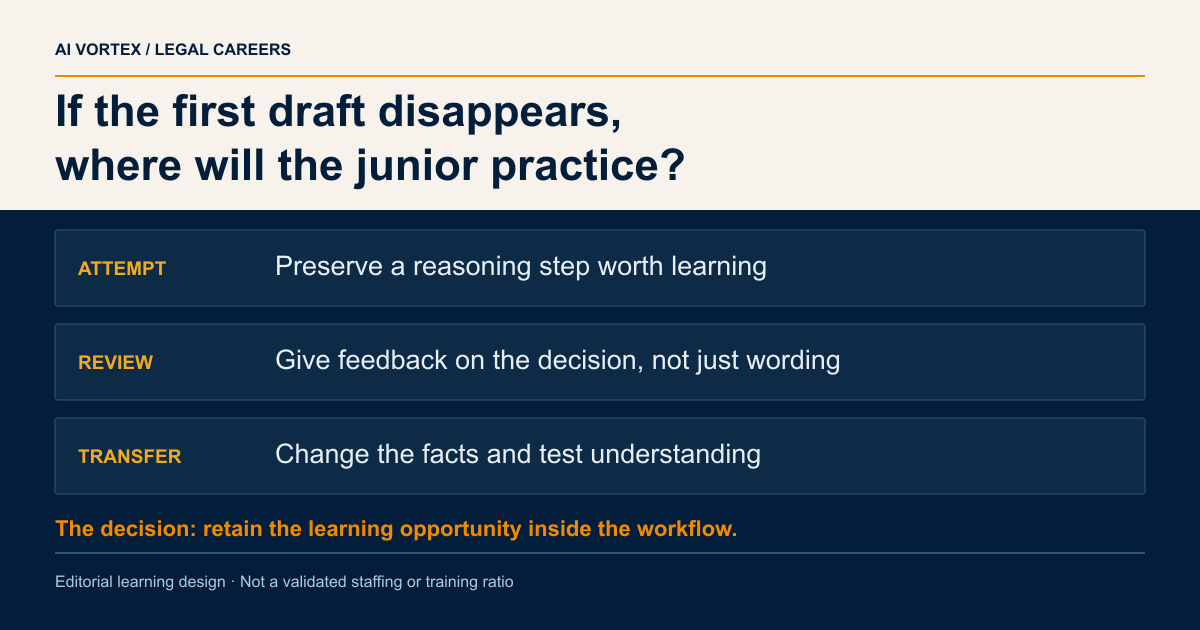
I would redesign one assignment before announcing another training program. Name a reasoning step, arrange time to review it and use a second task to see whether the correction transfers. The sequence here is an editorial proposal for supervisors, not evidence that a particular curriculum improves retention, promotion or productivity.
Protected practice and recognized time are different design choices
Penn Carey Law describes a first analytical writing assignment completed without AI before later targeted exercises. That is a school example of sequencing practice, not proof that firms should reproduce its curriculum or withhold every tool.
Ropes & Gray’s current AI page describes a TrAIlblazers track allowing first-year associates to devote 20 percent of creditable time to learning and innovating with AI. The figure describes the firm's stated allocation, not time billed to clients or an independently demonstrated learning gain. In a December 17, 2025 firm podcast, a participant emphasizes understanding a task manually before relying on assistance.
These examples address different constraints. Sequencing creates an opportunity to attempt the reasoning. Recognizing time makes room for it in the work model. A team may need both, but neither tells the supervisor whether a particular junior can now spot the issue they missed last week.
Preserve a decision, not every manual action
Consider a fictional contract-review exercise. A clause refers to an exception in a schedule, but the schedule is absent from the packet. The tool's summary says the obligation has no exceptions. Before showing that summary, ask the junior what materials are needed to describe the obligation accurately.
The learning target is recognizing that the missing schedule limits the conclusion. It is not retyping the contract. Once the junior has attempted the question, introduce the generated summary and ask what should change. A useful correction says the packet is incomplete and identifies the document needed; it does not silently choose the narrower or broader interpretation.
This design has a cost: the supervisor must prepare the exercise and inspect the answer. It can also avoid wasting practice on a step unrelated to the learning objective. Choose the portion of the task deliberately rather than equating all manual effort with learning.
A short assignment cycle the supervisor can inspect
| Stage | Supervisor’s instruction | Evidence of learning to look for |
|---|---|---|
| Before assistance | Identify the decision and the sources needed | The junior notices what the packet cannot establish |
| With assistance | Review the generated summary against the packet | The junior locates the unsupported conclusion |
| Feedback | Explain why the correction changes the handoff | The junior separates missing information from a substantive answer |
| Next attempt | Change the location or nature of the missing item | The junior applies the principle without copying the first answer |
| Matter transfer | Define permitted use and supervision for actual work | The responsible reviewer accepts the bounded task and escalation path |
Feedback must address the decision the junior made
‘Check your sources’ is difficult to act on when the junior does not know what was missed. A more useful response identifies the step: ‘You treated the main clause as complete even though it incorporates a missing schedule. Your next action is to identify that missing source before describing the exception.’ The learner can now attempt a correction tied to an observable decision.
Do not confuse a corrected document with a corrected mental model. The junior may have followed the supervisor's edit without understanding why it mattered. Ask them to explain what the record permits and what additional information could change the answer. Then alter the exercise so the same principle appears in a less familiar form.
For instance, the next fictional packet could contain the schedule but omit the amendment that changes it. A learner who merely memorized ‘ask for the schedule’ will struggle. A learner examining completeness should notice the new dependency. This is a proposed teaching comparison, not a claim that one pair of exercises establishes professional competence.
Make the supervision cost visible
Protecting practice requires review capacity. If the only senior reviewer is already overloaded, adding more generated exercises can enlarge the queue instead of improving learning. Select a small task the reviewer can actually discuss, and record the time needed to prepare, inspect and revisit it.
Track the kind of error and the next attempt, not only course attendance or tool usage. A pattern of unresolved source gaps calls for different feedback from sound analysis presented poorly. A change in a small practice set should be described as exactly that; it is not evidence of reduced malpractice risk or a better promotion pipeline.
Keep learning records appropriate to their purpose and access limits. Explain to the junior whether an exercise is developmental and how it will be used. Do not quietly turn an informal learning attempt into a high-stakes rating with criteria the learner never saw.
The next assignment is the test of the teaching
Use the synthetic review lab for a first rehearsal with synthetic material. The explanations are public, so change the exercise before using it to inspect transfer. The associate handoff guide shows the candidate-facing work product; the work-sample scorecard addresses a different setting, selection, with different assessment requirements.
My standard for this teaching cycle is whether the supervisor can name the decision practiced, the feedback given and the evidence still missing. If the only result is a polished draft or a completed module, the learning remains uncertain. Preserve enough of the work to make the next independent decision visible, then adjust the assignment when the evidence warrants it.
Questions and answers
Should juniors complete all work without AI first?
Not as a universal rule. Select the reasoning step the assignment is meant to develop and choose conditions that let the junior demonstrate it.
Does protected training time prove a program works?
No. It creates capacity for learning. Review of performance and transfer to another appropriate task is still needed.
Can synthetic exercises replace supervised matter experience?
No. They can isolate a learning problem, but actual work requires its own authorization, context and supervision.
What should the supervisor measure?
The decision attempted, error identified, feedback, next attempt and review effort. Attendance and tool usage do not by themselves establish learning.
Sources and scope
- Penn Carey Law: Forging the Future. 2025–2026 academic-year account; checked 2026-09-08.
- Ropes & Gray: Artificial Intelligence. living first-party practice page; checked 2026-09-08.
- Ropes & Gray: Embracing AI, Driving Legal Innovation. 2025-12-17; checked 2026-09-08.
U.S. occupational and professional sources inform this guide. Local rules, qualifications and employer requirements differ. Examples and practice plans are editorial proposals; they are not employment forecasts.
Editorial update. New supervisor-facing assignment design article. Institutional examples support sequencing and time allocation; the proposed exercises have no claimed measured learning outcome.
Prepared with AI-assisted research and editorial verification for AI Vortex. Sources are linked where claims are made.