Start with the capability, not the badge
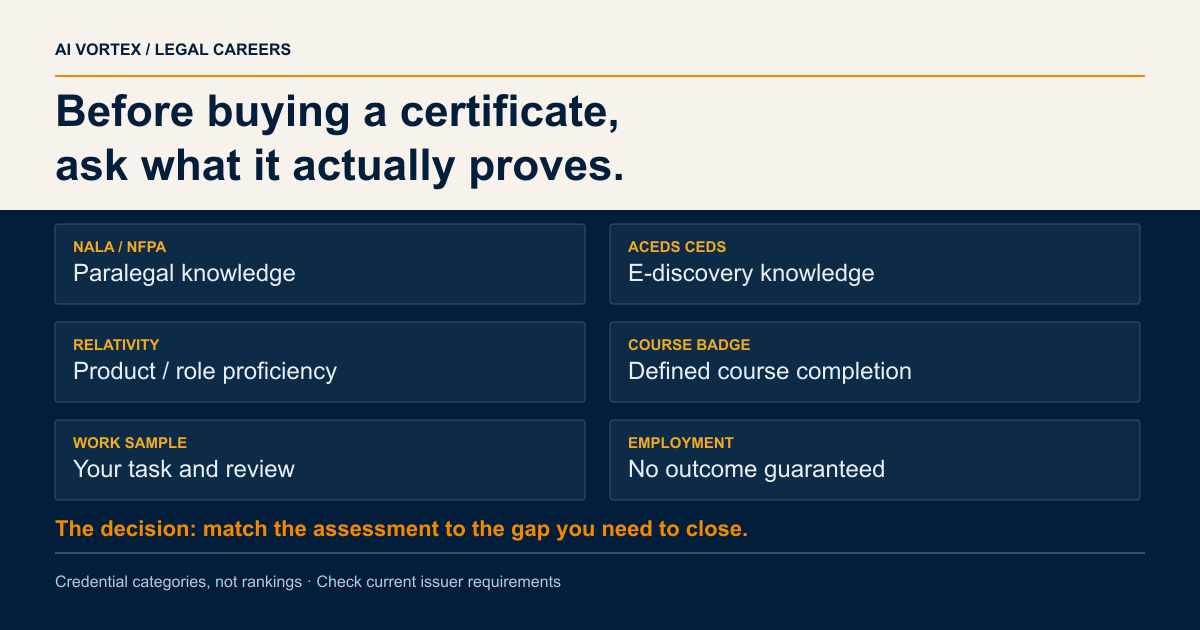
There is no single credential that proves an AI-equipped paralegal can perform every legal workflow. O*NET's paralegal profile covers records, research, trial preparation, communication and related tasks. A credential may assess general paralegal knowledge, e-discovery, or one product. Those are different claims.
Before paying, write the job or workflow you want to perform. Do you need broad paralegal education, e-discovery competence, or proficiency in a platform your employer already uses? Then read the issuer's current eligibility, exam, renewal and access rules. Do not infer hiring outcomes, salary premiums or professional authorization from a certificate.
ABA Formal Opinion 512 makes competence, confidentiality, communication and supervision relevant to lawyers' use of generative AI. A credential can support learning; it does not transfer responsibility for a matter.
Three buyers can rationally choose three different paths
Consider three hypothetical situations. The first applicant is looking at a role that explicitly requires a general paralegal credential. A product badge cannot be assumed to satisfy that requirement. The initial decision is to verify the employer's accepted credential and the applicant's eligibility, before spending time on preparation.
The second is an experienced paralegal moving toward e-discovery. General experience may be useful, but the gap could involve the evidence lifecycle and review process. A specialty curriculum deserves attention if its assessment matches that gap. It would still leave the applicant to demonstrate the practical work and meet the role's other requirements.
The third works on a team already using Relativity. A product-specific path may be the closest fit for the work the team needs done. That same path could be a poor purchase for someone whose target employer uses a different system. Product specificity is useful when it matches the task and limiting when the destination is unknown.
These examples are decision scenarios, not issuer rankings. The cost is more than an exam fee: study time, access to practice, ongoing maintenance and the opportunity to learn something else all matter. Buying a respected credential can still be the wrong decision when it assesses a capability you do not need.
NALA CP®: read the eligibility route
NALA's Certification Applicants page presents the CP® as a professional paralegal credential and directs applicants to eligibility categories. The eligibility requirements page says an applicant must meet one of its categories and provide the requested documentation.
The categories are not interchangeable. Category 1 lists approved or qualifying paralegal education pathways. Category 2 addresses a bachelor's degree plus paralegal experience or substantive paralegal coursework. Category 3 describes a high-school/equivalent, experience and recent substantive CLE route with supporting attestation or certificates. Confirm the current wording with NALA before applying; this guide intentionally omits fees and pass-rate claims.
NFPA PACE® and product or specialty credentials
The NFPA PACE brochure dated 2024 describes a voluntary competency exam, eligibility pathways, testing modes and 12 hours of biennial CLE maintenance, including ethics and DEI requirements. The document is dated, so check NFPA for current rules before relying on any detail.
For e-discovery, ACEDS describes the CEDS as a psychometric certification with a 145-question exam, preparation materials and a digital badge. Its FAQ describes a vendor-neutral scope, 11 subject areas and two-year recertification with continuing education. These are certification mechanisms and issuer descriptions, not independent proof of employability.
RelativityOne Certified Pro is a beginner product certification. Relativity's overview separates beginner, skilled and advanced paths, while its FAQ distinguishes non-expiring Pro certifications from designations with renewal requirements. A product badge shows product-specific learning, not broad paralegal competence.
A comparison before you enroll
| Credential type | What it can document | What it does not establish | Check before paying |
|---|---|---|---|
| NALA CP® | A paralegal certification route with education or experience eligibility. | A salary, job or AI-workflow outcome. | Current category, documentation, exam and fee rules. |
| NFPA PACE®/RP® | Competency assessment under the dated NFPA pathway. | Current market recognition or a universal employment advantage. | Current brochure, eligibility, exam and CLE maintenance. |
| ACEDS CEDS | Specialized e-discovery knowledge and the issuer's exam process. | General paralegal competence or vendor-independent hiring value. | Current exam, eligibility, renewal and preparation requirements. |
| Relativity certification | Proficiency in a Relativity product or role path. | Transferable legal judgment or competence in another platform. | Product/version, experience guidance, exam and renewal rules. |
| Course or vendor badge | Completion of a defined learning experience. | A regulated credential, supervision authority or job guarantee. | Issuer, assessment method, access, renewal and employer relevance. |
The purchase decision: requirement, assessment, opportunity to practice
Put three things beside each other: what the target role requires, what the issuer assesses and where you can practice the skill. If the role requires a particular credential, verify the accepted designation and your eligibility. If the purpose is learning, inspect the syllabus and assessment. If you cannot access the relevant workflow, explain how you will turn study into usable practice.
A general credential, a specialty exam and a product qualification can complement one another. That does not mean you need all three. The sensible sequence depends on the first gap blocking the work you want to do.
I would defer the purchase when the only justification is that the badge contains a fashionable tool name. First resolve the missing information: a target role, an employer requirement or a defined skill deficit. Use the paralegal practice guide to test a workflow in the meantime. A modest, permission-cleared exercise may reveal which training you actually need.
Recheck issuer requirements, fees, access and renewal immediately before enrolling. The dated NFPA brochure is context, not a current purchasing contract. No reviewed source establishes a salary premium or job guarantee from these credentials.
Questions and answers
Which credential is best for an AI paralegal?
There is no universal best choice. Match NALA or NFPA to the paralegal credential requirement, ACEDS to e-discovery, and Relativity to a role using that platform.
Does a certification increase salary?
The reviewed sources do not establish a salary premium. A credential may satisfy an employer requirement or structure learning, but compensation depends on role, market, experience and employer decisions.
Should I buy a product certification first?
Only if the target role uses the product and the current requirements fit your goal. Product certification does not replace paralegal knowledge or supervised judgment.
Can a certificate let me give legal advice?
No. A certificate does not confer a license or authorization to advise clients. Follow the role's supervision, jurisdiction and professional requirements.
Sources and scope
- BLS OOH: Paralegals and Legal Assistants. 2026 projection vintage, 2025-2035; checked 2026-09-08.
- O*NET Paralegals 23-2011.00. living occupational profile; checked 2026-09-08.
- ABA Formal Opinion 512. 2024-07-29; checked 2026-09-08.
- NALA Certification Applicants. living first-party page; checked 2026-09-08.
- NALA Eligibility Requirements for Certification. living first-party page; checked 2026-09-08.
- NALA Category 1 - Paralegal Studies. living first-party page; checked 2026-09-08.
- NALA Category 2 - Bachelor's Degree Minimum Paralegal Studies. living first-party page; checked 2026-09-08.
- NALA Category 3 - On the Job Experience. living first-party page; checked 2026-09-08.
- NFPA PACE Brochure 2024. 2024 document accessed 2026-09-08; checked 2026-09-08.
- ACEDS Certified E-Discovery Specialist. living first-party page; checked 2026-09-08.
- ACEDS CEDS Certification FAQs. living first-party page; checked 2026-09-08.
- RelativityOne Certified Pro. living first-party page; checked 2026-09-08.
- Relativity Certifications. living first-party page; checked 2026-09-08.
- Relativity Certification FAQs. living first-party page; checked 2026-09-08.
U.S. occupational and professional sources inform this guide. Local rules, qualifications and employer requirements differ. Examples and practice plans are editorial proposals; they are not employment forecasts.
Editorial update. removes unsupported pass rates, fees, salary premiums and recognition claims, and separates NALA, NFPA, ACEDS and Relativity credentials using current primary verification.
Prepared with AI-assisted research and editorial verification for AI Vortex. Sources are linked where claims are made.