
 By
By 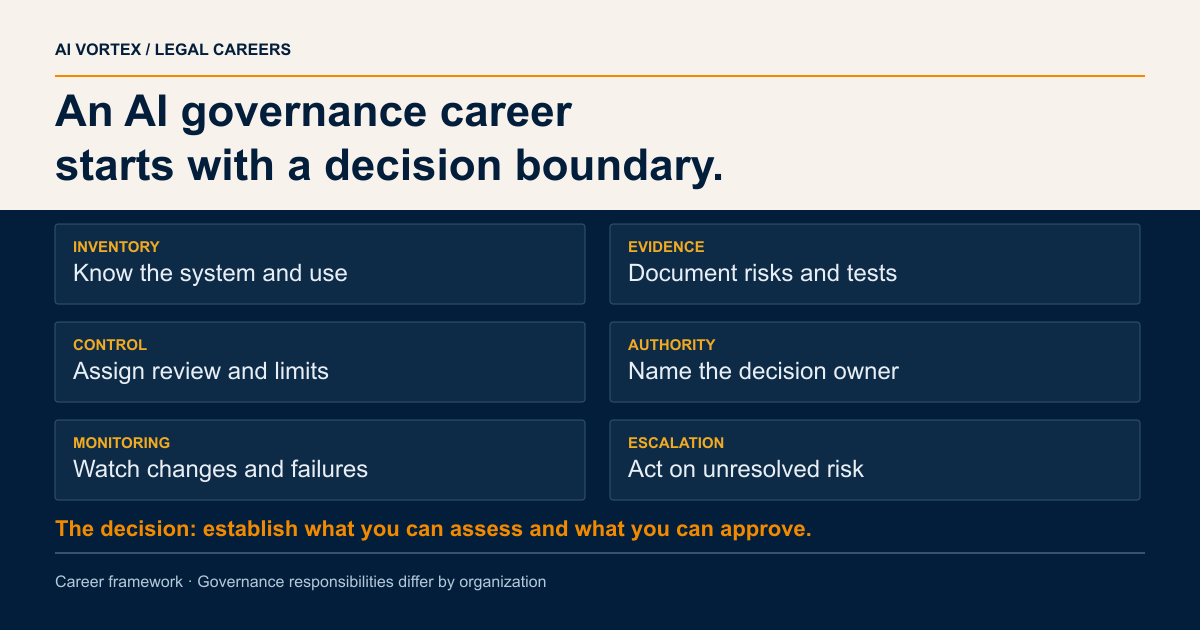
Governance is a decision system, not a policy PDF
An AI policy can state principles and still leave an organization unable to answer basic questions: What system is in use? Who approved it? What data does it touch? Which risk was accepted? What changes require a new review? Who can pause it when the evidence changes?
The NIST AI Risk Management Framework organizes its core around Govern, Map, Measure and Manage. NIST says governance is cross-cutting, and the functions are not a mandatory ordered checklist. That makes the framework useful for career orientation: governance work is the connective tissue that turns risk language into owners, evidence and action across the system lifecycle.
In a legal setting, professional responsibility still has its own authority. ABA Formal Opinion 512 addresses lawyers' competence, confidentiality, communication and supervision when using generative AI. A governance professional can support the controls; that does not transfer the lawyer's responsibility for a representation.
Employer role descriptions show the work behind the label
An indexed official BMO Senior Manager, Responsible AI Governance description assigns intake, triage and risk assessment of AI use cases, inventories and controls, metrics, cross-functional liaison work and audit-ready documentation. It asks for experience in AI implementation, risk management, governance, data science or related work in a regulated setting. The description named New York/Chicago. The live listing could not be recovered on September 8, 2026; this historical example supports the stated scope, not vacancy availability or a universal entry requirement.
A Cushman & Wakefield AI Governance Manager description focuses on operationalizing an enterprise framework, coordinating privacy, legal, compliance, risk, security, IT and business teams, managing impact assessments, maintaining a regulatory register, supporting third-party due diligence and preparing material for an AI council. The London role was retrievable from the employer’s public recruiting system on September 8, 2026, with its posting age stated as “30+ days.” This is a dated scope check, not a promise that it will remain open. The role makes governance a workflow with a repository and escalation path.
The common work is not writing a grand statement about responsible AI. It is keeping the inventory, assessment, approval, evidence and monitoring chain coherent as a use case changes.
Name the authority before you accept the responsibility
| Governance activity | Typical work | Authority to clarify | Evidence of completion |
|---|---|---|---|
| Use-case intake | Receive, classify and route a proposed AI use case | Who can require an assessment, reject incomplete intake or prioritize review? | A complete record with sponsor, purpose, data, vendor, users and lifecycle stage |
| Risk mapping | Identify legal, privacy, security, bias, operational, IP and model risks | Who determines risk tolerance and who owns the mitigation? | A documented risk statement tied to controls, assumptions and unresolved questions |
| Approval and conditions | Prepare a recommendation, define guardrails and record exceptions | Who has approval power, and who can stop or condition deployment? | A decision with approver, date, conditions, evidence and escalation route |
| Monitoring and change | Track use, incidents, model or vendor changes, review dates and remediation | What event triggers re-assessment and who must act when the control fails? | An inventory, review cadence, alert path and closure record |
Entry routes combine risk fluency with operational follow-through
AI governance is not a single degree or legal specialty in the sources reviewed. Current role descriptions draw from risk management, compliance, privacy, technology, data, audit, legal and program delivery. The entry point depends on whether the role is closer to policy interpretation, model or technology risk, vendor review, business enablement or control operations.
Build the durable skills in pairs: read a framework and turn it into an intake field; identify a legal requirement and map it to an owner and evidence; understand a model lifecycle and ask what changes the risk; write a policy and define how a team can follow it under time pressure. NIST's Generative AI Profile explicitly connects governance to legal and regulatory requirements, documented controls and AI-actor tasks.
Do not confuse familiarity with a framework with authority to approve a system. A certificate or course can support learning; the employer still decides who owns risk, legal interpretation, security sign-off and business acceptance.
Build a fictional intake record that can survive review
Use a synthetic legal summarization assistant as the example. Record the business purpose, users, data types, jurisdictions, vendor, model behavior, human review point and expected benefit. Map the risks: confidential information, unsupported citations, stale law, access, retention, bias or over-reliance. Assign each mitigation to an owner and state what would block approval.
Then introduce a change: the vendor adds a new retrieval source, the use expands to a second jurisdiction or the tool begins handling a new document type. Show which fields change, which reviewer is re-engaged and what evidence is required before continued use.
The sample should include a refusal or escalation. A governance record that always ends in approval teaches the wrong lesson. The professional's value is visible when the record makes uncertainty actionable without pretending to decide the legal matter itself.
Choose governance if you want to make accountability visible
Choose AI governance if you are willing to work across legal, privacy, security, data, technology and business teams while keeping a decision record coherent. You may enjoy risk mapping, policy translation, control design, vendor assessment, training, audit preparation and monitoring. Choose a legal advisory path if the central work is applying law to a client's matter. Choose engineering or legal engineering if the central work is building and evaluating system behavior. Choose operations if the central work is running the service and its systems.
Governance can be frustrating because authority is distributed. A role may maintain the register and contribute to governance while another person has authority to require a review. Clarify who holds that authority and how the role escalates an unresolved risk. A role that can pause a deployment but cannot obtain technical evidence is under-resourced. Ask for the escalation path, the decision forum and the evidence budget before treating a title as meaningful.
Use the role comparison to distinguish system building from function running, and the knowledge-management guide to distinguish source maintenance from risk approval. Governance touches both; it owns the decision trail.
Find the record behind the decision
My test for an AI governance role is whether it can answer four questions with evidence: what is being used, who accepted the risk, what control is active and what event triggers a new decision. If the role cannot reach those records or people, it may be policy education or coordination rather than governance ownership. That distinction is useful before choosing a path.
For teams changing this workflow
If your team needs to connect intake, review and escalation in an AI workflow, describe the use case and decision owners in the operating brief.
Describe the team workflow. Paid systems work, subject to fit and scope.
Questions and answers
Is AI governance a legal career?
It can sit close to legal work, but it is cross-functional. The role may combine legal, privacy, security, risk, data, technology and program management. A governance title does not itself authorize legal advice.
Do I need to be a lawyer for AI governance?
Requirements vary. The role descriptions reviewed include backgrounds in AI, risk, governance, compliance, data and technology; some may value legal experience. Match the entry requirements to the decision rights and risk domain of the specific role.
Is NIST AI RMF a checklist?
NIST describes the framework as functions, categories and outcomes that support dialogue and risk management. It says the functions are not a mandatory ordered checklist. Use it to structure questions and evidence, then apply the organization's requirements.
What should an AI governance portfolio sample contain?
Use a synthetic use case and show intake, risk mapping, control owners, approval conditions, monitoring and a change-triggered reassessment. Include an escalation or refusal outcome.
Sources and scope
- National Institute of Standards and Technology, AI RMF Core. AI RMF 1.0, 2023; checked 2026-09-08.
- National Institute of Standards and Technology, AI RMF Generative AI Profile. 2024 publication; checked 2026-09-08.
- BMO Careers, Senior Manager: Responsible AI Governance. Publication date not established; indexed official historical description, rechecked September 8, 2026; live vacancy not verified; checked 2026-09-08.
- Cushman & Wakefield Careers, AI Governance Manager. London posting retrieved September 8, 2026; employer displays “Posted 30+ Days Ago”; checked 2026-09-08.
- National Institute of Standards and Technology, AI Risk Management Framework overview. Current overview; AI RMF 1.0 published 2023; checked 2026-09-08.
- American Bar Association, Formal Opinion 512. Issued 2024-07-29; checked 2026-09-08.
U.S. occupational and professional sources inform this guide. Local rules, qualifications and employer requirements differ. Examples and practice plans are editorial proposals; they are not employment forecasts.
Editorial update. New career guide distinguishes AI governance from policy writing, legal advice, system building and operations through inventory, assessment, approval, monitoring and decision authority.
Prepared with AI-assisted research and editorial verification for AI Vortex. Sources are linked where claims are made.