
 By
By 
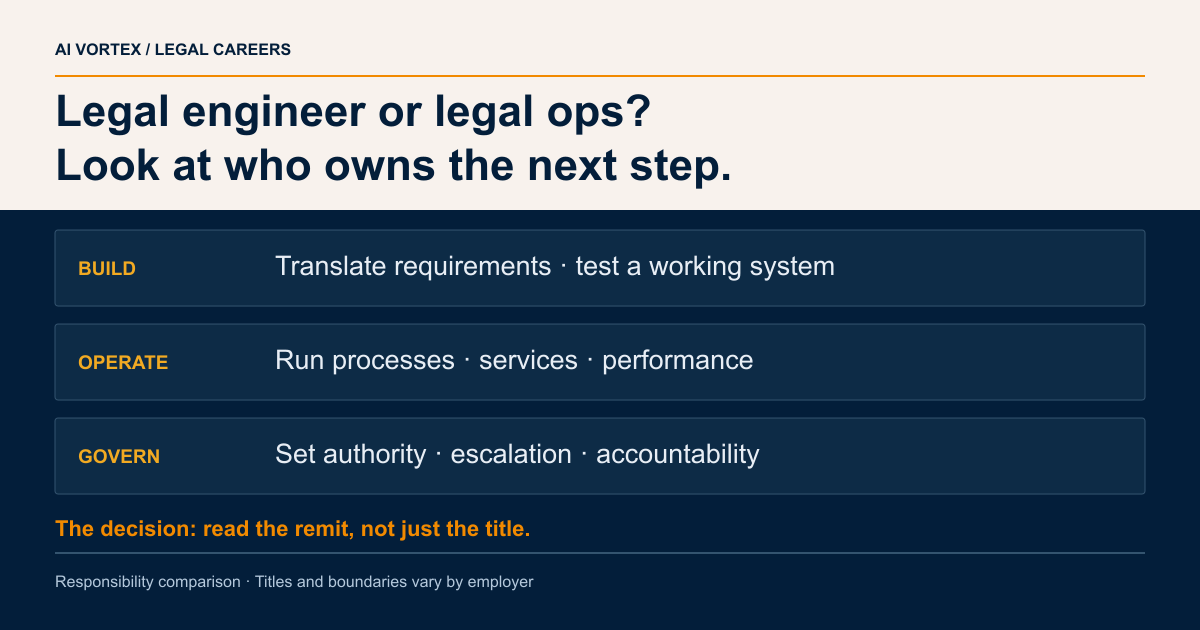
The same vocabulary hides two kinds of ownership
Legal engineer and legal operations can appear beside the same words: workflow, AI, technology, adoption, quality and efficiency. That overlap is real. It does not make the roles interchangeable.
A legal engineer usually turns a legal workflow into a system that can be specified, tested, evaluated and improved. Legal operations usually makes the legal function more predictable for the people it serves: intake, matters, vendors, budgets, knowledge, systems, reporting and change. The exact boundary depends on the organization, and neither label is a universal occupational classification.
The choice matters because a title can promise proximity to AI while leaving the actual authority undefined. Read the role as a chain: what need created it, what work repeats, who can approve a change and what evidence would show that the work helped?
Legal engineering: translate, test and put a workflow under pressure
Filevine's current Legal Engineer description places the role between legal practice, AI product development, data quality and model evaluation. It asks the person to translate legal tasks and documents into requirements, define what a good output means, review model behavior, identify edge cases and maintain rubrics, golden answers and failure taxonomies. The responsibility is not simply to know a legal tool; it is to make the system's behavior inspectable.
Latham & Watkins' 2026 Manager of Legal Engineering description shows a larger version of that ownership. The role leads legal and knowledge engineers, establishes prompt and workflow standards, oversees quality assurance, translates litigation requirements into specifications, sets success criteria for pilots and reports quality metrics to leadership. The description names document review, research, brief drafting, deposition preparation and case strategy as workflows, while retaining attorney expectations and escalation as constraints.
Harvey's role guide describes four broad pillars: legal expertise, AI and technology fluency, process design and improvement, and influence and user enablement. That is a useful orientation, not a licensing standard. Across these descriptions, the durable work is the handoff between legal judgment and system behavior.
Legal operations: make the legal function work repeatedly
CLOC describes legal operations as an integrated business partner and frames the function through strategic planning, financial management, project management and technology portfolio investment. Its Core 12 model also covers areas such as vendor management, knowledge management, information governance, business intelligence and service delivery. The central need is operational capacity: lawyers should be able to focus on legal advice while the function has a way to receive, route, measure and improve work.
The Association of Corporate Counsel's representative role descriptions make the range concrete. A legal operations specialist may manage incoming contract requests, maintain template versions, update analytics, support signatures and test applications. A technology and analytics specialist may document current processes, prioritize projects with legal and IT teams, implement tools, train users and translate reports into decisions. A coordinator may manage matter, e-billing, document and knowledge systems, budgets, vendors and department metrics. These are role descriptions, not a universal checklist.
ACC's state-of-the-role analysis describes legal operations as a business function focused on delivering legal services efficiently and effectively, with dedicated staff optimizing people, process and technology. CLOC's 2025 industry report likewise shows variation in structure: participating departments report formal teams, single leaders or decentralized responsibilities. The role exists on a continuum of organizational maturity.
Compare the need, task, authority and choice criterion
| Question | Legal engineering | Legal operations | What to ask before choosing |
|---|---|---|---|
| Need | A legal workflow or AI system must be translated, tested, improved or made reliable for practice. | A legal function needs predictable service delivery, prioritization, systems, information and operating rhythm. | Which failure is expensive here: bad system behavior or an unmanaged department process? |
| Recurring task | Write requirements, build or configure workflow patterns, evaluate outputs, classify failures and set quality gates. | Run intake, matter and contract processes; manage vendors, budgets, technology, knowledge and reporting; support adoption. | Would your week produce test cases and workflow specifications, or operating decisions and service visibility? |
| Authority | Often owns requirements, evaluation standards, pilot criteria and recommendations about workflow implementation; the boundary with counsel and engineering must be explicit. | Often owns process standards, operational priorities, system administration and coordination with leadership; reporting line and spending authority vary. | Who can approve a change, stop a workflow, allocate resources and accept residual risk? |
| Evidence of fit | A reviewed prototype, evaluation rubric, failure analysis or documented workflow that a technical and legal audience can use. | A process map, service-level view, system rollout, vendor decision or operating report that changes how the department works. | Which artifact would a hiring manager inspect in your first 90 days? |
| Choose it when | You want to stay close to legal judgment while making system behavior testable and repeatable. | You want to improve how legal work is requested, resourced, measured and delivered across the organization. | Which responsibility would you keep when the current tool or platform changes? |
Two plausible workdays, two different tests
Consider a fictional legal department with a slow contract intake process and an unreliable AI clause summary. A legal engineer might begin by defining the contract use case, specifying the information the system must retrieve, creating test examples, checking citations and setting an escalation path for missing context. The output is a workflow whose limits can be evaluated before a lawyer relies on it.
A legal operations professional might begin by mapping who submits the request, what information is missing, how matters are prioritized, who owns the template, which system records the decision and how cycle time or workload is reported. The output is a service process the business can follow and the legal team can manage.
Both people may attend the same project meeting. The first is accountable for whether the system's behavior is fit for the defined legal task. The second is accountable for whether the organization can receive and sustain the work. In a small team one person may do both; that is a reason to clarify the scope, not to erase the distinction.
The title should answer five authority questions
Before applying, ask for the written answer to five questions:
- What is the starting problem? Ask for the workflow, user group, practice area and current failure, not only the platform name.
- What can the role change? Separate recommendations from configuration, ownership, budget, policy and final legal judgment.
- Who reviews the work? A model evaluation may need legal and technical review; a process change may need the general counsel, IT, finance or business owner.
- What survives a tool change? Look for durable skills in evidence, process design, quality control, stakeholder alignment and escalation.
- How will the employer know it worked? Ask for the first deliverable, the baseline and the decision the metric will support. Avoid accepting “efficiency” without a defined quality and review condition.
The questions also protect candidates from an attractive but thin title. If the employer cannot name the decision authority or the evidence of success, the role may be exploratory. That can still be a fit, but it should not be described as a settled profession with a predictable path.
Overlap is useful only when the boundary is named
Legal engineering can borrow legal operations practices: intake, adoption, documentation, metrics and change management. Legal operations can include technology design, analytics and automation. The boundary is therefore a matter of primary accountability, not a claim that one role never performs the other's tasks.
O*NET's lawyer and paralegal profiles help explain the legal work that both roles may support, but they do not define either emerging title. A lawyer may interpret law, advise a client or represent a client; a paralegal may investigate facts, prepare documents and research precedent. The engineer or operations professional should not be assumed to hold the same authority merely because the role works beside those occupations.
Choose the direction whose hard problem you are willing to own. If you want to investigate why a model missed an exception and improve the evaluation, legal engineering may be the closer fit. If you want to make the request, budget, system and responsibility chain work across a department, legal operations may be closer. Both require judgment; they exercise it at different points in the delivery system.
Ask for the first artifact and its reviewer
The decision I would make is concrete: ask for the first artifact and the person who can accept it. A title that names the artifact, reviewer and authority gives you a real choice. A title that only names a technology gives you a marketing signal and leaves the work unresolved.
Questions and answers
Is legal engineering the same as legal operations?
No. They overlap around legal work, technology and change, but legal engineering usually centers on translating and evaluating legal workflows or AI systems, while legal operations centers on running and improving the legal function. A small team may combine them; the job description should state the primary accountability.
Do I need a law degree to become a legal engineer?
The answer varies by employer and scope. Filevine's description asks for a J.D. or equivalent legal training, while other engineering roles may emphasize technical development and legal workflow experience. Read the actual requirements; there is no universal entry rule in the sources reviewed.
Is legal operations an AI career?
It can include technology strategy, administration, analytics, automation and adoption, but its remit is broader than AI. CLOC and ACC describe operations through people, processes, technology, finance, vendors, knowledge and service delivery.
Which role is more secure from AI?
The sources do not support a role-level safety guarantee. Both roles can change as tools and organizational priorities change. Compare the task, review burden, authority and employer plan rather than ranking titles.
What portfolio piece fits each direction?
For legal engineering, show a bounded workflow specification, evaluation rubric, failure analysis or reviewed prototype. For legal operations, show a process map, intake design, service metric, system rollout or decision report. Mark fictional or synthetic work clearly and do not expose confidential material.
Sources and scope
- Corporate Legal Operations Consortium, What is Legal Ops. Undated page; current page checked; checked 2026-09-08.
- Corporate Legal Operations Consortium, 2025 State of the Industry Report. 2025 report; data derived from 2024 Harbor Law Department Survey; checked 2026-09-08.
- Association of Corporate Counsel, Compilation of Representative Legal Operations Job Descriptions. 2019-02 publication; current PDF checked; checked 2026-09-08.
- Association of Corporate Counsel, The State of the Legal Operations Role in Legal Departments. 2022-01-25 data release; current PDF checked; checked 2026-09-08.
- Filevine, Legal Engineer job description. Current listing; original posting date not stated; checked 2026-09-08.
- Latham & Watkins, Manager of Legal Engineering job description. 2026-02-26 last updated; checked 2026-09-08.
- Harvey, Legal Engineering: Role, Skills, and Resources. Copyright 2026; current page checked; checked 2026-09-08.
- O*NET OnLine, 23-1011.00 Lawyers. Updated 2026; task and occupation data displayed; checked 2026-09-08.
- O*NET OnLine, 23-2011.00 Paralegals and Legal Assistants. Updated 2026; task and occupation data displayed; checked 2026-09-08.
U.S. occupational and professional sources inform this guide. Local rules, qualifications and employer requirements differ. Examples and practice plans are editorial proposals; they are not employment forecasts.
Editorial update. New article distinguishes legal engineering from legal operations through need, recurring task, authority and evidence of fit; it uses current role descriptions while avoiding a fixed taxonomy or vacancy forecast.
Prepared with AI-assisted research and editorial verification for AI Vortex. Sources are linked where claims are made.