
 By
By 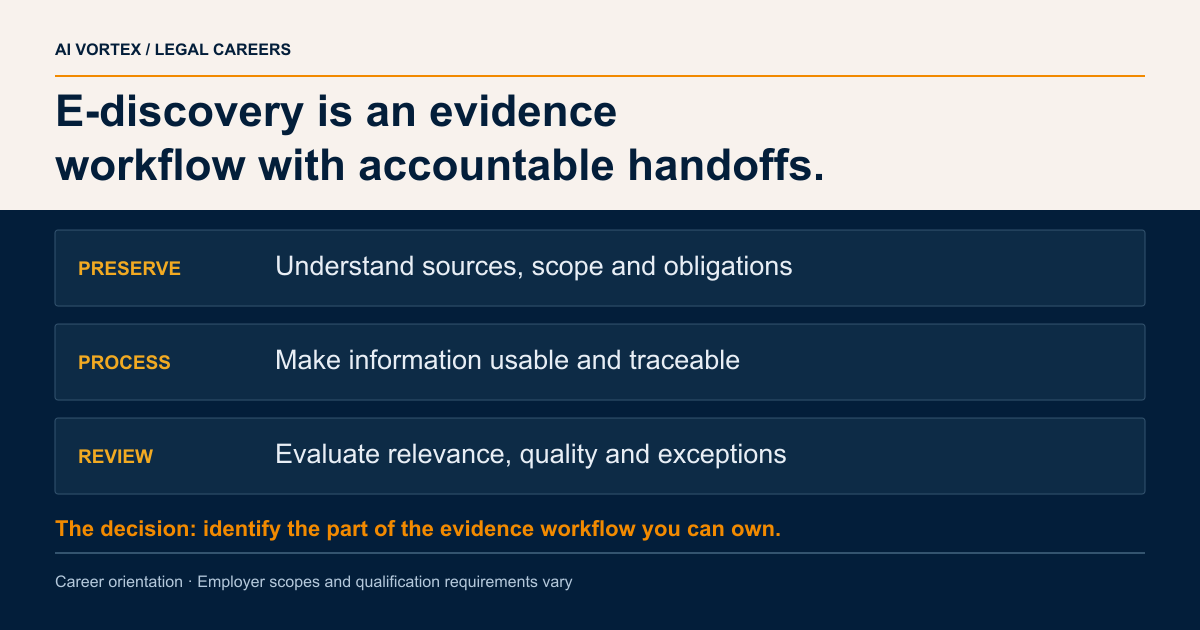
The career is an evidence chain
E-discovery is easy to reduce to a platform name. The work is broader: information must be identified, preserved, collected, processed, reviewed and produced in a way that lets a matter team explain what happened. A fast search that cannot show its scope, exceptions or decisions has not solved the professional problem.
The current EDRM 2.0 model, released September 1, 2026, places the Information Governance Reference Model at the foundation of the updated model. That is a useful career signal. Discovery work begins before a reviewer opens a document and remains connected to information governance after a production is made.
The decision is therefore not “Do I want to work with AI review?” It is “Which part of the evidence lifecycle do I want to own, and what would make my work defensible when another person asks how the result was produced?”
Different roles carry different parts of the lifecycle
The eDiscovery Certification Council describes several established role families: analyst, project manager, litigation support analyst, document review specialist, digital forensics practitioner, consultant and manager. Its career page is a professional orientation, not a guarantee that every employer uses the same titles.
| Role family | Recurring work | Acceptance test |
|---|---|---|
| eDiscovery analyst | Processing, search, review support, quality control, reporting and matter operations | Can the team reproduce the result and understand the exceptions? |
| Discovery project manager | Scope, schedule, budget, stakeholders, vendors, risk and delivery | Does the matter move with visible decisions, owners and deadlines? |
| Litigation support analyst | Databases, evidence management, productions, bundles and trial support | Can the case team retrieve the right material in the required form? |
| Document review specialist | Responsiveness, privilege, issues, confidentiality, redaction and review quality | Are coding decisions consistent with the protocol and escalation rules? |
| eDiscovery manager | Team leadership, service delivery, governance, technology and stakeholder management | Can the function deliver repeatably across matters without losing control? |
The distinctions are practical. A person who enjoys building a review protocol may not want to own vendor timelines. Someone who likes matter coordination may not want to make privilege calls. The title becomes useful only after the recurring decision is visible.
Read employer role descriptions as work samples
A current Fidelity Principal eDiscovery Analyst posting asks for familiarity with preservation, collection and analysis. Its described work includes intake and tracking of requests for electronically stored information, workflow database updates and communication among eDiscovery, litigation support, in-house counsel, security, compliance and business users. The role is a coordination and evidence-management problem before it is a software problem.
Dentons' April 9, 2025 Discovery Project Manager description, recovered from the indexed official page, adds matter-level budgets, workflow and database design, review and production processes, vendor support, training and quality procedures. It names a five-year experience requirement and Relativity certifications for that particular role. That is the employer's threshold for the dated example, not a universal entry rule or a claim that the vacancy remains open. The direct page was access-restricted when rechecked on September 8, 2026.
An indexed official GAF Manager, Litigation Technologies description names the role as a liaison and eDiscovery subject-matter expert between business and legal teams. It asks for experience with the eDiscovery lifecycle, retention policies, stakeholder problem-solving and delivery within technical and budget parameters. The live listing could not be recovered on September 8, 2026; this is a historical scope example, not an available vacancy. The common thread is the ability to explain the evidence path and control the failure points.
Authority sits at the decision points
| Point in the chain | Work you may perform | Authority to clarify | Failure you must be ready to surface |
|---|---|---|---|
| Preservation and collection | Receive the request, identify sources, track holds or collection steps and record scope | Who defines the legal scope, approves a collection change and owns the custodian decision? | A source was unavailable, altered, omitted or collected under an unclear instruction |
| Processing and loading | Manage metadata, exceptions, deduplication, data conversions and load validation | Who accepts the processing protocol and decides how an exception is handled? | The dataset appears complete while a format, time zone or load problem changes what can be reviewed |
| Review and analysis | Configure search or review workflows, support coding, redaction and quality checks | Who sets the protocol, resolves an ambiguity and signs off on a sampling result? | A relevant, privileged or sensitive item is misclassified or never reaches the reviewer |
| Production and reporting | Prepare exports, reports, logs and matter status for the legal team | Who approves the production set, format, recipient and final representation? | The delivery cannot be reconstructed or a limitation is hidden by a clean-looking report |
Entry is a sequence of evidence skills
There is no single e-discovery entry route in the sources reviewed. A candidate may arrive from litigation support, paralegal work, records or information governance, data operations, legal technology or a technical role that learned the matter context. Employers then set different thresholds for education, experience, platform knowledge and certification.
Start with the concepts that survive a platform change: electronically stored information, metadata, preservation, collection scope, processing exceptions, review protocols, privilege and confidentiality, production formats, audit trails and communication with the matter team. Learn the platform after you can explain why the step exists.
The eDCC career guidance groups progress around understanding the profession, building evidence skills, adding technology capability, validating knowledge and increasing responsibility. Treat that as a professional development map. It does not replace the requirements of a specific employer or the authorization of counsel.
Build a synthetic matter someone else can inspect
A useful portfolio sample does not need client data. Create a fictional matter with a small set of clearly synthetic emails, attachments and metadata. Write the collection request, define the scope, log an unavailable source, process one deliberate exception and produce a short QC report. Include what you did not decide because that authority belonged to counsel.
Then ask a reviewer to answer five questions: Can they identify the collection boundary? Can they trace an item from source to review? Can they see which exception changed the result? Can they distinguish a technical finding from a legal decision? Can they reproduce the production choice from the record?
This sample demonstrates the work better than a screenshot of a search box. It also reveals the tradeoff in AI-assisted review: a model can reduce the time needed to find candidates for review, while the professional still has to establish the scope, measure quality, handle exceptions and explain the consequence of the output.
Choose the work you would still own under pressure
Choose e-discovery if you are drawn to evidence integrity, structured process, careful exception handling and communication across legal and technical teams. Choose a collection or preservation path if you prefer defining scope and maintaining the record. Choose review operations if you want to translate a protocol into consistent decisions. Choose project management if you want to coordinate people, budget, vendors and deadlines across the lifecycle.
Do not choose the field because an AI feature makes it sound frictionless. A tool may classify, cluster or summarize. It cannot, by itself, grant you authority to define legal scope, waive privilege or represent the completeness of a production. If the role description does not say who makes those decisions, ask before treating the title as a career path.
Compare this evidence workflow with the broader career-direction map and the legal engineer versus legal operations guide. They overlap in technology and process; e-discovery owns a defined evidence chain and its defensibility.
Inspect the chain before choosing the role
The decision I would carry into an interview is specific: show me the evidence chain, the escalation point and the artifact that proves quality. If those are visible, the job can be evaluated. If the posting only names a platform, the career story is still incomplete.
Questions and answers
Is e-discovery just document review?
No. E-discovery spans information governance, preservation, collection, processing, review, analysis, production and matter delivery. Document review is one part of the lifecycle.
Do I need Relativity certification to enter e-discovery?
Some roles require or prefer particular certifications, as the Dentons posting illustrates. The sources do not establish one universal requirement. Learn the evidence concepts and check the employer's current description.
Does AI remove the need for e-discovery professionals?
The sources do not support that conclusion. AI may assist search, classification or analysis, while professionals still need to define scope, manage exceptions, validate quality and explain the production record.
What can I put in an e-discovery portfolio?
Use synthetic data. Show a scope note, collection log, exception treatment, review protocol, QC result and handoff. Never expose client or employer evidence.
Sources and scope
- Electronic Discovery Reference Model, Current EDRM Model 2.0. Released 2026-09-01; checked 2026-09-08.
- eDiscovery Certification Council, eDiscovery Careers. Current page checked; publication date not stated; checked 2026-09-08.
- Fidelity Careers, Principal eDiscovery Analyst. Posted 2026-09-02; checked 2026-09-08.
- Dentons US LLP, Discovery Project Manager. April 9, 2025; indexed official description; direct page restricted on recheck; checked 2026-09-08.
- GAF Careers, Manager, Litigation Technologies. Publication date not established; indexed official historical description, rechecked September 8, 2026; live vacancy not verified; checked 2026-09-08.
- NALP, JD Advantage Guide 2025. 2025 guide; checked 2026-09-08.
U.S. occupational and professional sources inform this guide. Local rules, qualifications and employer requirements differ. Examples and practice plans are editorial proposals; they are not employment forecasts.
Editorial update. New career guide differentiates e-discovery roles by evidence lifecycle, authority and defensibility, using the current EDRM 2.0 model and dated role descriptions without inventing a standardized ladder.
Prepared with AI-assisted research and editorial verification for AI Vortex. Sources are linked where claims are made.