
 By
By 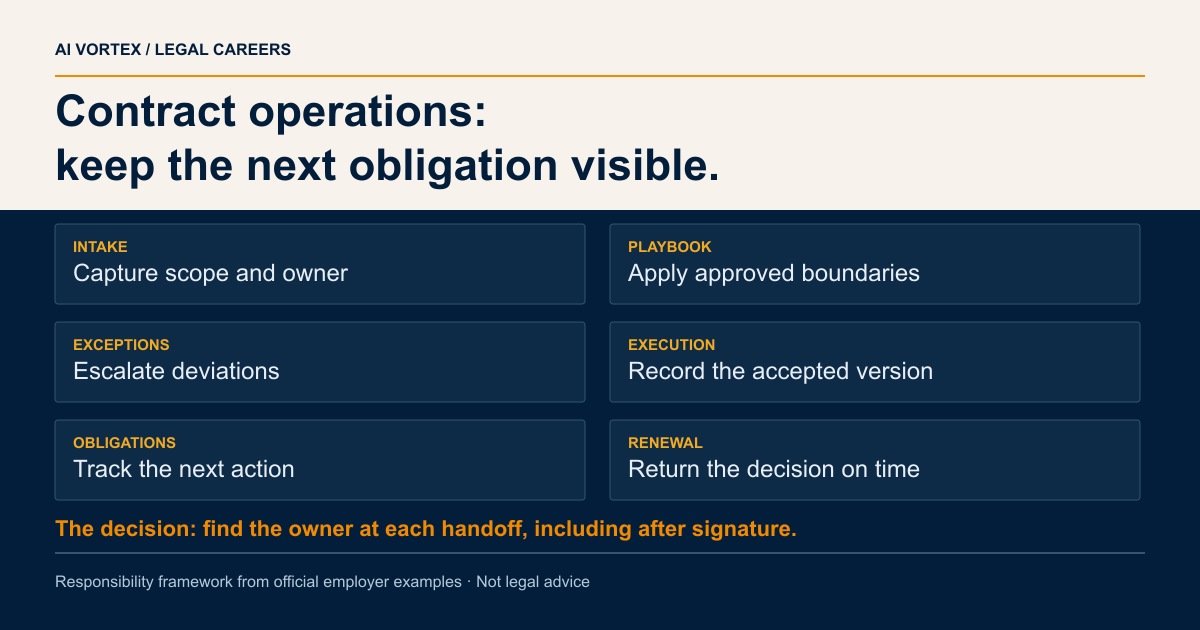
The job starts before the redline
Contract operations is often described as a contract lifecycle management (CLM) implementation because the system is visible. The professional problem starts earlier: a request arrives with no business owner, no deadline, an unclear counterparty or a document that does not match the chosen route. Someone has to capture the facts, apply the playbook, route the exception and preserve the final record.
That work is narrower than all legal operations and different from being the lawyer who decides the legal position. It sits between the business request, the contract workflow and the authorized reviewer. A good process makes the standard path easy to follow and makes the non-standard path harder to miss.
The career decision is therefore not “Do I want to work with a CLM?” It is: do I want to own the repeatable contract path, its data and its escalation conditions?
Current roles show the contract-operations boundary
An Early Warning Contract Operations Manager description places the role inside the Legal Department and assigns intake-pipeline management, review prioritization, triage, CLM implementation support, KPI reporting, stakeholder coordination, training and audit-request support. It also says the role works closely with Legal Operations and Litigation, which makes the boundary visible rather than assuming one title owns everything.
A current Striveworks Legal and Contracts Operations Manager description combines systematic triage and review with contract databases, workflow optimization, public-sector clauses and CLM implementation. It asks for contract-management or legal-operations experience and a bachelor's degree for that role. That is a particular employer's entry bar, not a universal requirement.
Niantic Spatial's Business Operations Manager, Finance & Legal description assigns end-to-end contract intake, cross-functional approvals, repository and renewal management, playbooks, templates, operating procedures and turnaround metrics. These descriptions point to a durable core: a contract operations practitioner owns the path and its visibility, while legal counsel owns the legal judgment that the path escalates.
Separate the lifecycle from legal authority
| Lifecycle point | Contract-operations work | Authority to clarify | Failure to expose |
|---|---|---|---|
| Intake and triage | Capture counterparty, business owner, value, deadline, contract type, data and requested route | Who can classify a request as standard, urgent or exceptional? | The request enters the wrong queue or omits a fact that changes risk |
| Template and playbook | Maintain approved forms, clause positions, fallback language and version status | Who approves a clause position and who can change the playbook? | A stale template is treated as current or a fallback is used outside its guardrail |
| Review and escalation | Route redlines, coordinate reviewers, track approvals and record open issues | Which terms may be handled within the playbook and which require counsel or another function? | A workflow appears complete while a material deviation has no owner |
| Execution and repository | Coordinate signature, store the executed agreement, preserve versions and capture metadata | Who confirms the final document, signer authority and system of record? | The signed agreement cannot be found or differs from the approved version |
| Renewal and obligation | Track dates, notices, obligations, owners and handoffs to the business | Who owns the commercial or legal decision to renew, amend or exit? | A deadline passes because the repository had a date but no accountable owner |
Entry routes start with contract fluency and process discipline
Contract operations can be entered through contract administration, paralegal work, procurement, deal desk, legal operations, commercial operations or a business role that learned how agreements move. The role may sit inside Legal, Finance, Procurement or a cross-functional operations team. The employer's placement changes the adjacent skills and decision rights.
Learn the lifecycle before the platform: request qualification, template versioning, clause and playbook controls, approval routing, signature authority, repository metadata, renewal notices, audit trails and access rules. Then learn the CLM system used by the target team. A platform certificate cannot compensate for not knowing who may approve a deviation.
The Pearl Health Legal and Compliance Operations description illustrates a role with first-pass redlines, playbook maintenance, limited negotiation within guardrails, CLM workflows, databases and compliance coordination. It is a broader hybrid example, so use it to ask which work belongs to contract operations and which requires attorney supervision.
Build a contract-path sample with a deliberate exception
Use a fictional NDA or standard SaaS agreement. Create an intake form with business owner, counterparty, data type, geography, term, deadline and requested deviation. Route the standard request through an approved template. Then introduce one non-standard term that triggers escalation and document why the playbook cannot settle it.
Finish the sample with an approval log, signature-authority check, executed-document metadata, renewal owner and a short dashboard showing where the request spent time. A reviewer should be able to tell which step you controlled, which decision belonged to counsel or the business and what would happen if the contract changed after signature.
This is a different artifact from a contract-review memo. The memo demonstrates legal analysis of terms. The operations sample demonstrates whether the path captures the right information, keeps the right people involved and leaves a record that survives turnover.
Choose contract operations if you want to own the path
Choose contract operations if you like turning repeated requests into a usable route, making exceptions visible and keeping a high-volume process reliable. You may enjoy configuring CLM, maintaining templates, coordinating reviews, training business users, tracking cycle time and making repository data trustworthy.
Choose substantive commercial legal work if you want to spend most of your time interpreting obligations, negotiating risk and advising the business. Choose broad legal operations if you want to own the wider department's finance, vendors, knowledge, systems and service model. Choose legal engineering if the central problem is evaluating or building AI behavior inside the workflow.
The role comparison helps keep those choices separate. Contract operations can be an important bridge between them, but a bridge is not the same as owning every destination.
Locate the owners across the lifecycle
The practical test is whether the job description names the intake owner, playbook authority, escalation rule, system of record and renewal responsibility. If it only says “optimize contracts with AI,” the career path is not specified enough to evaluate.
For teams changing this workflow
For a team with a stalled contract process, describe the intake, approval and renewal handoffs in the operating brief to discuss whether a scoped systems engagement fits.
Describe the team workflow. Paid systems work, subject to fit and scope.
Questions and answers
Is contract operations the same as legal operations?
Contract operations is a narrower responsibility centered on the contract lifecycle, intake, playbooks, approvals, repositories and renewals. Legal operations may include those areas plus finance, vendors, knowledge, technology and wider service delivery.
Do contract operations professionals negotiate contracts?
Some roles may handle standard terms or limited negotiation within approved guardrails. The Pearl Health description is one example. The job must state which decisions can be made independently and which require counsel or business approval.
Do I need to be a lawyer to work in CLM operations?
Not universally. Employers may hire from contract administration, paralegal, procurement, legal operations or business operations. Legal authority and role requirements vary, so read the specific posting.
What should a contract-operations portfolio sample show?
Show a synthetic intake, standard route, deliberate deviation, escalation, approval and executed-document record, including the owner and renewal handoff.
Sources and scope
- Early Warning Careers, Contract Operations Manager. 2026 listing; current role description checked; checked 2026-09-08.
- Striveworks, Legal and Contracts Operations Manager. Current listing; observed 2026-09-08; checked 2026-09-08.
- Niantic Spatial, Business Operations Manager, Finance & Legal. Current listing; observed 2026-09-08; checked 2026-09-08.
- Pearl Health, Legal and Compliance Operations Manager. Current listing; observed 2026-09-08; checked 2026-09-08.
- Vultr, Legal Operations Manager. Current listing; observed 2026-09-08; checked 2026-09-08.
- Association of Corporate Counsel, Compilation of Representative Legal Operations Job Descriptions. 2019-02 publication; current PDF checked; checked 2026-09-08.
U.S. occupational and professional sources inform this guide. Local rules, qualifications and employer requirements differ. Examples and practice plans are editorial proposals; they are not employment forecasts.
Editorial update. New career guide separates contract operations from broad legal operations, legal advice and legal engineering through lifecycle ownership, playbook authority, escalation and repository evidence.
Prepared with AI-assisted research and editorial verification for AI Vortex. Sources are linked where claims are made.