
 By
By 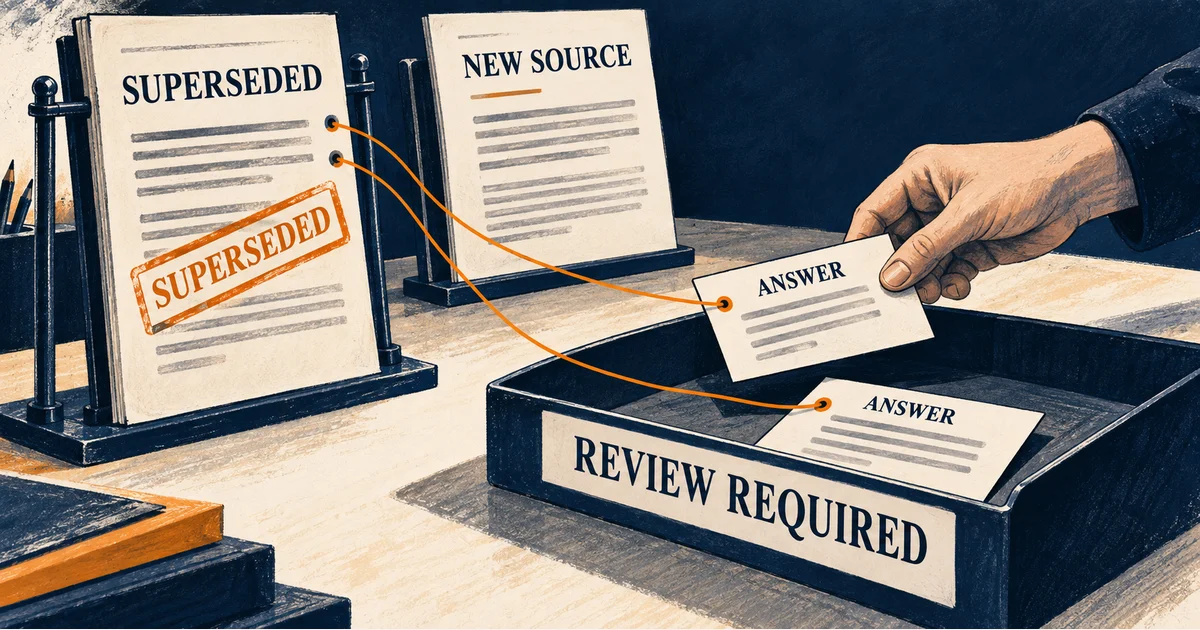
The job is not a prettier folder
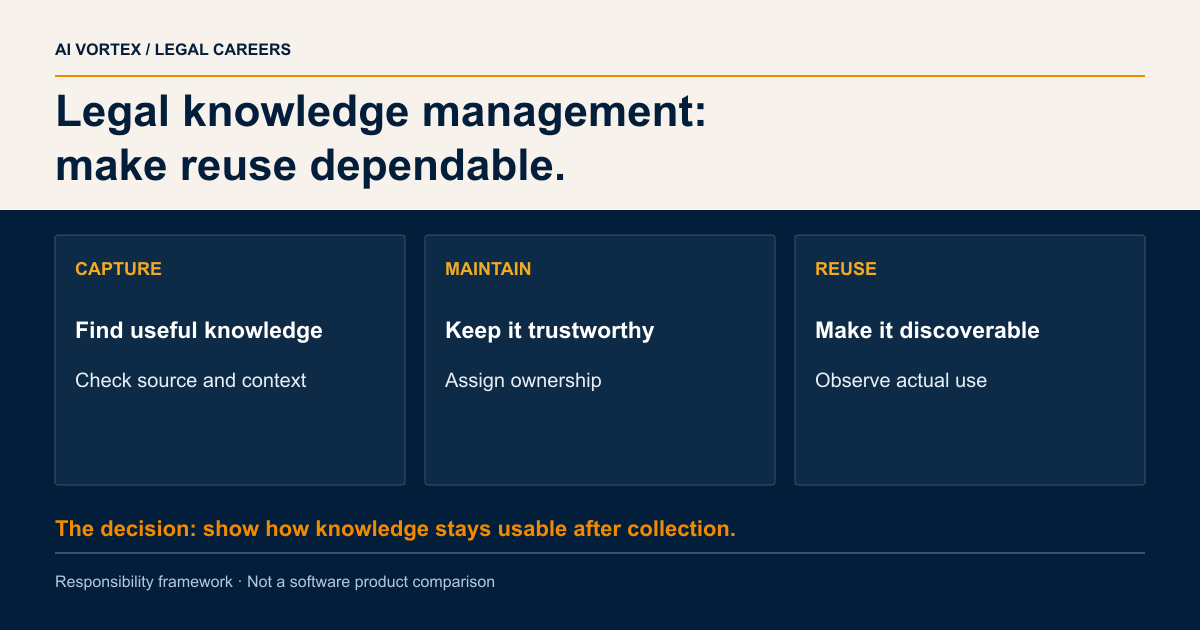
A legal knowledge system can look organized and still answer the wrong question. A precedent may be out of date, a playbook may lack its owner, a search result may omit the jurisdiction or a generated answer may cite a document that no longer controls. The work begins before retrieval: decide what belongs, why it is trusted and how its status changes.
That makes knowledge management different from simply using an AI search tool. It combines legal or domain judgment with editorial discipline, information architecture, access rules, change control and user feedback. The output is not only an answer. It is a source environment that lets someone inspect how the answer was assembled.
The career choice is therefore: do you want to maintain the conditions under which a team can reuse knowledge safely? If yes, ask which sources, users, systems and decisions the role owns.
Employer role descriptions show two useful shapes
An indexed official Xero Risk, Ethics, Advocacy & Legal Operations posting describes end-to-end ownership of the knowledge environment: architecture, governance, day-to-day content quality, AI agent integrations, adoption, metrics and platform health. The description was for a 12-month role in Melbourne or Sydney. The live posting was unavailable when rechecked on September 8, 2026, so it is used here as a historical example of scope. It sits inside an operating function, so the knowledge work is connected to technology, processes and reporting.
EvenUp's Product Quality Counsel role describes a different shape. It places knowledge management and applied research beside legal subject-matter expertise, asking the lawyer to decompose reasoning into decision trees, anchor conclusions to the record, translate judgment into taxonomies and evaluation criteria, and maintain practice-area templates.
Both are knowledge work. The first emphasizes the environment and its operating health; the second emphasizes the substance and quality logic inside a system that generates legal work product. Neither description defines the whole profession.
Separate source authority from system ownership
| Work layer | What the practitioner does | Authority to clarify | Useful proof of fit |
|---|---|---|---|
| Source curation | Select, classify, version and retire precedents, policies, templates or guidance | Who can declare a source current, authoritative, restricted or superseded? | A source register with owners, dates, status and a documented change decision |
| Structure and retrieval | Design metadata, taxonomies, permissions, search paths and retrieval tests | Who approves the information model and who resolves a conflict between findability and access control? | A small information architecture with test questions and known failure cases |
| Applied legal knowledge | Turn expert reasoning into playbooks, decision trees, templates or evaluation criteria | Who is the subject-matter reviewer and who remains responsible for advice? | A synthetic decision tree tied to authorities and reviewed edge cases |
| Maintenance and adoption | Monitor stale content, usage, feedback, training and the effect of a source change | Who funds maintenance, accepts a gap and decides whether a system remains in use? | A change log, review cadence and evidence that a user found or corrected an item |
Entry routes combine a domain with a maintenance habit
Knowledge management does not have one entry credential in the sources reviewed. A candidate may come from professional support, legal research, practice-group work, library or information services, legal operations, product quality or technology. The useful common ground is the ability to understand a domain and maintain a reliable knowledge environment.
Build the skills in pairs. Learn enough of the practice area to recognize a material distinction, and enough information design to preserve it. Learn to write for retrieval, and to explain why a source is authoritative. Learn to configure a tool, and to define what happens when the source changes or the answer cannot be supported.
ACC's representative legal-operations descriptions include knowledge management alongside systems, reporting, training and process support. CLOC similarly places knowledge management within a broader operating function. These are pathways, not requirements. A job description that asks only for “AI fluency” has not yet told you whether the real work is editorial, substantive, technical or operational.
Build a source-change sample, not a chatbot demo
Use a public or synthetic policy set. Create a small source register with owner, jurisdiction, effective date, status and permitted use. Add a decision tree that routes three plausible questions. Then mark one source as superseded and show what breaks: which answer changes, which links must be updated and who must review the change.
Test the environment with questions that differ by one material fact. Record the expected answer, supporting source and the result returned by your retrieval method. Include an “I do not have enough support” outcome. A polished response without that boundary demonstrates writing, not knowledge management.
This sample also exposes a real tradeoff. More structure can make knowledge easier to find, but every field creates maintenance work. A taxonomy that no one updates becomes a false signal of authority. The professional has to choose the smallest structure that keeps the decision visible.
Choose between source work, system work and advice
Choose knowledge management if you are drawn to making expertise reusable without pretending that reuse eliminates judgment. You may enjoy source curation, taxonomy, retrieval tests, precedent maintenance, playbooks or training. Choose a substantive knowledge role if you want to stay close to the reasoning and practice area. Choose a platform or operations role if you prefer architecture, permissions, adoption, metrics and maintenance across teams.
Keep the authority boundary visible. Maintaining a legal playbook does not authorize legal advice. A retrieval system can expose a source; it does not decide whether that source controls the client's matter. A lawyer who converts reasoning into a template still needs a review model for exceptions.
The legal engineer versus legal operations guide helps separate system evaluation from function ownership. The e-discovery guide provides a useful contrast: knowledge work maintains reusable source and context, while discovery work maintains a defensible record of a defined evidence collection.
Ask what happens when the source changes
My test for a knowledge role is not whether it contains an AI feature. It is whether the role can name the source owner, the change signal, the reviewer and the point at which the system must decline to answer. Without those, the job may still be interesting, but its professional promise is not yet inspectable.
For teams changing this workflow
For teams redesigning a knowledge workflow, the operating brief can describe the sources, maintenance owner and point where unsupported answers need review.
Describe the team workflow. Paid systems work, subject to fit and scope.
Questions and answers
Is legal knowledge management the same as legal operations?
They overlap in systems, process and adoption. Knowledge management focuses on making institutional or substantive knowledge current, structured and usable; legal operations is broader and may include finance, vendors, intake, reporting and service delivery.
Do I need to be a lawyer for legal knowledge management?
Requirements vary by the work. A substantive knowledge role may require legal practice or subject-matter expertise; a platform or operations role may emphasize information architecture, systems and change management. Read the employer's scope and authority.
Is a knowledge base an AI governance program?
No. A knowledge base can support governance evidence, but governance also requires risk ownership, assessment, approval, monitoring and escalation. The systems and decision rights must be connected explicitly.
What should a knowledge-management portfolio sample show?
Show a source register, information structure, retrieval test, version change and reviewer decision using public or synthetic materials. Include what the system could not support.
Sources and scope
- Corporate Legal Operations Consortium, What is Legal Ops. Undated page; current page checked; checked 2026-09-08.
- Corporate Legal Operations Consortium, 2025 State of the Industry Report. 2025 report; data derived from 2024 Harbor Law Department Survey; checked 2026-09-08.
- Xero Careers, Senior Business Operations Manager: Risk, Ethics, Advocacy & Legal. Publication date not established; indexed official historical description, rechecked September 8, 2026; live vacancy not verified; checked 2026-09-08.
- EvenUp Careers, Product Quality Counsel: Knowledge Management & Applied Research. Current listing; observed 2026-09-08; checked 2026-09-08.
- Association of Corporate Counsel, Compilation of Representative Legal Operations Job Descriptions. 2019-02 publication; current PDF checked; checked 2026-09-08.
- International Legal Technology Association, Knowledge Management white paper archive. Archive material; publication date displayed in source; checked 2026-09-08.
U.S. occupational and professional sources inform this guide. Local rules, qualifications and employer requirements differ. Examples and practice plans are editorial proposals; they are not employment forecasts.
Editorial update. New career guide separates knowledge curation, retrieval structure, applied legal reasoning and maintenance authority; it uses current role descriptions without treating a knowledge-management title as a universal taxonomy.
Prepared with AI-assisted research and editorial verification for AI Vortex. Sources are linked where claims are made.