The short answer
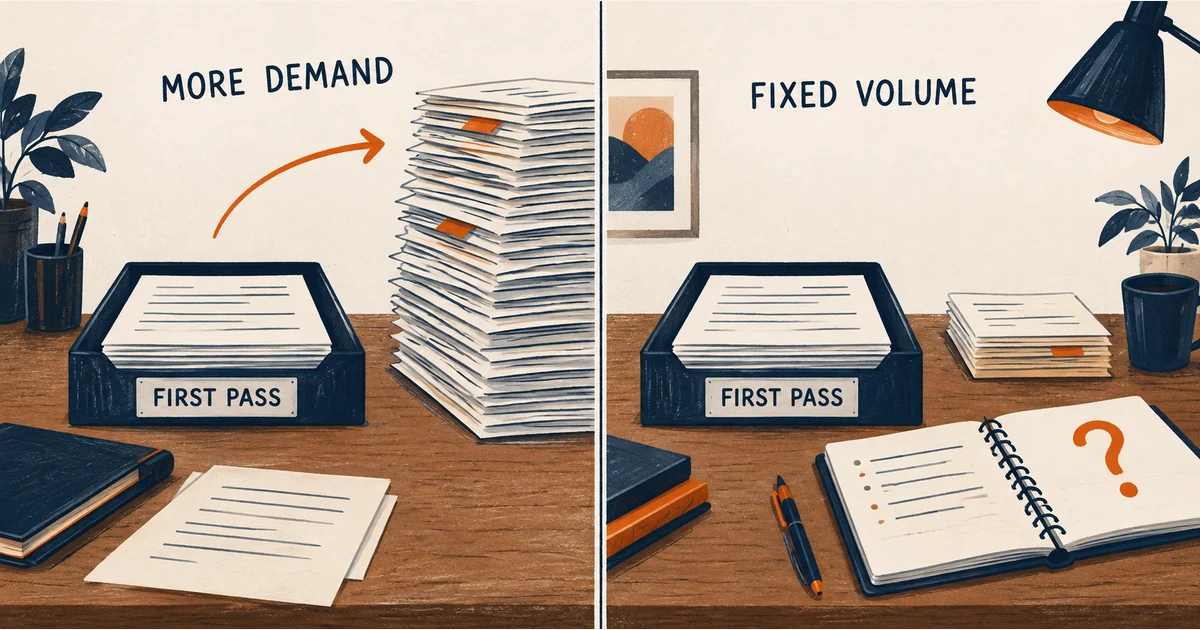
No paralegal job can be promised safe, and the data says paralegals carry more employment risk than lawyers. The Bureau of Labor Statistics projects 0% growth for paralegals and legal assistants from 2025 to 2035, a change of -1,100 jobs on a base of 404,900. BLS states that demand "is expected to be limited by advances in technology, including artificial intelligence (AI)."
That does not mean the job disappears. BLS also projects about 40,800 openings per year, almost all from people leaving the occupation or retiring. The number of paralegal seats is flat. The tasks inside those seats are what change. For the broader employer-side explainer, read will AI replace paralegals. This page is the task-level answer.
What the BLS numbers say
Read all four figures together, from the BLS paralegals and legal assistants page (May 2025 pay data, 2025-2035 projections):
- Median pay: $62,890 per year ($30.24 per hour), May 2025.
- Jobs: 404,900 in 2025.
- Projected change: 0%, or -1,100 jobs, 2025 to 2035.
- Openings: about 40,800 per year on average, mostly replacement.
For comparison, BLS projects 5% growth for lawyers over the same period. A flat paralegal market next to a growing lawyer market is the pattern worth watching: lawyers absorb the work that technology makes cheaper, and the support layer does not grow with it.
Task-by-task risk for paralegals
The table splits the paralegal job into its recurring tasks. The exposure ratings are my editorial judgment about how much of the first pass an AI tool can already produce. They are not measured probabilities.
| Paralegal task | Exposure to AI first pass | What still lands on the paralegal |
|---|---|---|
| Document review and summaries | High | Missing documents, privilege flags, exceptions the summary skipped and whether the review protocol fits the matter |
| Routine drafts: discovery responses, form pleadings, correspondence | High | Matching the draft to the file, local rules and the attorney's instructions |
| Cite checking and legal research support | Medium | Confirming each authority exists, is current and says what the draft claims |
| Deadlines, filing and docket management | Medium | Court-specific rules, service issues and the calendar the attorney actually depends on |
| Fact investigation, witness and client contact | Lower | Trust, follow-up questions and judgment about what a person is not saying |
| Trial and hearing preparation | Lower | Exhibits, logistics and last-minute changes that need a person in the room |
Work that is only a first pass on documents is the most exposed. Work that requires a person to coordinate, verify and answer to an attorney is the least.
What practitioners expect
The 8am 2026 Legal Industry Report surveyed more than 1,300 legal professionals in September and October 2025. It found 69% now use general-purpose AI tools for work, up from 31% the year before, and 39% expect a reduction in paralegal or support roles.
That 39% is an expectation, not an observed layoff count. It is still the number to take seriously, because the people answering are the ones who make staffing decisions.
What to do about it
- Audit your own week. Mark each task in the table above as first pass or verification. Use the which legal jobs are safe from AI framework for the full method.
- Move toward verification and coordination. The paralegal who can say what a tool missed is harder to cut than the one who produced the first draft.
- Own a workflow. Pick one recurring process, such as discovery responses or intake, and document how AI output is checked in it.
- Ask your employer where the saved time goes. More matters, fewer people and lower fees are different futures. The paralegal employment page lays out the three scenarios.
- Train on something you can show. See the AI-literate paralegal guide and the paralegal AI certification guide.
Questions and answers
Are paralegal jobs going away because of AI?
BLS projects 0% growth for paralegals and legal assistants from 2025 to 2035, or -1,100 jobs from 404,900, and says AI will limit demand. It also projects about 40,800 openings per year from turnover, so the occupation is flat, not gone.
Which paralegal tasks are most exposed to AI?
First-pass document review, document summaries and routine drafts are the most exposed. Fact investigation, client and witness contact and trial preparation are the least exposed. Cite checking and docket management sit in between.
How much do paralegals earn?
BLS reports a median of $62,890 per year ($30.24 per hour) for paralegals and legal assistants in May 2025. That figure covers the whole occupation, not any one employer or city.
Do paralegals need to learn AI tools?
Yes. In the 8am 2026 Legal Industry Report, 69% of legal professionals use general-purpose AI tools for work. A paralegal who can verify AI output is more useful to an attorney than one who cannot.
Is it still worth becoming a paralegal in 2026?
There are about 40,800 openings a year and a $62,890 median, but no net growth. Choose an employer that can name who reviews AI output and how junior staff move into that review role.
Sources and scope
- BLS Occupational Outlook Handbook: Paralegals and Legal Assistants. Page dated 2026-08-27; checked 2026-10-21. May 2025 pay data; 2025-2035 projections.
- 8am 2026 Legal Industry Report (summary). Survey of 1,300+ legal professionals, September-October 2025; checked 2026-10-21. Report publication date not stated on the page read.
- BLS Occupational Outlook Handbook: Lawyers. Page dated 2026-08-27; checked 2026-10-21. May 2025 pay data; 2025-2035 projections.
U.S. occupational and professional sources inform this guide. Local rules, qualifications and employer requirements differ. Exposure ratings in the tables are editorial judgments for a task audit; they are not measured automation probabilities or employment forecasts.
Prepared with AI-assisted research and editorial verification for AI Vortex. Sources are linked where claims are made.