
 By
By 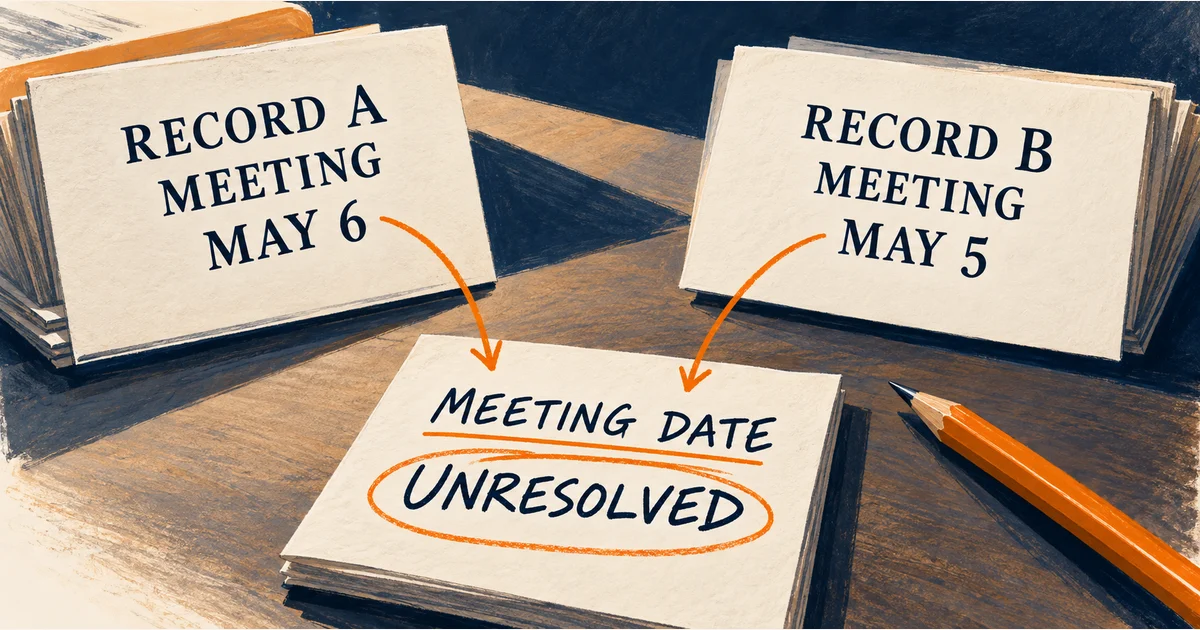
A polished answer can hide the work you need to demonstrate
An employer looking at a generated memo cannot easily tell whether the candidate understood the sources, noticed a missing fact or simply accepted a fluent answer. Adding the names of several AI tools does not resolve that ambiguity. The sample needs to show where the candidate exercised judgment.
I would start with a small task whose result another person can inspect. A source-bound chronology, a research handoff or a version check can be more revealing than a large demonstration with no visible review. These exercises connect to research, records and communication in the lawyer and paralegal occupational profiles. They are editorial practice proposals, not an employer-endorsed assessment.
Choose the reviewer before choosing the demonstration
A supervising lawyer, legal-operations manager and technology evaluator may need different evidence. The lawyer may ask whether your proposition fits the authority. The operations manager may ask whether a colleague can continue the process. The evaluator may need a reproducible failure and the inputs that produced it.
Write one sentence describing the reviewer and the decision the sample should support. For example: “This exercise lets a supervisor inspect how I separate a source statement from an inference.” That promise is narrow enough to test. A promise to demonstrate complete AI expertise is not.
Use public or synthetic material and an approved environment. A portfolio does not create permission to disclose client work, employer methods or restricted coursework. If a sample requires removing so much context that it cannot be checked, choose a different example.
Make the failure visible without staging a fake achievement
Consider a fictional record with two documents describing the same meeting on different dates. A first pass produces one neat date and leaves out the disagreement. The useful part of the exercise is the correction: preserve both attributed statements, identify their sources and flag the unresolved event date.
You do not need to claim that you discovered this error in client work. Label the dossier as synthetic. Explain the error the exercise is designed to test and show the answer against the supplied record. If you actually run a tool, retain what it returned; do not fabricate a failed output and describe it as a model result.
The review lab provides three complete synthetic dossiers with explanations. Use them to practice the distinction, then create your own permission-cleared example. Repeating the supplied answer is practice, not evidence of independent performance.
The smallest complete review package
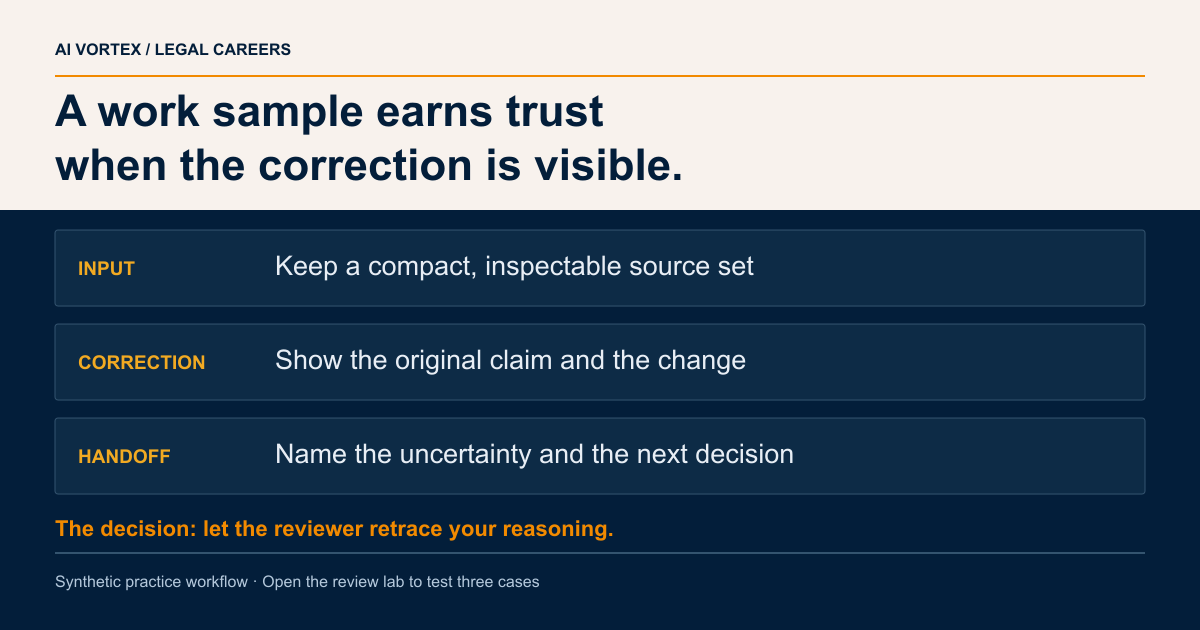
| Part | What to include | What it lets the reviewer check |
|---|---|---|
| Brief | Intended user, task, source boundary and exclusions | Whether the sample solves the question it claims to solve |
| Source record | Public/synthetic inputs with identifiers and relevant dates | Whether material statements can be traced |
| Correction | First pass if one was produced, error and revised output | What you changed and why |
| Handoff | Supported conclusion, unresolved point and next owner | Whether another person can continue responsibly |
| Method note | Your contribution, tools if used and limits | What belongs to your work rather than the tool or supplied example |
A clean document and a working record have different jobs
The reviewer should not have to read every prompt to find the answer. Lead with a concise work product and keep the source and correction record nearby. Too little supporting material conceals your reasoning; too much undifferentiated material transfers the organizing work to the reviewer.
For the fictional chronology, the clean output might be a short table of attributed events. The method note should identify the conflicting date and explain why you left it unresolved. The handoff should say what would resolve it: another record or a decision by the responsible reviewer. The point is to reduce uncertainty about your reasoning, not to erase uncertainty in the facts.
ABA Formal Opinion 512 addresses competence and supervision in lawyers' use of generative AI. It does not endorse a portfolio format or qualify a candidate. Applicable rules and employer policies remain separate from this practice method.
Test the sample with a fresh reader
Give an appropriate reviewer the brief, record and final package. Ask them to identify the main conclusion, the source supporting it and the decision still needed. If they cannot find one of those, revise the package before adding visual polish.
A useful review can also reveal that the problem was too easy. When every source agrees and nothing requires a choice, the exercise may demonstrate formatting rather than judgment. Increase difficulty by adding a meaningful ambiguity or exception, not by multiplying pages.
If you measure time, include preparation, verification and correction. A portfolio can show careful work without making an efficiency claim. An honest account of an unresolved point often gives a reviewer more to assess than an unsupported assertion that the tool made you faster.
Use the sample for the decision you actually face
For a career transition, compare the sample with the responsibilities in the career-path guide. For a junior legal role, see the associate handoff. A hiring team needs a consistent assessment process as well as a good exercise; the work-sample scorecard addresses that different task.
Keep the sample small enough that a real reviewer can finish it. The standard is a complete chain from source to correction to handoff. If that chain works, the sample gives another person something concrete to discuss with you.
Questions and answers
Can I use a fictional case?
Yes, as a clearly labeled synthetic exercise. Do not invent an actual court decision or describe a simulation as paid client work.
Do I need to claim time savings?
No. If you do, compare the same scope and acceptance standard and include verification and rework.
Is the supplied lab answer a portfolio achievement?
It is a practice reference. Demonstrating your own judgment requires explaining your contribution and distinguishing supplied material from independent work.
Sources and scope
- O*NET Lawyers 23-1011.00. living occupational profile; checked 2026-09-08.
- O*NET Paralegals 23-2011.00. living occupational profile; checked 2026-09-08.
- ABA Formal Opinion 512. 2024-07-29; checked 2026-09-08.
U.S. occupational and professional sources inform this guide. Local rules, qualifications and employer requirements differ. Examples and practice plans are editorial proposals; they are not employment forecasts.
Editorial update. New source-grounded practice article. Synthetic exercises are explicitly labeled; no hiring, salary or productivity outcome is claimed.
Prepared with AI-assisted research and editorial verification for AI Vortex. Sources are linked where claims are made.