
 By
By 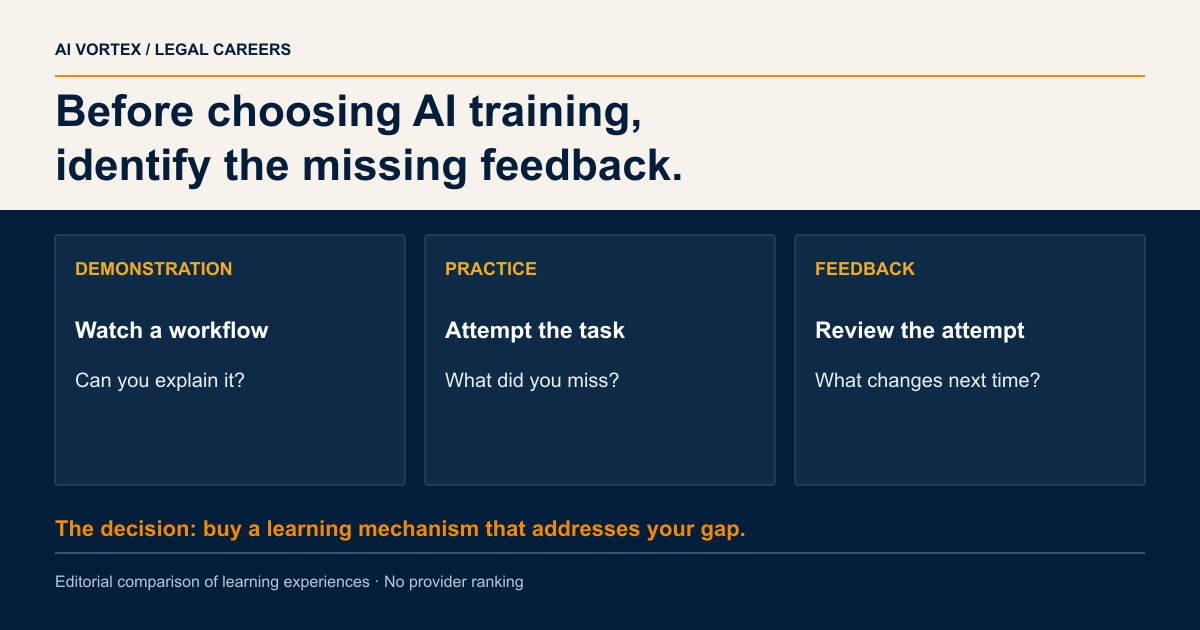
The wrong course can answer a perfectly reasonable question
A lawyer who cannot explain why a generated argument is unsupported has a different learning problem from someone who cannot find a feature in a research platform. A legal-operations professional trying to improve a handoff has another problem again. All three may search for legal AI training. A single list of recommended courses would conceal the most important difference between them.
I would choose training by the failure I want to correct. That requires more than a topic match. The learner needs an opportunity to attempt the work, discover what went wrong and receive a response that helps with the next attempt. A badge can record completion without resolving that learning problem.
The three first-party examples below were checked September 8, 2026. They illustrate different kinds of instruction, not a ranking or an evaluation of graduate outcomes. This article is about selecting learning for yourself or a named learner; it is not a plan for deploying AI across a firm.
First decide whether the gap is reasoning, product use or process
Consider a hypothetical research exercise. The learner knows which question needs answering, but cannot tell whether the retrieved material supports the draft. More instruction on navigating the interface may make the learner quicker without making the answer better. The useful training must expose the gap between a plausible sentence and adequate support.
Now change the problem. The learner can evaluate the sources but struggles to carry out a task in the team's approved platform. Product instruction may be exactly right. Its specificity is an advantage because the learner can use it immediately; that same specificity is a limitation for someone who has no access to the product.
Finally, suppose several capable people keep losing context between intake and review. An individual prompting lesson might leave that failure untouched. Learning about service delivery, knowledge management or process ownership may be more relevant. The tradeoff is breadth: a program that explains the system may not teach the button sequence needed for tomorrow's assignment.
Lexis: a foundation in prompting and evaluating output
LexisNexis announced AI Prompt Essentials on June 15, 2026 as self-paced instruction for legal professionals, including people without prior AI experience. The current course page lists two components: an introduction to large language models and prompting basics. Its stated objectives include distinguishing generated output from legal reasoning and assessing and refining responses.
That makes it a relevant starting point to investigate when the gap is conceptual or concerns how instructions shape an output. The public pages establish the subject and format; they do not show that an instructor will critique your own work. Before relying on it for that purpose, check the current enrollment process, exercises and assessment. A stated objective is not an independently measured learning result.
Thomson Reuters: learning attached to a product workflow
Thomson Reuters describes its Legal Learning Hub as a combination of self-paced modules, live online classes and learning paths for products including CoCounsel, Westlaw and Practical Law. The description identifies instructor Q&A in live sessions. The training entry point currently leads to sign-in; individual course availability and account entitlements were not inspected behind that screen.
For a learner already using those products, a lesson tied to an immediate task may be easier to apply than a broad AI survey. But access to a learning portal and access to the software needed for practice are separate questions. Confirm both. Live Q&A can answer a question without amounting to individual review of a submitted work product; ask which form of feedback the course actually provides.
CLOC: broader operational learning, with different access constraints
The CLOC Academy page describes Core 12 foundations at Level 100 and deeper practice at Level 200. It identifies legal-operations professionals as the audience, describes Academy Day courses as in-person, and awards completion certificates and badges rather than CLE credit. Level 300 remains marked as coming soon on the page checked.
This is operational education, not a substitute for a legal AI prompting class. It becomes relevant when the learner's gap concerns how work is organized. In-person participation adds travel and scheduling constraints; a course that fits the subject but cannot be attended is not an actionable choice. Request the current session syllabus and check how exercises and feedback work. Do not infer a particular coaching arrangement from the classroom format.
Read the course promise against the evidence
| Decision | Evidence to seek | What would change the choice |
|---|---|---|
| Capability | A task the learner should perform afterward | The course teaches interface navigation while the gap is source judgment |
| Practice | A sample exercise with permitted inputs and a deliverable | The product or practice environment is unavailable |
| Feedback | Who reviews what, and whether a revision follows | Only attendance or a completion quiz is assessed |
| Access | Current enrollment, audience, schedule and account requirements | The right lesson is restricted to an inaccessible session or account |
| Assessment | What the certificate or badge records | The desired professional credit or employer requirement is not covered |
Use a small exercise before committing to a learning path
Try one scenario in the synthetic review lab before selecting a program. Use its synthetic materials, attempt the review and then compare your answer with the explanation. The point is to locate a learning gap, not to turn a public practice exercise into a qualification test.
Write down where you became stuck. Did you miss a conflicting fact, fail to check the support for a proposition, or identify the error but struggle to explain the handoff? Those observations produce a more useful question for a course provider than whether the program is suitable for beginners. Ask which activity addresses that exact difficulty and what feedback the learner receives.
After training, use a different but comparable exercise. Repeating a published answer can show memory of the example without showing that the learning transfers. Record the correction you can now make, and the uncertainty that still needs supervision. This is a suggested learning method, not a validated test of professional competence.
Choose the next attempt, not the most impressive badge
A short self-paced course may be sufficient to establish vocabulary or begin a practice task. A product lesson may solve an immediate obstacle. A broader program may be justified when the learner needs to understand work across several people. None wins independently of the gap.
I would defer a larger commitment until I can name the task, access the practice and explain how feedback will improve the next attempt. That may mean taking an introductory lesson first, requesting a syllabus or arranging a review of an exercise. The decision is complete when the next learning step is concrete, not when a course title sounds current.
For professional paralegal designations, use the separate credential comparison. For choosing the work you want to own, start with legal AI career paths. This training decision follows that choice; it should not make it on your behalf.
Questions and answers
Is a legal AI course the same as a professional certification?
No. Check exactly what the issuer assesses and awards. Course completion, product proficiency, professional credentials and CLE credit are different claims.
How can I compare feedback before enrolling?
Ask for an example exercise, the review method, who responds to submitted work and whether you can revise after feedback. A live Q&A session does not necessarily include review of your own deliverable.
Can I practice without uploading client files?
Yes. Use synthetic material, such as the review lab, within the terms of the learning environment. Real client work is unnecessary for these practice decisions.
Does this guide recommend one provider as best?
No. The examples illustrate different learning purposes and access conditions. Current enrollment details and the learner’s specific gap determine the fit.
Sources and scope
- LexisNexis: AI Prompt Essentials launch. 2026-06-15; checked 2026-09-08.
- LexisNexis University: AI Prompt Essentials Certification. living course page; checked 2026-09-08.
- Thomson Reuters: Legal Learning Hub description. living first-party article; date not relied upon; checked 2026-09-08.
- Thomson Reuters Legal Learning Hub sign-in. living sign-in page; checked 2026-09-08.
- CLOC Academy: Core 12 curriculum and FAQ. living first-party program page; checked 2026-09-08.
U.S. occupational and professional sources inform this guide. Local rules, qualifications and employer requirements differ. Examples and practice plans are editorial proposals; they are not employment forecasts.
Editorial update. New article comparing learning purposes, practice, feedback and access from current first-party program pages. Course descriptions are not claims of hiring value or demonstrated learning outcomes.
Prepared with AI-assisted research and editorial verification for AI Vortex. Sources are linked where claims are made.