
AI Systems Blueprint
Decide what should change.
Map the workflow and existing tools, make review and ownership explicit, and decide what to build, buy, configure or connect. You get an architecture and a scoped next step.
Manuel Ayala · Founder, AI Vortex
I’m Manuel Ayala. I build AI systems, work on search and distribution, and run AI Vortex. Alongside that work, I make small products and films to explore what AI can do.

01 / The person & the approach
My main work is building and improving systems: how information arrives, what happens next, who reviews it and how the work gets delivered. I also work on search and distribution, because a useful project still needs people to find it.
On the side, I try things with AI: small products, generated images, animation and films. They give me a way to test an idea, find its limits and bring what I learn back into the larger systems I work on.
AI Vortex is also a publication I’ve built and grown. Legal AI is its editorial focus; it isn’t the boundary of everything I make.
The experiments feed the systems work. Building and running my own projects gives me practical experience with the context, review and handoffs a tool alone doesn’t solve.
Read the legal AI research02 / Working with AI Vortex
For founders and operations leaders who can point to a recurring problem, involve its owner and make a decision about the next step.
Research, intake, review or reporting may be the starting point. You don’t need a finished AI specification.
Scope, pricing & current termsDecide what should change.
Map the workflow and existing tools, make review and ownership explicit, and decide what to build, buy, configure or connect. You get an architecture and a scoped next step.
Put one workflow to the test.
Turn an agreed scope into a working system through configuration, integration or a lightweight custom build. Define the success condition, review controls and handoff before expanding.
Keep the work moving.
Ongoing ownership of the systems roadmap, delivery and refinement when the work needs continuity. We agree the scope around the operation and the work that needs continuity.
03 / Search & distribution
I work on systems, useful content and distribution across projects. This is one dated view of how four of them were found through Google Search.
Google Search clicks rose in all four from the first to the last 30 days. It’s one measurable slice of ongoing work, with different starting points and names kept private.
Historical snapshot · June 6–September 3, 2026 · Names anonymized
| Project | First → last | Change |
|---|---|---|
| A | 162 → 1,043 | +544% |
| B | 1,614 → 5,623 | +248% |
| C | 107 → 240 | +124% |
| D | 1,153 → 2,714 | +135% |
Source views / Google Search Console
These are the original performance views for the same 90-day window. Open any image to see the curve and dashboard values at full size.
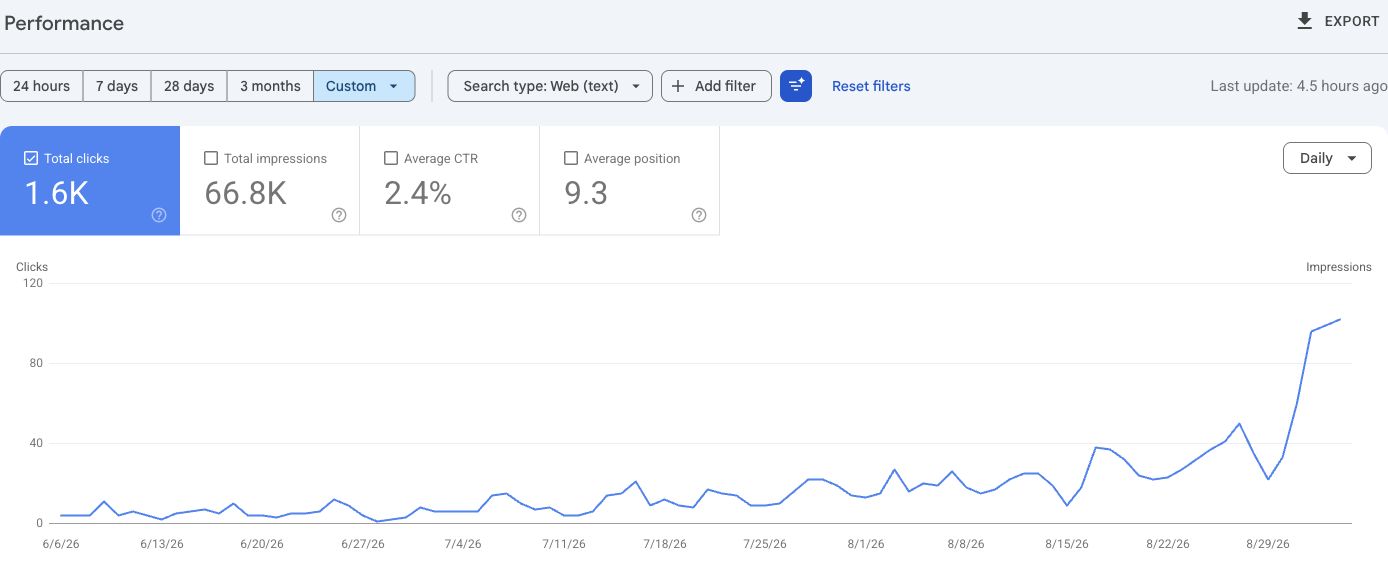
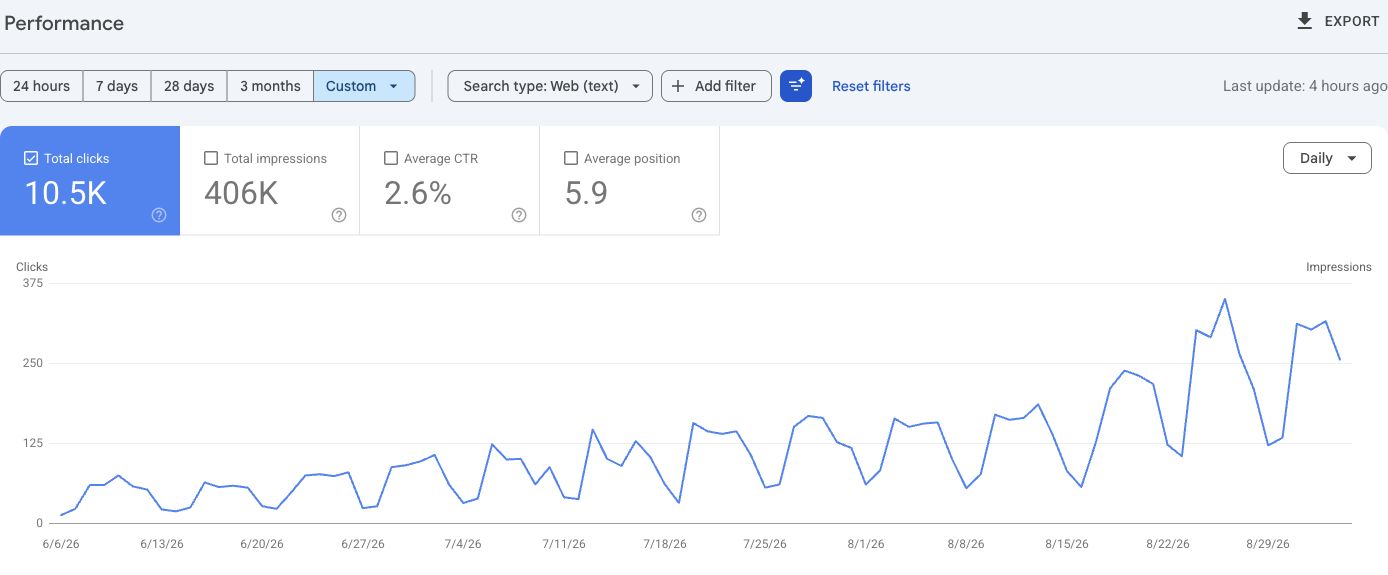
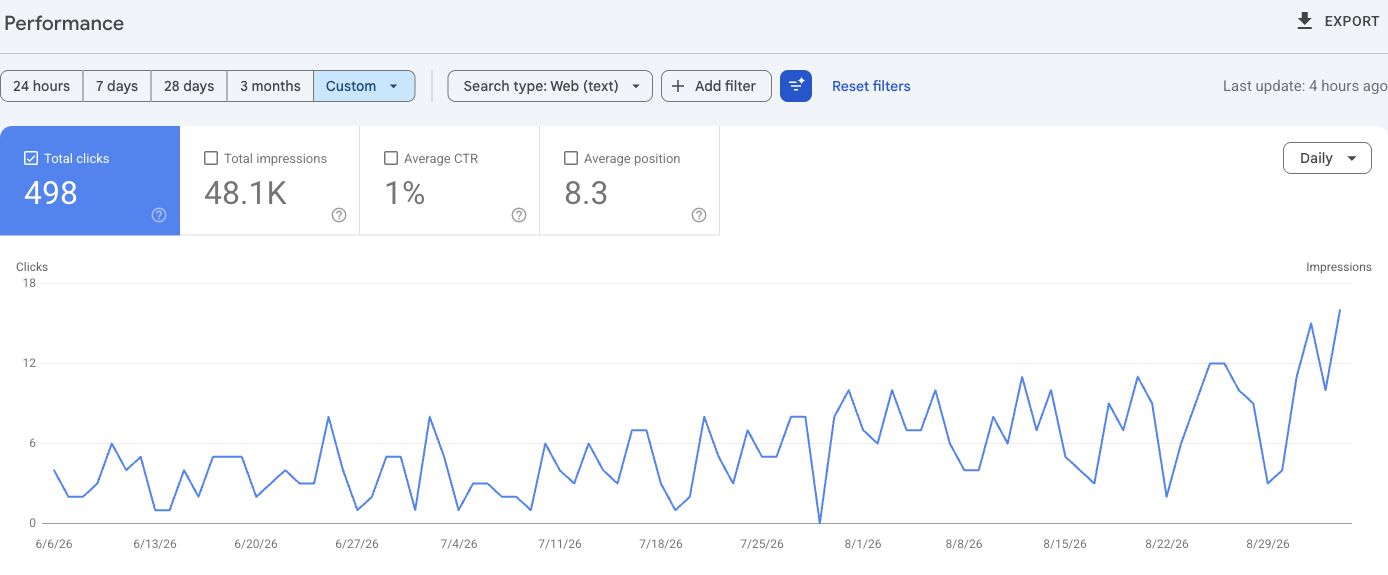
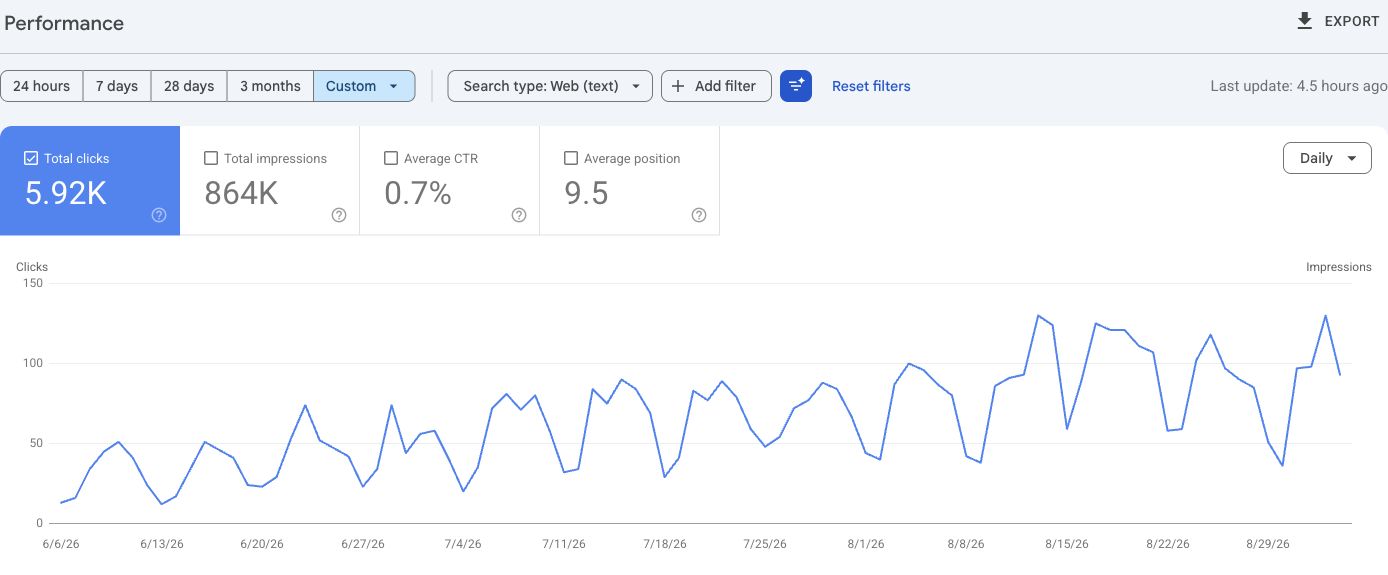
Property names, account details and query tables are outside the image crop. Screens captured September 28, 2026; the first-to-last comparisons above come from the complete daily exports.
Three equal 30-day periods: Jun 6–Jul 5 · Jul 6–Aug 4 · Aug 5–Sep 3. Each chart has its own scale; labels show actual clicks.
AI search / A separate signal
In a separate 28-day comparison, Google AI impressions rose across all four projects. Bing citations rose in three and fell in one. I track both; they don’t measure the same thing as a visit.
July 10–August 6 → August 7–September 3, 2026. These are two 28-day windows, not the three-month chart above.
| Project | Google AI impressions | Bing citations |
|---|---|---|
| Project A | ≈1,040 → ≈3,370 | ≈9,621 → ≈14,917 |
| Project B | ≈36,800 → ≈68,300 | 5,751 → 5,390 |
| Project C | ≈2,620 → ≈4,060 | ≈2,047 → ≈3,800 |
| Project D | ≈43,600 → ≈55,000 | 478 → 552 |
Google totals are rounded dashboard values. Bing totals are sums of daily citations; ≈ marks estimates affected by rounded daily values. Impressions, citations and visits are different measures.
Source: Google Search Console daily exports, retrieved September 6, 2026. Each project has 90 complete, distinct days with final data, grouped into three consecutive 30-day periods. Percentages compare the last period with the first, rounded to the nearest whole percent. These are not calendar-month totals or live results.
The AI visibility comparison comes from Google and Bing dashboards captured on September 6, 2026. It uses the separate dates shown above. Project labels stay consistent across both views. Names, domains, queries and private operational data are omitted.
These are observed acquisition and visibility results from projects I work on, not a controlled estimate of my individual impact. Demand, seasonality and other changes can contribute. They do not establish qualified leads, revenue or a promise of similar results.
The work around those numbers is practical: research, site structure, useful content, tools and distribution. I look at what gets found, what people actually use and what to change next.
04 / On the side
Small products and films I make to explore what AI can do. A few selected experiments alongside my work on systems, search and distribution.
A desk, a clock, a stack of work. I used an AI-generated image and animated the story with hand-drawn motion, typography and timing built in React and TypeScript.
14 seconds. Presented without sound.
A ball moves through a desk-top system of a queue, clock, review stamp and trays. The animation separates routine passes from exceptions. On-screen message: route routine, escalate exceptions.
AI-generated imagery, 3D, motion design and a programmatic edit. One complete vertical film.
Visuals: a physical production line fills with AI-written code. Review and testing gates hold up delivery. The final sequence routes routine work through and holds exceptions for human judgment. An explanatory model, not a customer workflow.
AI writes code faster. But review and testing cannot keep up. Delivery still stalls. Watch the line: more code hits review. The gate opens, the queue crashes into testing. At Meta, Reuters reported internal platform and infrastructure code changes rising 220% year over year. Changes delivering new or improved user-facing features rose 36%. Different measures. Not a conversion rate. Output alone is a bad scoreboard. Fix the route. Scan routine work automatically. If it passes, keep it moving. If it fails: mark it, divert it, send it to a human. Now the line flows. Faster code matters when the whole system delivers.
Reporting: Katie Paul, Reuters, August 26, 2026. The factory is my explanatory model, not a reconstruction of Meta’s workflow.
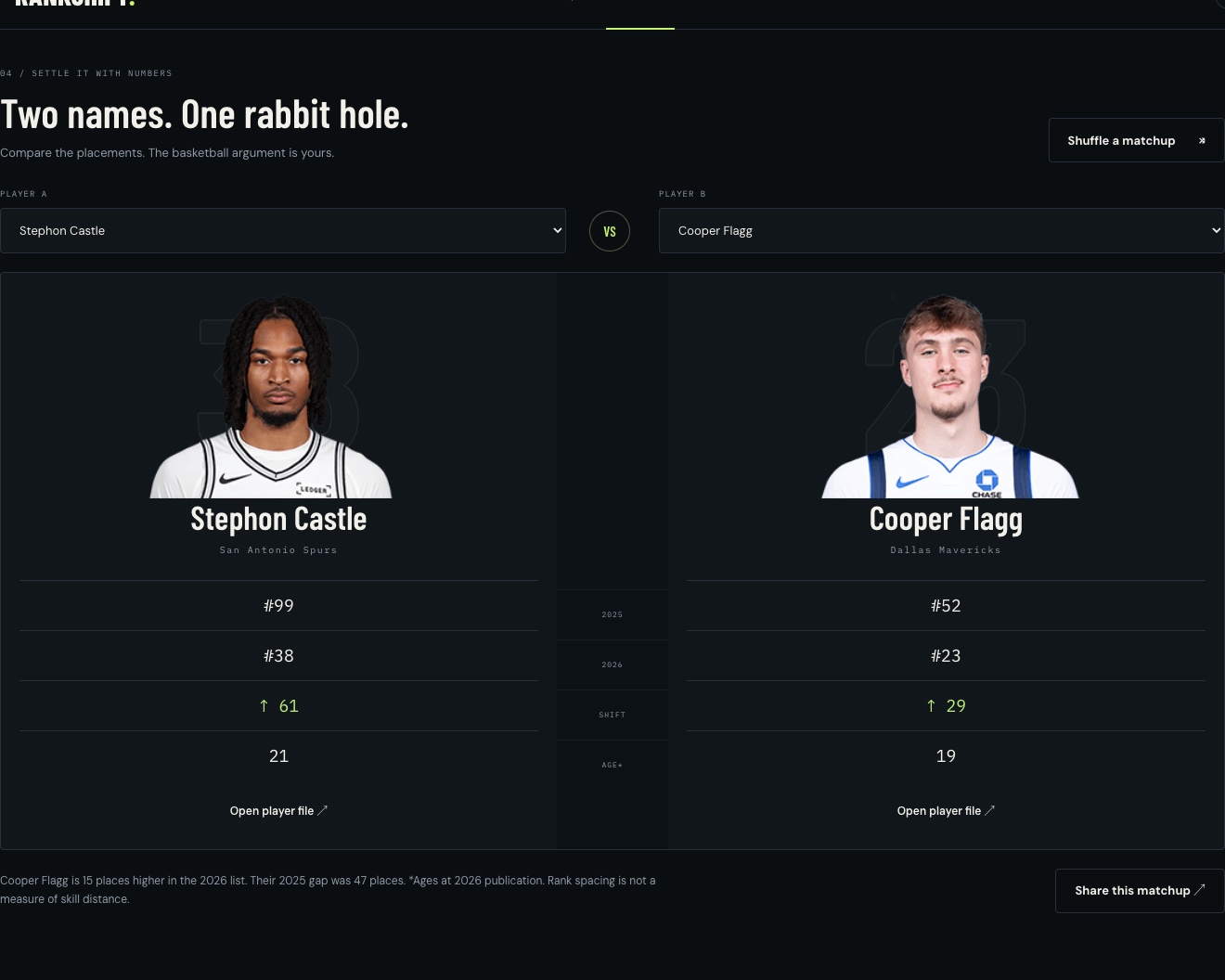
Data product · Public
I wanted the whole list.
And last year next to it.
ESPN’s NBA rankings were spread across separate articles. I brought them into one board, with year-over-year comparisons and downloadable data.
Explore RankShiftIndependent side project. Not affiliated with ESPN or the NBA.
05 / Working together
You work directly with me from diagnosis through handoff. The scope follows the operation, with responsibilities agreed before delivery.
Share what happens today, who owns it and what needs to change. A short operating brief is enough. No client files or sensitive material at this stage.
I review the brief and, when appropriate, respond with a private Loom and a proposed next step. A call comes when it helps clarify scope.
Define the scope, delivery window, review responsibilities and success condition. The work may start with a Blueprint, a Pilot or an ongoing need.
06 / Key facts
A person you can contact.
Work you can inspect.
07 / Useful questions
Looking specifically at how a firm or vendor appears in search and AI discovery?
Explore AI visibilityAI Vortex is Manuel Ayala’s independent research publication and AI systems consulting practice. Manuel also works on search and distribution across projects, and explores AI through small products and films. Manuel leads consulting work from diagnosis through handoff.
No. Legal AI is the focus of the public research. The consulting work also serves founders and operations leaders with research, review, intake or reporting workflows that need clearer context, controls and ownership.
Both. The AI Systems Blueprint helps decide what to build, buy, configure or connect. An AI Systems Pilot puts one scoped workflow into practice through configuration, integration or a lightweight custom build. The starting point depends on what is already clear.
The films and public tool are side projects. The growth section shows anonymized search data from four projects Manuel works on. It is evidence of acquisition and visibility, not a claim of client endorsement, revenue or results caused by one person alone.
Start with a short operating brief or an email describing the workflow, its owner and what needs to change. You can find current pricing, delivery windows and scope on the consulting page. Commercial terms are confirmed after fit and scope; a call is not required to make the first contact.
Start with the workflow
Tell me what arrives, where it gets stuck and who has to make the next decision.
No calendar booking required to start. Please don’t send confidential files in your first message.