
 By
By 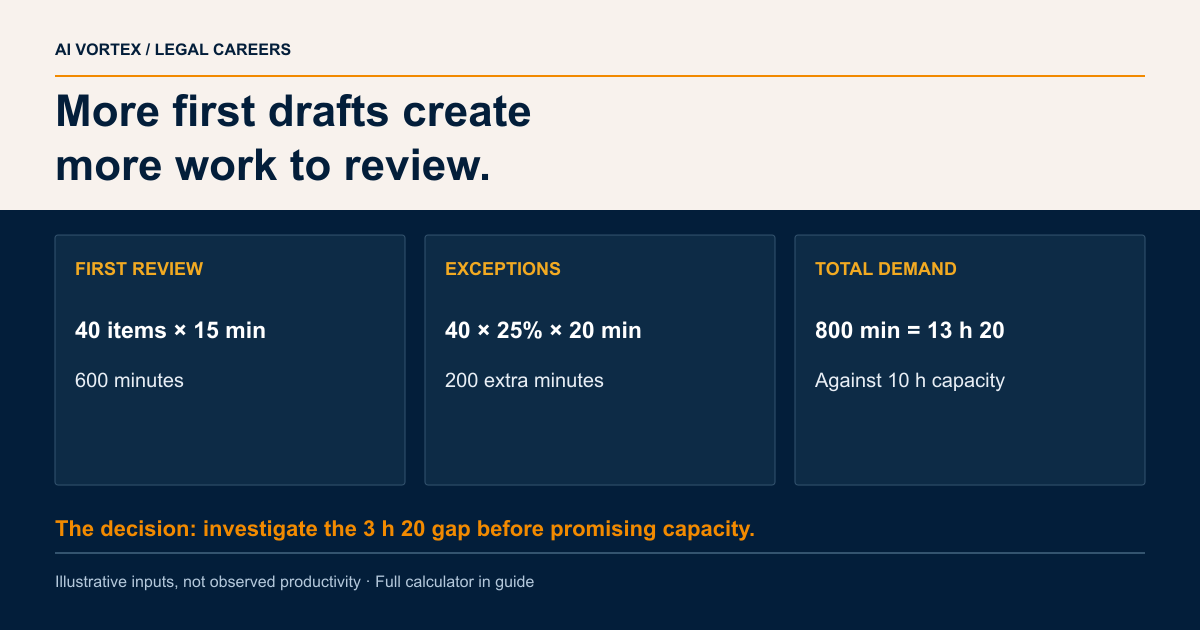
The next bottleneck may be the person accepting the work
A team can make its first pass faster while making its supervisor's queue longer. More output is arriving, but someone still has to decide which parts are supported, what needs correction and whether the work is ready to leave the team. A demonstration that ends at the draft does not show that the complete workflow can absorb the change.
The useful management question is therefore about reviewed output. How much review work arrives, and how much time can the responsible people actually give it? This article provides a transparent planning model. It is not a staffing recommendation or a measure of any firm's performance.
Separate normal review from the exceptions that change the workload
Choose one reasonably consistent item: a defined research note, chronology or intake summary. Do not mix a short status update and a complex legal opinion into one average without examining the difference. Count the first review, the frequency of exceptions and the additional work needed when an exception occurs.
Available time also needs a boundary. A partner's working day is not all review capacity; client work, supervision, administration and interruptions compete for it. Enter the review time that can actually be protected for this workflow. If several people contribute, avoid counting the same hour twice.
The model can show an arithmetic gap. It cannot tell you whether the work is legally adequate or whether a particular reviewer is competent to accept it. Those judgments remain with the responsible professionals.
A model whose assumptions you can inspect
| Input | Meaning | Common mistake |
|---|---|---|
| Items per week | Comparable work units reaching review | Counting generated drafts that never enter the process |
| First-review minutes | Time to inspect one item before exceptional rework | Using first-draft generation time |
| Exception rate | Share needing the additional review step | Treating an untested guess as a measured failure rate |
| Extra minutes per exception | Additional effort beyond first review | Counting work already included in the first-review estimate |
| Review hours available | Protected capacity for this workflow | Using total staff working hours |
A worked illustration, with no measured firm result
Suppose a fictional team expects 40 items a week, 15 minutes for a first review and an additional 20 minutes on 25% of items. Expected review load is 40 × (15 + 0.25 × 20) = 800 minutes, or 13 hours 20 minutes. If the team allocates 10 hours, the planning gap is 3 hours 20 minutes.
The inputs are invented to explain the calculation. An average does not capture variability, urgent items or a difficult exception that consumes the available time. The model does not establish a safe operating limit. It makes the assumptions visible enough to challenge.
Use the review-capacity worksheet to change each input and inspect the result. It runs locally in the browser without sending your entries or storing them. Use non-sensitive aggregate estimates, then replace assumptions with observations when appropriate.
A capacity gap is a decision point, not an instruction to lower review
If estimated load exceeds the time available, several questions become useful. Can the team narrow the first use case? Can input quality improve? Are repeated exceptions caused by a missing source or an unclear instruction? Is a different reviewer qualified and available? Would changing the handoff reduce duplicated checking?
Cutting review time until the model balances merely changes an input. It does not demonstrate that the work can be reviewed adequately in that time. Likewise, adding nominal reviewer hours is not a solution if those hours are already committed elsewhere.
I would investigate the exception pattern before expanding the stream of drafts. A recurring source problem may call for a better input process; a recurring judgment question may need a clearer escalation path. Those are different interventions, and buying another generation tool may address neither.
Keep responsibility and training inside the calculation
ABA Formal Opinion 512 discusses competence and supervision for lawyers using generative AI. The SRA's August 17, 2026 warning, for those it regulates, emphasizes accountability, effective supervision and appropriate controls. Neither source gives this model's inputs or endorses a universal review ratio. Their jurisdictions and authority differ.
Training also takes capacity. A supervisor who explains a correction is doing more than accepting an output. If a rollout removes opportunities for junior staff to practice but provides no alternative learning route, the apparent short-term gain may conceal an organizational problem the spreadsheet does not measure.
Keep review, learning and service outcomes visible separately. The hiring analysis explains why faster drafting alone cannot settle staffing. The assessment guide addresses how to inspect a candidate's work.
Use the first week to test the model
Record items reaching review, first-review time, exceptions and additional effort with appropriate permission. Compare the observed workload with the estimate. Investigate the largest difference rather than treating a favorable average as a rollout approval.
For a solo practitioner, the constraint may be a protected review block. For a small team, it may be one person receiving every exception. In a larger organization, it may be disagreement over who accepts a handoff. Size does not determine the answer; the route of work and authority does.
The model earns its place when it changes a concrete decision: narrow the task, improve an input, assign an exception or protect review time. It is useful even when the result is to expand more slowly.
For teams changing this workflow
If your team needs help turning the review model into a working process, describe the workflow, review owner and current constraint in the AI Vortex operating brief.
Describe the team workflow. Paid systems work, subject to fit and scope.
Questions and answers
Does this calculator predict staffing needs?
No. It estimates review workload from your assumptions and compares it with stated capacity. It does not assess legal adequacy, variability, qualifications or employment decisions.
What if the exception rate is unknown?
Treat it as an assumption, compare scenarios and collect permitted observations. Do not present an assumed rate as a measured result.
Can I reduce review minutes until capacity is sufficient?
Changing an input does not prove adequate review. Validate the required review against the task and applicable professional obligations.
Sources and scope
- ABA Formal Opinion 512. 2024-07-29; checked 2026-09-08.
- Solicitors Regulation Authority: Misuse of AI warning notice. 2026-08-17; checked 2026-09-08.
U.S. occupational and professional sources inform this guide. Local rules, qualifications and employer requirements differ. Examples and practice plans are editorial proposals; they are not employment forecasts.
Editorial update. New planning framework with a reproducible arithmetic example and interactive worksheet. Inputs are illustrative, not a benchmark or staffing prescription.
Prepared with AI-assisted research and editorial verification for AI Vortex. Sources are linked where claims are made.