
 By
By 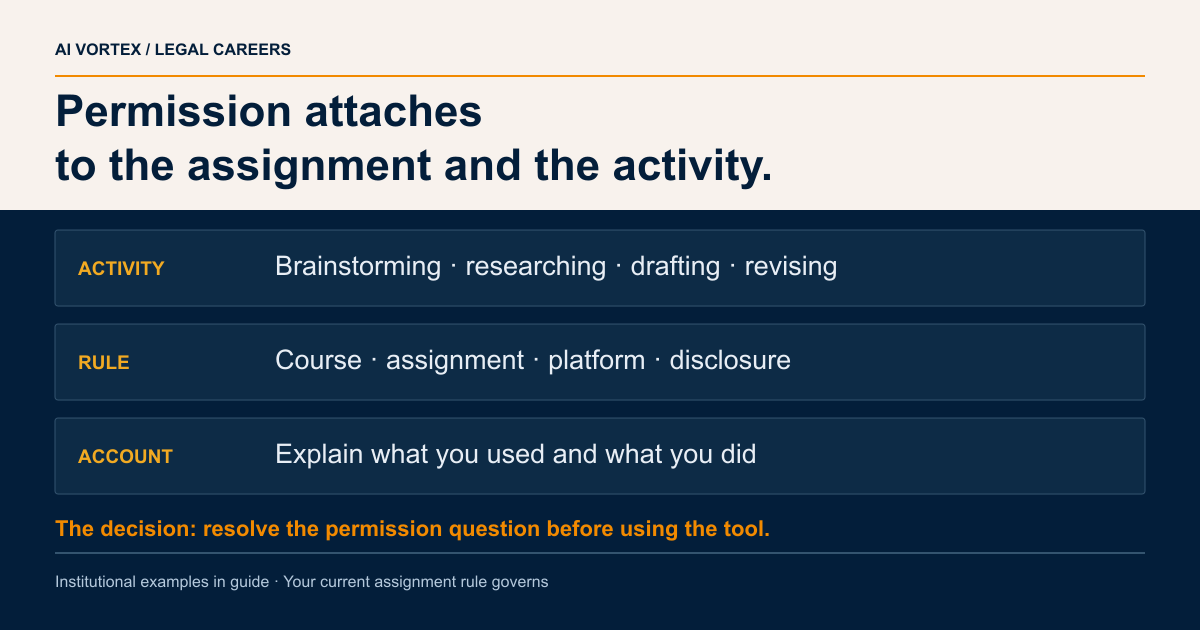
The permission belongs to the activity, not the account
A student has access to a university AI tool and an assignment due tomorrow. The syllabus permits editing but expects independent legal analysis. Asking the tool to improve sentence clarity and asking it to reconstruct an argument are different activities, even when both happen in the same text box.
The difficult question is not simply whether the school allows AI. It is whether this use, on these materials, at this stage of this assignment is permitted. A license answers an access question. An assignment policy answers an academic one. Confusing them can leave a student with a polished submission they were not authorized to produce that way.
I would settle the permission before delegating the work. That also makes the learning decision clearer: which part of the assignment must I be able to perform and explain myself? The method below is an editorial reading aid. Your current institutional, course and assignment rules remain the authority.
Two official policies show why a universal answer fails
The UChicago Law handbook page presents a default policy revised in Autumn 2025 and flags the school's July 2026 strategy. It distinguishes examinations from other work and permits instructors to specify course policies in writing. Under the displayed default, documenting AI-generated composition does not by itself make that composition permissible. Students should confirm the current syllabus and any transition instructions rather than treating this summary as permission.
The Center for Transnational Legal Studies policy updated January 8, 2026 takes a different approach: subject to course parameters, it permits specified forms of assistance and requires an AI declaration for written submissions, including an attestation when no AI was used. This is a CTLS policy hosted by Georgetown, not a statement of a universal Georgetown Law rule.
The difference matters in practice. A disclosure can satisfy one requirement while leaving a prohibited activity prohibited. Conversely, silence in an individual assignment may interact with an institutional default. You need the applicable rule, not a remembered policy from another class.
Turn a broad permission into a precise question
| Check | Example of the distinction | Record to keep |
|---|---|---|
| Activity | Proofreading your sentences versus generating the analysis | The relevant policy wording and instructor clarification |
| Material | Your own draft versus clinic records or restricted course readings | Permission for the particular input and environment |
| Stage | Private practice versus work submitted for assessment | Which exercise and submission the rule covers |
| Output | Suggestions you evaluate versus text incorporated in the submission | What was used, rejected or changed |
| Disclosure | A tool citation versus an activity/process declaration | The required format and accurate account of actual use |
Ask about the ambiguity that would change your work
Suppose an assignment allows language editing but does not explain whether a tool may reorganize the argument. A useful clarification is specific: ‘May I ask the approved tool to suggest a different order for sections of my own draft, or is that part of the analysis I must complete independently? If it is permitted, how should I record the assistance?’ This is a hypothetical question, not a message sent to an instructor.
Until the ambiguity is resolved, continue work you know is permitted. Read the sources, make your own outline or identify the issue you need to ask about. Do not use an uncertain feature and hope that adding a footnote later cures the problem. Keep the response with the assignment instructions so the scope does not drift as you revise.
Penn's teaching-center guidance on generative-AI policies explains why rules can differ by assignment and includes examples from different courses. It is guidance and a set of examples, not a single Penn Law permission. Its useful lesson for a student is to connect the rule to the skill the assignment is meant to develop.
An honest account describes your contribution
Where assistance is allowed, keep a short working record while you use it: tool and date, purpose, material entered, output retained and checks performed. Follow the required declaration rather than treating this suggested record as a replacement. Some assignments may require prompts or fuller documentation; others may prohibit the activity entirely.
A truthful hypothetical account might read: ‘I used the permitted tool to suggest shorter versions of three sentences in my draft. I accepted two wording changes, rejected a change that overstated the source, and checked the final paragraph against the assigned opinion. I developed the issue analysis and structure myself.’ Use such wording only if it accurately describes what happened.
The point is not to produce an impressive audit trail. It is to make the boundary between assistance and your reasoning inspectable. If you cannot explain why a proposition follows from a source, a detailed tool log does not supply that understanding.
Practice the reasoning without turning practice into permission
The synthetic review lab lets you practice finding gaps in synthetic output. Attempt a scenario, explain your correction, then read the answer discussion. It is outside any particular course assessment and does not authorize AI use on a graded assignment.
A useful self-check is to explain the corrected answer without consulting a generated explanation. What supports it? What remains uncertain? Which different fact would change it? This proposed exercise makes a learning gap visible; it is not a validated measure of course performance.
For comparing teaching approaches across schools, see how law schools teach AI. For your current assignment, the decision is narrower: identify the permitted task, resolve the material ambiguity and submit work whose reasoning and assistance you can account for. That is more reliable than either a blanket refusal to learn the tool or an assumption that access makes every use acceptable.
Questions and answers
Does a university AI account mean I can use it for any assignment?
No. Access, permitted inputs and permitted academic activities are separate questions. Read the current rules for the course and assignment.
Does citing AI make an otherwise prohibited use acceptable?
Not necessarily. Permission and attribution are separate requirements; an accurate disclosure does not automatically authorize the activity.
What if the syllabus is unclear?
Ask about the exact activity, material and output you plan to use. Continue clearly permitted work while the uncertainty is resolved.
Can I reuse the example declaration?
Only if the activity is permitted and the words accurately describe your use. Follow the instructor’s required format.
Sources and scope
- UChicago Law handbook: Generative AI policy. Autumn 2025 revision; July 2026 strategy notice; checked 2026-09-08.
- CTLS: Policy on AI in Academic Work. 2026-01-08; checked 2026-09-08.
- Penn CETLI: Generative AI Policies. 2023-07-25; current examples page checked; checked 2026-09-08.
U.S. occupational and professional sources inform this guide. Local rules, qualifications and employer requirements differ. Examples and practice plans are editorial proposals; they are not employment forecasts.
Editorial update. New student-facing policy-reading guide. Institutional examples are scoped and dated; the article does not grant assignment permission.
Prepared with AI-assisted research and editorial verification for AI Vortex. Sources are linked where claims are made.