
 By
By 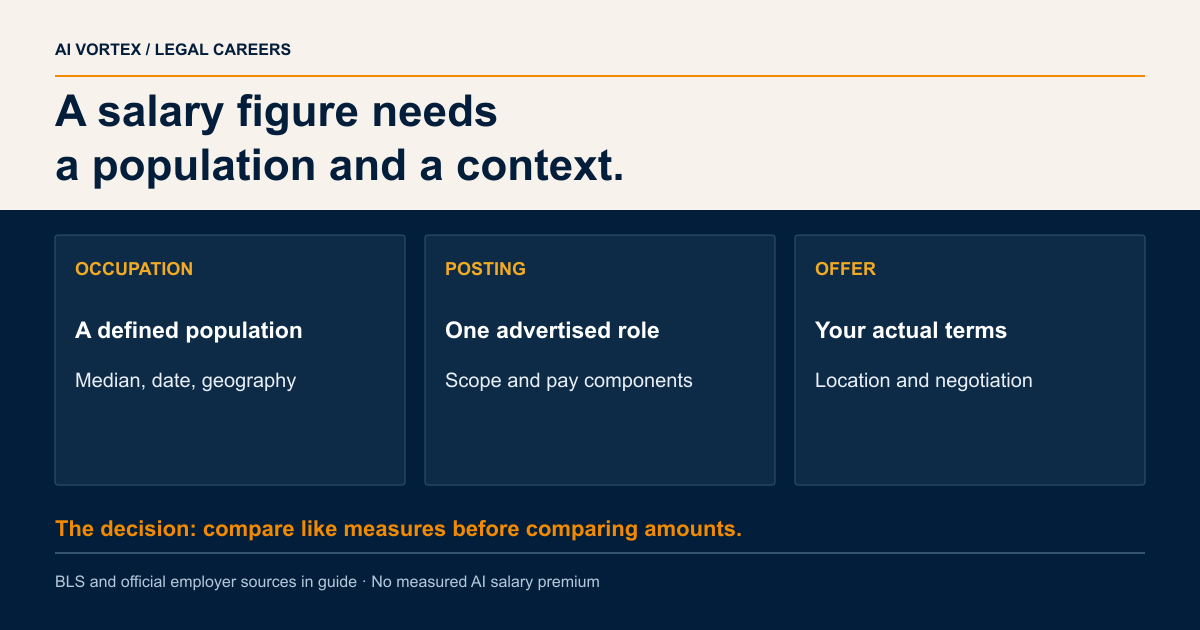
The title is a clue, not a pay scale
Searches such as AI lawyer salary and artificial intelligence lawyer salary sound as if they point to one occupation. They do not. A lawyer using an approved research tool, a legal engineer evaluating model output and a legal operations manager running intake may sit in the same conversation while doing different work under different compensation systems.
The first question is therefore not “What is the AI premium?” The sources reviewed here do not establish an AI premium. The first question is: what kind of number is this? It may be a national occupation median, a percentile, a posted base range or a total package described by one employer. Those measures answer different questions and cannot be averaged into a new market rate.
This guide uses current U.S. public sources as an instrument-reading exercise. The figures are not a global salary table, a promise for an individual or evidence that AI-specific workers form a measured population.
BLS measures occupations, not an AI submarket
The Bureau of Labor Statistics reports the wage at which half of workers in an occupation earned more and half earned less. Its Occupational Employment and Wage Statistics measure is attached to an occupation and a reference period; it does not identify whether a person uses generative AI, owns a workflow or has the title “legal engineer.” The OEWS wage data exclude self-employed workers, owners and partners in unincorporated firms. They should not be read as a measure of all law-firm partner income.
| Occupation measure | Reference | 2025 median annual wage | What the number can support |
|---|---|---|---|
| Lawyers | BLS Occupational Outlook Handbook; May 2025 | $159,670 | A national midpoint for workers classified as lawyers |
| Paralegals and legal assistants | BLS Occupational Outlook Handbook; May 2025 | $62,890 | A national midpoint for workers classified in that occupation |
BLS also reports that the lowest 10 percent of lawyers earned less than $78,360 and the highest 10 percent more than $351,600 in May 2025. For paralegals and legal assistants, the corresponding figures were below $44,740 and above $101,500. The spread is a reminder that a midpoint does not describe level, geography, employer, practice or responsibility.
BLS describes lawyers as advising and representing clients in legal proceedings or transactions. It describes paralegals and legal assistants as supporting lawyers through activities such as organizing files, research and drafting. O*NET's 2026 profiles add task detail, but both systems remain occupation references. Neither isolates people whose work is specifically AI-enabled.
A posted range measures one employer's decision
An announced range is closer to an offer conversation, but it is still not a market median. One current Latham & Watkins posting for a Legal Engineering Attorney lists a base range of $220,000–$250,000. The same listing describes a role requiring a J.D., substantive legal practice and prior full-time experience in a legal-engineering or comparable workflow role. That is a specific employer, level, location and scope; it does not mean every legal engineer earns that range.
Read the posting as a bundle. The number is attached to the work the employer wants owned, the experience it names and the conditions it states. A range can exclude bonus, equity, benefits or other compensation. It can also be adjusted by location, internal equity, experience and the final level assigned to the candidate.
The contrast is useful:
| Signal | Population or unit | Safe reading | Unsafe reading |
|---|---|---|---|
| BLS median | Workers in an occupation during a stated survey period | Half of the classified workers earned above and half below the midpoint | The going rate for an AI title |
| BLS percentile | Distribution tails for that occupation | The occupation has a wide observed spread | A guaranteed floor or ceiling for a candidate |
| Employer range | One posting and its stated role conditions | The employer has disclosed a base range for that job | A national average or proof of demand |
| Total compensation claim | A package with its own definitions | Only the components and period explicitly described | A comparable salary when the components differ |
The work behind a legal AI title changes the comparison
“AI” can describe a tool used inside a familiar legal role or a role that owns the translation between legal work and a system. Latham's separate Manager of Legal Engineering description assigns responsibility for AI workflow specifications, prompt libraries, quality metrics, pilots and deployment decisions. Filevine's current Legal Engineer description emphasizes evaluation rubrics, golden answers, annotation guidance, edge cases and structured feedback to product and machine-learning teams.
Legal operations is a different comparison point. CLOC describes the function through strategic planning, financial management, project management and technology portfolio investment, with the aim of making the legal function work more effectively. Its 2025 State of the Industry report describes legal operations responsibilities across areas including outside-counsel and vendor management, technology, projects, finance, knowledge management and service delivery. It is not a BLS “AI occupation.”
That is why the legal engineer versus legal operations comparison starts with need, task and authority. The salary question follows from that scope. A person who evaluates model behavior, a person who runs a contract intake system and a lawyer who uses an AI assistant may all need legal fluency, but they are not interchangeable observations.
Use a salary number as a question list
Before treating a number as relevant to you, ask which of these facts are known:
- Population: Is it an occupation survey, a title-specific survey, one employer's posting or a self-reported anecdote?
- Period: Which month or year does it cover, and is it base pay, total cash or something else?
- Scope: Does the role build and evaluate systems, run a department process, advise clients or use a tool inside existing legal work?
- Level: What experience, management responsibility and decision authority does the employer require?
- Location: Is the figure national, local, hybrid, remote or tied to a stated office?
- Evidence: Can the employer show the work product, review model and success criteria that justify the range?
The last question is easy to skip. A high number attached to an undefined title is weaker evidence than a modest number attached to a clear scope. A role that owns evaluation, escalation and adoption carries a different accountability than one that only attends tool training. Ask what a successful first six months would produce and who can approve a change to the workflow.
What the numbers do not prove
These sources do not prove that an AI label earns more than a conventional legal label. They do not estimate a salary for people who call themselves legal engineers, nor do they show that a legal operations function will be created in every company. CLOC's industry report is a description of participating legal departments, not a vacancy forecast.
They also do not convert an employer's range into an offer. Candidate experience, jurisdiction, credentials, portfolio, location, internal equity and the final responsibility set may all matter. A candidate can use the number to ask better questions without presenting it as an entitlement.
The practical rule is simple: preserve the denominator. Say “BLS median for lawyers in May 2025,” “an announced base range for this posting,” or “a survey result for the participating departments.” Do not shorten one into “the legal AI salary.”
Compare the scope before the prestige
My decision rule is to compare scope before prestige. If the number is attractive but the employer cannot explain review, authority or the work that survives when the tool fails, the salary signal is incomplete. If the scope is concrete, the source can be read with the right denominator and the compensation question becomes answerable without inventing an AI premium.
Questions and answers
What is the average AI lawyer salary in 2026?
There is no verified national AI-lawyer average in the sources reviewed. BLS reports occupation-level wages for lawyers, not an AI subset; an employer posting reports its own range and conditions. Preserve that distinction rather than inventing an average.
Is a legal engineer paid more than a lawyer?
The sources do not establish a general comparison. Legal engineer is a changing role label with different scopes. Compare the specific responsibilities, level, location and compensation components in the posting.
Does BLS include legal operations?
BLS occupation tables do not present legal operations as a standalone AI occupation. Legal operations may draw on several backgrounds and responsibilities; CLOC and ACC role descriptions are better for understanding its work, while their survey or posting figures have their own limits.
Can I use an announced salary range to negotiate?
You can use it as one employer's stated base range and ask how your scope and level map to it. It is not proof of a national rate, an offer or total compensation.
Does AI fluency guarantee a salary premium?
No. The reviewed sources do not isolate or prove an AI premium. Demonstrated legal competence, workflow ownership, evaluation ability and the employer's needs may matter, but a guarantee is unsupported.
Sources and scope
- U.S. Bureau of Labor Statistics, Occupational Outlook Handbook: Lawyers. 2026-08-27 page update; May 2025 wage data; checked 2026-09-08.
- U.S. Bureau of Labor Statistics, Occupational Outlook Handbook: Paralegals and Legal Assistants. 2026-08-27 page update; May 2025 wage data; checked 2026-09-08.
- U.S. Bureau of Labor Statistics, Occupational Outlook Handbook: Legal Occupations. 2026-08-27 page update; May 2025 wage data; checked 2026-09-08.
- Latham & Watkins, Legal Engineering Attorney job posting. 2026 listing; page observed with posted base range; checked 2026-09-08.
- O*NET OnLine, 23-1011.00 Lawyers. Updated 2026; task and occupation data displayed; checked 2026-09-08.
- O*NET OnLine, 23-2011.00 Paralegals and Legal Assistants. Updated 2026; task and occupation data displayed; checked 2026-09-08.
- Corporate Legal Operations Consortium, What is Legal Ops. Undated page; current page checked; checked 2026-09-08.
- Corporate Legal Operations Consortium, 2025 State of the Industry Report. 2025 report; data derived from 2024 Harbor Law Department Survey; checked 2026-09-08.
- Filevine, Legal Engineer job description. Current listing; original posting date not stated; checked 2026-09-08.
- Latham & Watkins, Manager of Legal Engineering job description. 2026-02-26 last updated; checked 2026-09-08.
U.S. occupational and professional sources inform this guide. Local rules, qualifications and employer requirements differ. Examples and practice plans are editorial proposals; they are not employment forecasts.
Editorial update. New article separates occupation medians, percentiles and employer ranges; it removes unsupported AI salary premiums and ties compensation interpretation to role scope, level, location and authority.
Prepared with AI-assisted research and editorial verification for AI Vortex. Sources are linked where claims are made.